


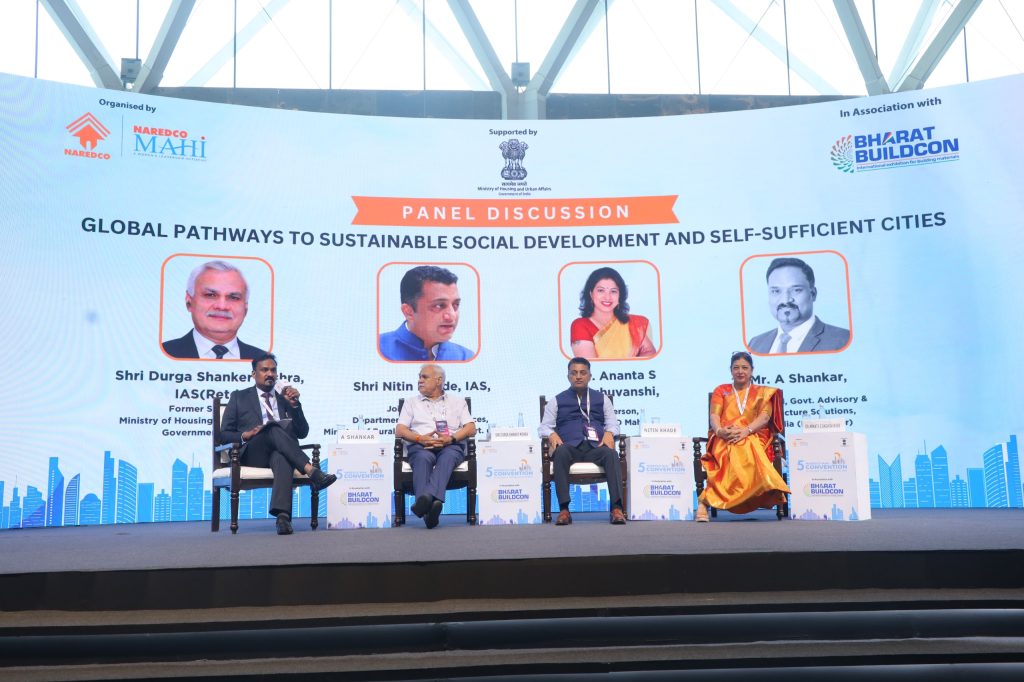
New Delhi : Sustainable, inclusive and self-sufficient cities can only be built through people-centric planning, efficient resource management, improved mobility, quality housing and stronger urban-rural integration, said eminent policymakers and industry leaders during a panel discussion on “Global Pathways to Sustainable Social Development and Self-Sufficient Cities” at the 5th NAREDCO Mahi Real Estate Convention 2026, held today at Yashobhoomi, New Delhi.
The session witnessed thought-provoking deliberations on the future of urban development, highlighting the need for water-secure cities, inclusive infrastructure, sustainable housing, conservation of natural resources and balanced regional development to reduce excessive pressure on urban centres.
Addressing the august gathering, Shri Nitin Khade, IAS, Joint Secretary, Department of Land Resources, Ministry of Rural Development, called for exploring alternative development models that strengthen rural economies while supporting sustainable urbanization.
He pointed out that despite ongoing efforts to make cities more liveable, challenges continue to persist, necessitating innovative approaches to balance demand and supply. Highlighting the work undertaken by the Department of Land Resources, Shri Khade said that nearly 34 million hectares of degraded land have been restored over the last twelve years, improving agricultural productivity and creating better livelihood opportunities.
Expressing concern over emerging water challenges and changing climatic conditions, Shri Khade firmly said the urgent need for water conservation measures across both urban and rural regions. Appealing to the industry, he encouraged developers to contribute more extensively towards water conservation and rural development initiatives, stating that sustainable growth would require a balanced approach benefiting both cities and villages.
Speaking during the session, Shri Durga Shankar Mishra, IAS (Retd.), Former Secretary, Ministry of Housing and Urban Affairs, said that sustainability is fundamentally about ensuring the long-term survival and prosperity of cities. He noted that future cities must be self-sufficient in critical resources such as water, energy and human capital while remaining inclusive and accessible to all sections of society.
“Cities are for the people. They must provide quality housing, robust infrastructure, efficient mobility and a better quality of life for every citizen,” he said. Referring to the transformation witnessed over the past decade, Shri Mishra highlighted the impact of initiatives such as Swachh Bharat Mission, AMRUT and Smart Cities Mission in reshaping India’s urban landscape.
Dr Ananta S. Raghuvanshi, Chairperson, NAREDCO Mahi, highlighted the complexities associated with developing sustainable cities in India, where rapid urbanization coexists with legacy infrastructure and redevelopment requirements.
She noted that Indian cities face unique challenges arising from vertical growth, increasing population density and mounting pressure on infrastructure. “Sustainability today is no longer an option but a necessity. The encouraging part is that conversations around sustainability, which were almost absent a few decades ago, are now moving to the centre stage,” she said.
In another panel discussion on “Skilling and Sustainability: Building a Future-Ready Workforce for Real Estate,” moderated by Smt Chitra S. Jain, President-Elect, NAREDCO Mahi, experts unanimously poured their viewpoints that developing a skilled workforce is critical to the future growth of the real estate sector. The speakers highlighted that NAREDCO Mahi has emerged as a significant platform for promoting skill development and capacity building across the industry. They noted that sustainability is now an integral part of modern construction practices, with increasing adoption of green buildings and environmentally responsible development models. As green building footprints continue to expand across the country, developers are embracing sustainable practices with greater commitment. The panelists stressed that government, industry bodies, developers, training institutions and other stakeholders must work together to equip workers with the skills required for a rapidly evolving and sustainability-driven real estate ecosystem.