


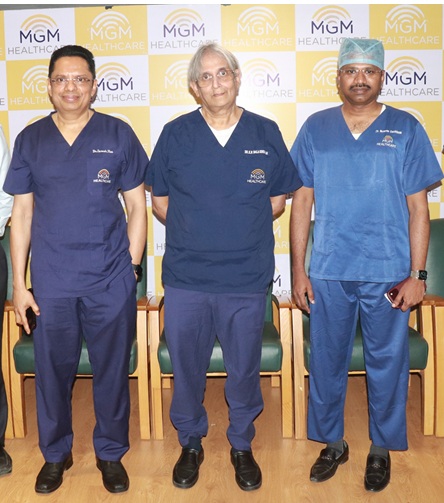
Chennai : Through timely surgical interventions and multidisciplinary care, MGM Healthcare successfully averted the need for lung transplantation in a 15-month-old boy from Russia who developed progressive respiratory failure due to multisystem Langerhans cell histiocytosis (LCH), a rare disorder characterised by the abnormal multiplication and accumulation of Langerhans cells in the body.
The child, airlifted from Russia, was admitted at MGM Healthcare, originally for bilateral lung transplantation due to severe lung involvement, characterised by extensive cystic lung disease, recurrent bilateral pneumothorax (collapse of the lungs caused by air leaking into the space around them), and progressive breathing difficulties.
However, the hospital’s multidisciplinary team decided to explore all viable surgical options before proceeding with lung transplantation, an irreversible and complex procedure. The team performed bullectomy, a procedure for the removal of large air-filled space from the lung and repeated chest drain procedures to remove trapped air from around the lungs and allow the lungs to re-expand. It also carried out thoracoscopic atypical lung resection, a minimally-invasive surgery to remove a diseased portion of the lung, rather than removing an entire lung lobe, for diagnosis and treatment. Following these interventions and close monitoring, the child’s respiratory condition improved significantly, and he is now doing well. The baby no longer requires a lung transplant.
The multidisciplinary team comprised specialists in cardiac critical care, haematology and haemato-oncology, paediatric pulmonology and surgery, infectious diseases, neurology, urology, dermatology, ENT, thoracic surgery and lung transplantation, along with physician assistants and the ICU staff. There was a prolonged hospital stay, from May through September 2026, as the baby required mechanical ventilation, multiple intercostal drains, advanced imaging, invasive monitoring, multidisciplinary critical care and repeated surgical interventions.
The team was led by Dr. K. R. Balakrishnan, Director, Institute of Heart and Lung Transplant and Mechanical Circulatory Support, and Dr. Suresh Rao K. G., Co-Director of the Institute of Heart and Lung Transplant and Mechanical Circulatory Support and Cardiac Critical Care.
In his comments, Dr. Balakrishnan said, “Multisystem LCH is a rare disorder in which abnormal cells can accumulate in different organs. When LCH affects the lungs, it can cause cystic changes and serious respiratory complications, sometimes necessitating consideration of lung transplantation. However, the course of pulmonary LCH can be unpredictable, and some children with severe lung involvement may recover with appropriate medical and supportive care. This case underscores the importance of continuous clinical reassessment and multidisciplinary decision-making before proceeding with an irreversible intervention such as lung transplantation.”
Dr. Suresh Rao commented, “Given the severity of the child’s lung condition, transplantation was a serious consideration. However, the child’s remarkable response to medical management and the recovery of the native lungs allowed us to avoid transplantation. For a child who had travelled all the way from Russia with the possibility of a lung transplant, this was an exceptionally gratifying outcome. It reinforces the principle that knowing when to proceed with transplantation is as important as having the expertise to perform it.”
****