


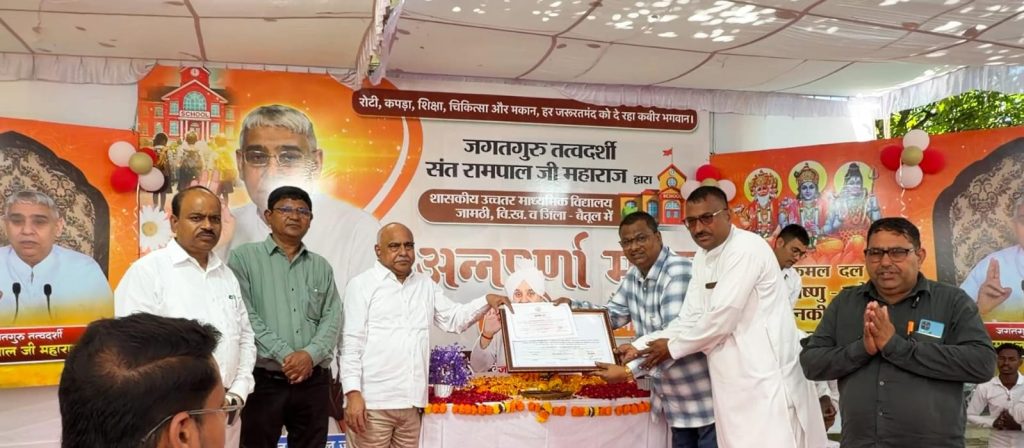
India : A growing portfolio of education and welfare initiatives under Annapurna Muhim is bringing essential infrastructure and learning resources to government schools across Haryana, Madhya Pradesh and Maharashtra, addressing practical challenges that shape children’s access to education and their everyday school experience.
Associated with the wider welfare activities of Satlok Ashram and undertaken under the leadership of Sant Rampal Ji, the initiatives span at least ten school-related locations. The reported interventions include school transportation, classroom construction, drinking-water facilities, kitchen and dining infrastructure, computers, digital learning equipment, sports facilities and restoration work following severe waterlogging.
Together, these projects reflect a broad-based approach to educational support—one that recognises that meaningful access to education depends not only on classrooms, but also on safety, sanitation, nutrition, reliable infrastructure and opportunities for holistic development.
In Dhamana, Hansi, Haryana, a school van has reportedly been provided to a government middle school serving more than 70 students from the village and neighbouring communities. Intended to improve access for children travelling several kilometres, the initiative also includes arrangements for the driver’s salary, fuel and vehicle maintenance, extending support beyond the initial provision of transport.
In Gijhi, Rohtak, a government school serving more than 250 students has reportedly received a modern kitchen, a storeroom and a permanent dining shed. The facilities include dedicated food preparation and dining spaces, along with tables, benches, sinks, lighting, ventilation and other essential fittings designed to improve the school’s daily meal arrangements.
Access to safe drinking water is another priority. Reported interventions include water coolers, storage tanks, pipelines and taps at government schools in Bapoda, Bhiwani, and Karsola, Jind. The Karsola project includes a reverse osmosis (RO) plant with a stated capacity of 500 litres per hour.
In Jamthi, Betul, Madhya Pradesh, the reported project includes new classrooms, a veranda, boundary-wall infrastructure, separate toilets for boys and girls, drinking-water facilities and electrical fittings. The project material references approval for eight classrooms, while a separate local report describes a completed phase involving five classrooms. The final scope and completion figures require confirmation.
At a government primary school in Urdan, Betul, reported assistance includes 20 table-bench sets, two computers, water facilities, toilet fittings and improvements to the approach road. Additional classroom, sanitation, drinking-water and boundary-wall support is also listed for schools in Dhoul, Betul.These interventions address practical infrastructure gaps while creating more functional environments for students and teachers.
In Saiman, Rohtak, restoration work was reportedly undertaken after severe waterlogging affected a government girls’ senior secondary school, disrupting classes and access to the premises. The reported assistance included soil filling, water pumps and extensive piping, alongside efforts to restore the school ground and surrounding access areas.
The portfolio also extends to student development and digital education. An indoor sports facility measuring approximately 98 by 131 feet is reported in Ritoli, Rohtak, with the potential to serve students from six to ten surrounding villages. In Dhavlapuri, Ahilyanagar, Maharashtra, a 65-inch interactive digital board has reportedly been provided to a school with more than 600 students, supporting more visual and interactive teaching, particularly in subjects such as science and mathematics.
Annapurna Muhim’s broader welfare framework, as described in organisational material, encompasses food, clothing, education, medical assistance and housing support for vulnerable families. Its reported activities also include assistance with school fees, uniforms, shoes, bags and stationery, alongside other forms of household support.
The school initiatives illustrate how this wider commitment can translate into practical, community-based infrastructure—from an individual drinking-water facility to a school transport service or an expanded learning campus.
While beneficiary figures vary by project and should not be aggregated without verification, the reported geographical spread and diversity of interventions demonstrate an effort extending across multiple school communities and essential areas of educational support.
The next step in establishing the programme’s overall impact will be consolidated documentation of project completion, beneficiary numbers, handover records and ongoing maintenance arrangements.
Ultimately, the significance of these initiatives lies in the everyday difference that functional school infrastructure can make: a safer journey to school, access to clean drinking water, a dignified place to eat, improved learning resources and spaces where children can study, play and develop.
Across rural communities in three states, Annapurna Muhim’s reported interventions place these fundamental requirements at the centre of a wider vision for educational access and community welfare.