


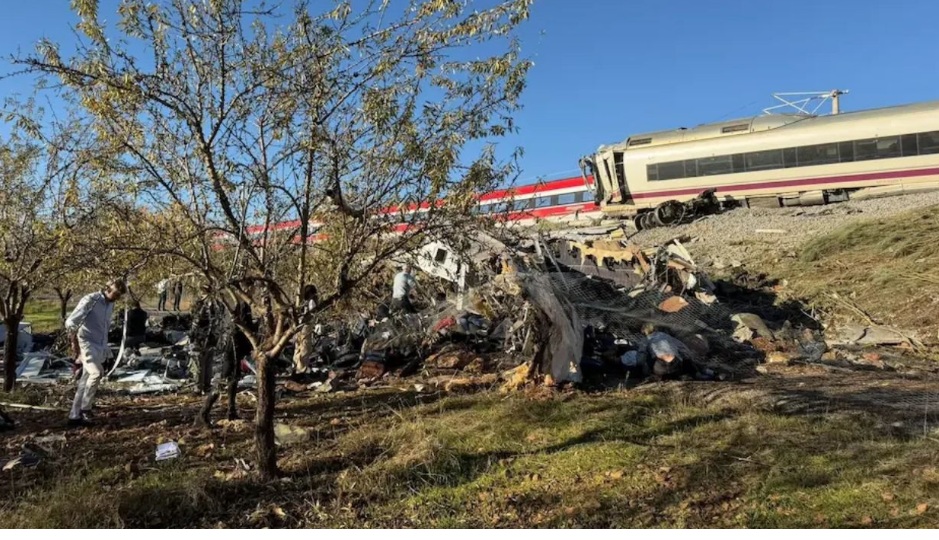
London: At least 30 people were killed and dozens more seriously injured on Wednesday when a high-speed passenger train rear-ended another train on the Madrid-Seville line south of the capital, Spanish regional authorities said.
The collision occurred at about 8:54 a.m. local time near the towns of Mora, Orgaz and Urda in Toledo province, in the Castilla-La Mancha region, roughly 140 kilometres south of Madrid. A Renfe AVE train travelling from Madrid to Seville struck the rear of an Iryo train that was stationary or moving slowly on the tracks, causing at least two carriages of the Iryo service to derail and plunge down an embankment, according to Spain’s rail infrastructure operator Adif and regional officials.
Esther Padilla, spokeswoman for the Castilla-La Mancha regional government, told state broadcaster TVE that the confirmed death toll stood at 30 and was expected to rise as rescue teams continued working through the wreckage. Regional president Emiliano García-Page also confirmed the figure of at least 30 dead and warned it could increase further. The Iryo train was carrying 146 passengers plus one baby, while the Renfe train had 397 people on board, for a combined total of more than 540 passengers. Dozens of people were reported seriously injured, with emergency services deploying firefighters, helicopters, mobile intensive-care units and a field hospital to the remote rural site.
Prime Minister Pedro Sánchez expressed shock at the accident and said he remained in constant contact with the transport minister and regional leaders as emergency crews worked to assist victims. High-speed services between Madrid and Andalusia were suspended in both directions.
Preliminary indications point to a failure in the main LZB automatic train protection and signalling system, which forced traffic onto a secondary lineside signalling arrangement. According to early reports from Spanish media and government sources, several trains were halted after the system fault; when services were ordered to resume, the Iryo train remained stationary for reasons still under investigation. An operator at the Atocha control centre in Madrid is believed to have mistakenly authorised the following Renfe train to proceed into the occupied section, leading to the rear-end collision. Officials stressed that these findings are preliminary and that a full investigation is under way.
The incident is the second major high-speed rail disaster in Spain this year. In January, a collision near Adamuz in Córdoba province killed more than 40 people. Wednesday’s crash has prompted renewed questions about safety on the country’s extensive high-speed network. Rescue and recovery operations continued into the afternoon as authorities warned the number of fatalities could climb further.