


By Suresh Unnithan
As Bihar nearing its two-phase assembly elections on November 6 and 11, 2025, the electoral encounter for the 243-seat Legislative Assembly has intensified into a multi-cornered battle involving the ruling National Democratic Alliance (NDA), the opposition Mahagathbandhan (MGB), and the emerging Jan Suraaj Party (JSP) led by Prashant Kishor. With over 7 crore voters poised to cast their ballots, the campaign’s final days are marked by high-stakes rallies, manifesto releases, and underlying tensions that could sway the outcome.
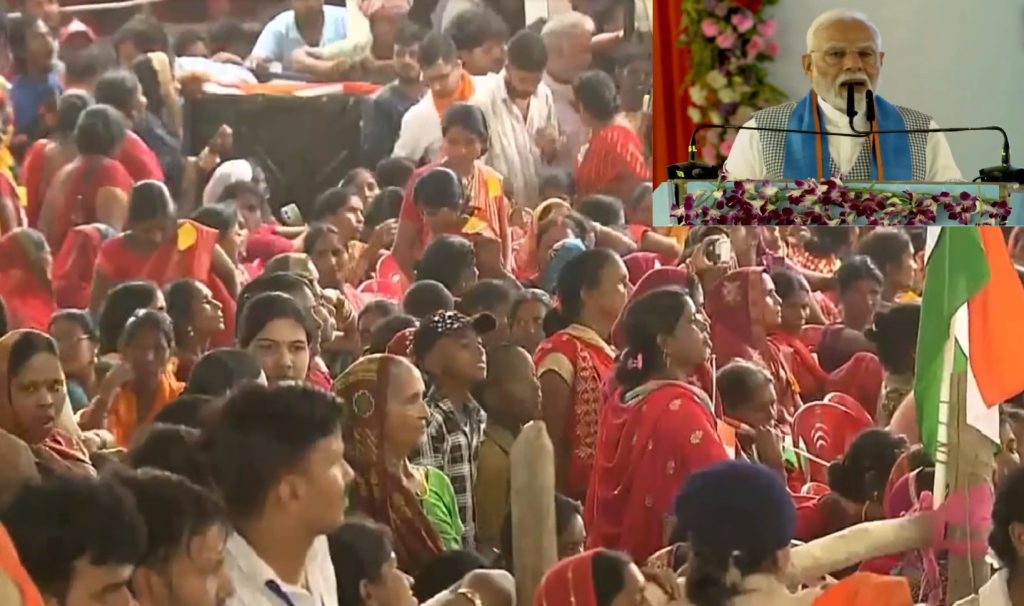
The NDA, comprising the BJP, JD(U), and allies, has presented a united front through its joint manifesto, the Sankalp Patra, which pledges one crore jobs for the youth, empowerment of one crore women as “Lakhpati Didis,” and the establishment of mega skill centers in every district. Prime Minister Narendra Modi and Home Minister Amit Shah have been actively campaigning, highlighting development achievements and criticizing the opposition for past “jungle raj” governance. However, visible signs of discord within the alliance have emerged, including Chief Minister Nitish Kumar’s absence from some of Modi’s rallies and the lack of an explicit endorsement of Nitish as the NDA’s chief ministerial candidate by Modi or Shah. Although Shah recently affirmed continuity with “Modi in Delhi, Nitish in Bihar,” the ambiguity has fueled speculation about internal discontent, particularly in the Nitish camp, where supporters feel sidelined. This NDA’s Nitish Gamble—leaving the CM projection unclear—could lead to a shift in Nitish’s traditional vote bank—primarily among Extremely Backward Classes (EBCs) and non-Yadav Other Backward Classes (OBCs)—towards the MGB, potentially eroding NDA’s cohesion.
In contrast, the MGB—anchored by the RJD, Congress, Left parties—has clearly projected Tejashwi Yadav as its chief ministerial face, with Mukesh Sahani, a backward, as deputy, aiming to solidify its Muslim-Yadav (M-Y) base while expanding outreach. Their manifesto focuses on ambitious promises like one government job per family, free electricity, and a caste-based survey to address social justice. Leaders such as Rahul Gandhi and Tejashwi have aggressively targeted the NDA on governance failures, with unemployment emerging as the prime issue dominating voter concerns amid high youth migration and job scarcity in the state. Despite initial seat-sharing challenges, the alliance has stabilized, though rebel candidates pose minor risks.
Adding complexity is Prashant Kishor’s JSP, contesting nearly all seats as an anti-establishment alternative appealing to disillusioned youth and promising systemic change. Kishor has positioned his party as the main challenger to the NDA, claiming the MGB is fading to third place. Analysts eye JSP splitting 50-60 seats’ votes, poaching upper castes from BJP and OBC/EBC from both giants. Kishor himself is not contesting, prioritizing long-term party building despite facing candidate withdrawals.
Caste rules supreme in Bihar’s electoral battlefield: Upper castes (15%) fragment amid JSP’s youth appeal; EBC/OBC (50%) waver on Nitish snub; Dalits (16%) and Muslims (17%) surge to MGB’s jobs pitch—with Dalits/Muslims Tilt[ing] MGB. Voter shifts indicate Dalits and backward classes increasingly favoring the MGB’s job-focused agenda, while upper castes remain fragmented, potentially benefiting the opposition in tight races. Surveys hint MGB edge on unemployment rage, eroding NDA despite BJP’s 160 seats, JD(U)’s 45.
Amid these factors, the NDA’s internal discord, especially in the Nitish camp over leadership clarity, may give the MGB a slight edge in pre-poll assessments, as it capitalizes on unified messaging and voter dissatisfaction with unemployment. Seat-sharing in the NDA allocates around 160 to the BJP, 45 to JD(U), over 25 to LJP(RV), and the rest to smaller partners, while the MGB contests over 200 seats.
As campaigns peak with Modi’s planned roadshow in Patna on November 2 and Tejashwi’s statewide blitz, the focus remains on jobs, caste census demands, and contrasting visions of “vikas” versus social equity. Voter turnout and last-minute realignments will be crucial in this unpredictable race. The results, to be declared on November 14, could signal a potential shift in power or a hung assembly, reshaping Bihar’s politics and influencing national alliances.