


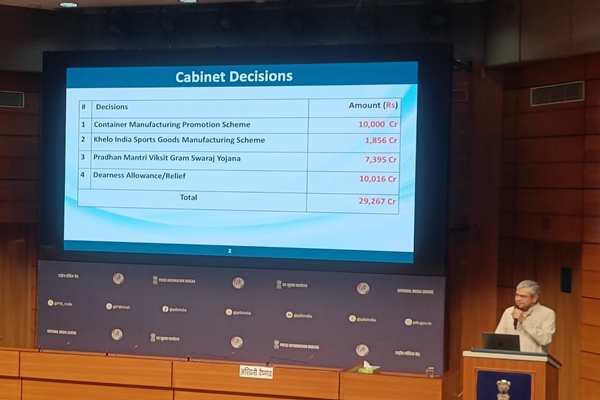
New Delhi: The Union Cabinet has approved the Container Manufacturing Promotion Scheme to promote domestic manufacturing of shipping containers. The total outlay for the scheme is Rs 10,000 crore for 13 years up to Financial Year 2039-40. The scheme aims to establish a globally competitive container manufacturing ecosystem in India, reduce import dependence and strengthen supply chain resilience. Briefing the media after the Union Cabinet meeting chaired by Prime Minister Narendra Modi, Information and Broadcasting Minister Ashwini Vaishnaw said the scheme is intended to support new manufacturing facilities as well as the expansion of existing container manufacturing units. It has four key components including Interest Subvention Assistance, Testing and Certification Assistance, Land Leasing Support and Operational Expenditure Assistance. Mr Vaishnaw added that the scheme will create an internationally competitive manufacturing base, with the potential to position India as a global export hub for quality shipping containers.
The Container Manufacturing Promotion Scheme will strengthen the resilience of India’s maritime and logistics supply chains. It is expected to generate an estimated 3,000 direct jobs and over 50,000 indirect jobs, while supporting ancillary industries such as corner castings, specialised steel, wooden frames and paints.
The Union Cabinet has also approved the Khelo India Sports Goods Manufacturing Scheme to position India as a global hub for high-quality sports goods. Giving details about the scheme, Union Minister Ashwini Vaishnaw said the scheme has an approved outlay of over Rs 1,856 crore over an eight-year period from 2026-27 to 2033-34. He said the scheme will support the development of a globally competitive sports goods industry and strengthen India’s position in global supply chains.
Mr Vaishnaw said the Scheme envisages the development of dedicated Sports Goods Manufacturing Zones (SGMZs) to promote cluster-based manufacturing and create integrated industrial ecosystems. He added that incentives and interventions are the two parts of the scheme, where incentives support manufacturing while interventions build the wider ecosystem.
The Union Minister also said a key focus of the Scheme is to attract new investments and strengthen domestic manufacturing capacity in the sports goods sector. The Anchor Investment Support component will encourage leading domestic and global manufacturers, brands and retail chains to establish manufacturing facilities within designated Sports Goods Manufacturing Zones and foster the development of robust supplier and ancillary ecosystems. Complementing this, the Turnover Linked Support component will incentivise higher production, capacity expansion and sustained manufacturing growth.
Mr Vaishnaw further informed that the Union Cabinet has approved the Pradhan Mantri Viksit Gram Swaraj Yojana (PMVGSY) scheme as a Centrally Sponsored Scheme. It aims to transform Panchayats into empowered, self-reliant, accountable and high-performing institutions of local self-government, in line with the vision of Viksit Bharat.
Mr Vaishnaw said the scheme has a total financial outlay of Rs 7,395 crore and the duration of the scheme is for five years from 2026-27 to 2030-31. He said the scheme applies to all States and Union Territories, including rural local governance institutions in non-Part IX areas where Panchayats do not exist. It will cover more than 2.78 lakh Rural Local Bodies and Traditional Bodies across the country. Around 32 lakh elected representatives, along with Panchayat functionaries and other stakeholders, across over 2.55 lakh Panchayats and Traditional Local Bodies will be direct beneficiaries of the scheme.
Mr Vaishnaw informed that the Union Cabinet also approved a three per cent increase in Dearness Allowance to Central Government employees and Dearness Relief to pensioners with effect from 1st of July 2026. Mr Vaishnaw added that this will benefit over 48 lakh Central Government employees and 68 lakh pensioners.
The combined impact on the exchequer on account of the increase in both Dearness Allowance and Dearness Relief would be over Rs 10,000 crore per annum.