


By Suresh Unnithan
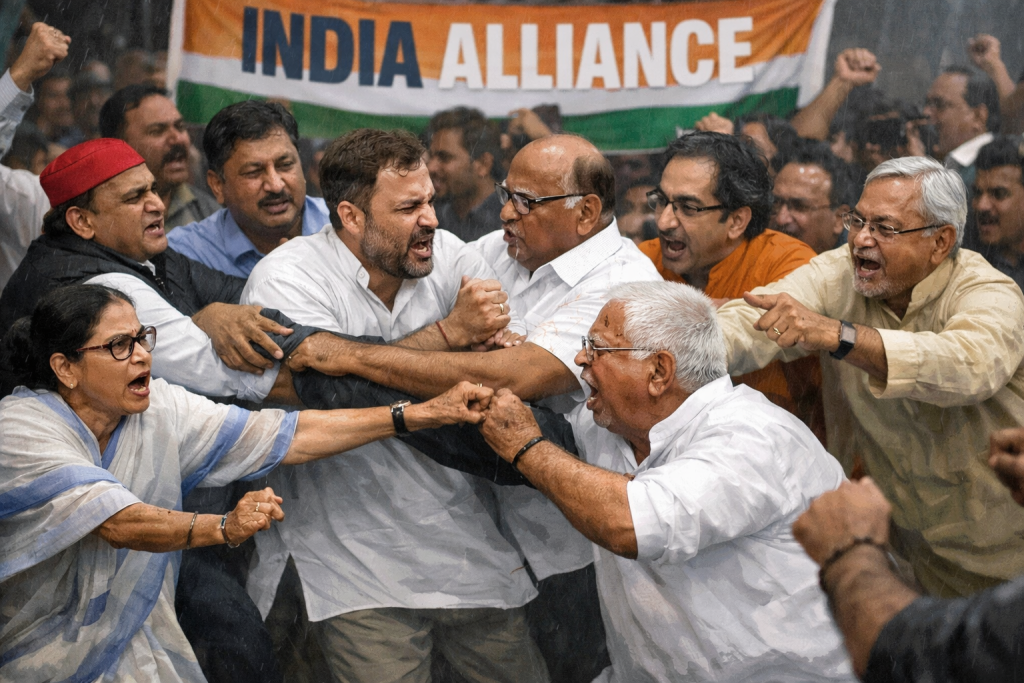
In the glittering circus of Indian politics, the INDIA alliance rolled onto the stage like a brightly painted clown car stuffed with too many oversized egos and too few seats. Horns honking, leaders waving, it promised a grand spectacle to challenge the BJP-NDA behemoth. Instead, it has delivered non-stop slapstick: a circular firing squad dressed in secular costumes, where every bullet is aimed lovingly at the nearest ally’s foot while the real target strolls away with the trophy.
The numbers tell the tragicomedy. In 2014, BJP alone grabbed 282 seats; NDA crossed 330. By 2019, BJP peaked at 303 and NDA touched 353 — a disciplined steamroller flattening a scattered opposition. Even in 2024, when BJP “slipped” to 240, the NDA still cruised to 293 seats and a comfortable majority. The INDIA bloc scraped together 234, with Congress recovering to 99. Impressive on paper, yet miles short of toppling a machine that knows how to keep its mismatched parts from falling off.
History repeats as farce. The 2014 UPA was already a rotting joint family estate plagued by scams and paralysis. Subsequent attempts at grand alliances produced little more than glamorous wedding photos followed by immediate divorce proceedings. Local successes — Bihar 2015, Karnataka 2018 — rarely scaled nationally because personal ambition always proved stronger than anti-Modi glue.
Launched in 2023 with much fanfare, the Indian National Developmental Inclusive Alliance was supposed to be the Avengers of opposition politics. In reality, it resembled a dysfunctional saas-bahu serial where every character wants to be the tyrannical mother-in-law, the scheming daughter-in-law, and the sole inheritor of the family empire.
Mamata Banerjee played the reluctant diva, treating alliance meetings like optional high-society parties she might grace only when her own Bengal stage needed extra lights. Arvind Kejriwal, the self-proclaimed common man’s messiah, blew hot and cold like Delhi’s erratic summer AC — fully committed only when it suited his own fiefdom and freebie script.
And then there is Nitish Kumar, the undisputed trapeze artist of Indian politics. The Bihar wizard who helped birth the INDIA alliance executed yet another mid-air flip back to the NDA in early 2024, landing gracefully in the Chief Minister’s chair once more. One moment denouncing BJP’s “divisiveness,” the next swearing loyalty like a groom repeating vows for the nth time. His acrobatics make the opposition look less like a political bloc and more like a bunch of crabs in a bucket, each pulling the other down while dreaming of climbing out alone.
The Congress, natural claimant to the opposition throne, supplies the richest comedy. Fresh from its Kerala “thumping victory,” the party transformed the celebration into a fierce game of musical chairs for the CM post. K.C. Venugopal lobbied from a distance with the confidence of someone who attended the victory party via video call. Meanwhile, the ever-flexible Chennithala positioned himself as the ultimate compromise candidate — a political contortionist willing to bend any principle for the chair. Rahul Gandhi delivers soul-stirring lectures on Nyay, love, and brotherhood during Bharat Jodo yatras, yet his party resembles a grand old mansion where the furniture constantly fights over who gets to sit on the throne. Priyanka brings Bollywood glamour, but even star power cannot mask the high-command paralysis and internal knife fights.
Other allies complete this chaotic baraati procession. Akhilesh Yadav guards his UP turf like a suspicious landlord. Tejashwi Yadav eyes dynastic revival in Bihar. Sharad Pawar offers grandfatherly wisdom while managing his own splintered NCP factions. Every INDIA meeting turns into a pre-nuptial negotiation: who gets the biggest slice of future power, who holds veto rights, and who gets photographed closest to the symbolic “unity” garland. Their only real common manifesto remains “Stop Modi.” Beyond that, it is egos colliding like bumper cars at a fair.
Contrast this circus with the BJP’s NDA tactics. The ruling alliance is no love fest, but it runs like a reasonably well-oiled (if occasionally squeaky) political machine. Modi’s central narrative of development, nationalism, and decisive leadership acts as the steel frame. The BJP excels at “unequal alliances” — absorbing smaller caste-based parties that deliver targeted votes without threatening supremacy. When allies splinter (Shiv Sena, NCP), it pragmatically adopts the friendly faction. Seat-sharing is clinical. The result: even after shedding seats in 2024, the NDA held firm because its components mostly stayed on script instead of auditioning for solo careers.
The Indian voter, tired of never-ending political tamasha, prefers the illusion of stability over a fragile convoy of regional satraps each eyeing the driver’s seat. A clown car stuffed with ambitious performers projects chaos. A coordinated (if imperfect) front sells purpose.
This disunity is not tactical error but cultural DNA. Opposition leaders, raised in family fiefdoms and regional kingdoms, view any broader alliance as a zero-sum mahaul — if one rises, another must be cut down. Sacrifice is for saints and election slogans. Photo-ops are plentiful; actual coordination is rarer than a honest politician.
Until these leaders realise that true unity demands parking personal ambitions outside the meeting room, the BJP will keep winning — not always through unmatched brilliance, but through the opposition’s reliable talent for self-sabotage. The greatest obstacle to Narendra Modi is not the INDIA alliance itself, but the mirror these parties steadfastly refuse to consult.
Indian voters ultimately choose governability over grievance. And in that contest, a brightly painted clown car — no matter how loud the horns — rarely outruns a battle bus.