


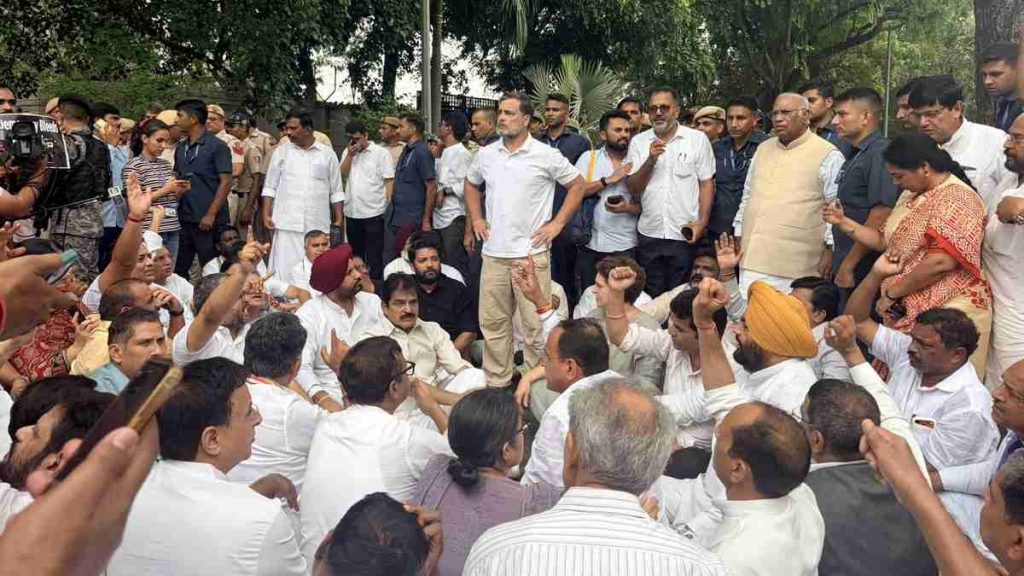
New Delhi: The Delhi Police on Monday formally de-notified Jantar Mantar as a designated site for public demonstrations, ending its long-standing status as the capital’s primary protest venue. The decision, implemented with immediate effect, follows recommendations from a Ministry of Home Affairs committee and comes amid weeks of escalating political protests over electoral roll revisions and the functioning of the Election Commission.
Under the revised arrangement, public demonstrations will now be permitted only at three alternative locations: Ramlila Ground, Burari Ground, and CBD Ground in East Delhi. Authorities said revised standard operating procedures for the new venues will be issued separately. Jantar Mantar has been heavily barricaded and placed under lockdown, rendering it off-limits for future gatherings.
The move is widely viewed as a response to sustained agitation by the opposition INDIA bloc and the Gen-Z-led Cockroach Janta Party (CJP). Both groups have held a series of protests in recent weeks demanding transparency in electoral rolls and questioning the conduct of Chief Election Commissioner Gyanesh Kumar. The CJP, in particular, had sought permission to stage a demonstration at Jantar Mantar, a request that has now become moot following the de-notification.
Officials indicated that the intensity and frequency of protests at the historic site had raised concerns over public order, traffic disruption, and security management in the central Delhi area. The MHA committee is understood to have reviewed existing arrangements after multiple rounds of demonstrations that drew large crowds and prompted police deployment on several occasions.
Jantar Mantar has served as the default venue for protests in the national capital for decades, hosting gatherings on a wide range of issues ranging from farmers’ demands to civic grievances. Its proximity to Parliament and government offices made it a symbolic and practical choice for demonstrators. The shift to peripheral locations is expected to alter the visibility and logistical dynamics of street protests in the capital.
While the INDIA bloc has so far not issued a formal reaction, CJP functionaries have previously argued that restrictions on traditional protest sites amount to curbing democratic expression, especially on questions of electoral integrity. Police sources, however, maintained that the decision was administrative and aimed at ensuring orderly conduct of demonstrations without compromising law and order.
As of Monday afternoon , the barricades around Jantar Mantar remained in place, with restricted access for the public. Authorities have asked organisations planning protests to apply for permission at the newly designated grounds under the forthcoming SOPs. The de-notification marks a significant change in Delhi’s protest landscape at a time when electoral and institutional issues continue to dominate political discourse.