


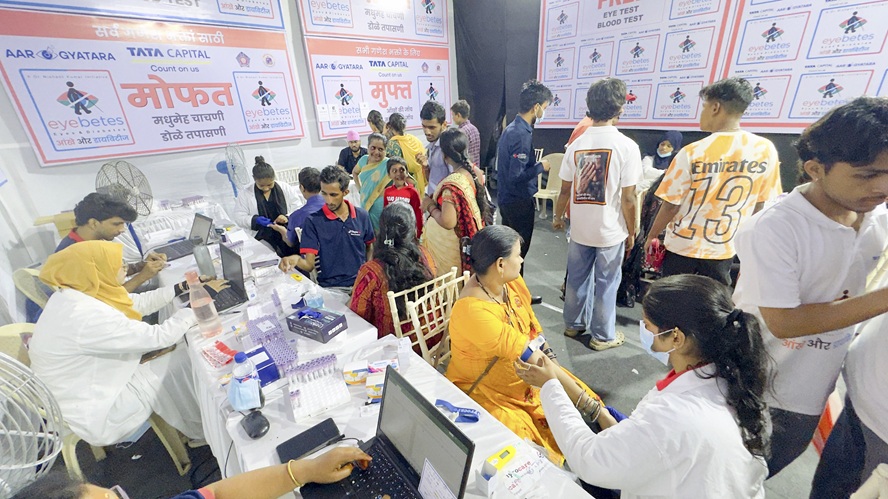
Mumbai: A decade of community health screenings during Mumbai’s Ganpati celebrations has highlighted a significant burden of undiagnosed diabetes and eye health concerns among devotees. The Eyebetes Foundation has found that around 40% of people above the age of 40 screened through its Ganpati camps were either prediabetic or diabetic, with the proportion rising to approximately 60% among those above 60, according to the Foundation’s observations over the past 10 years.
The Foundation, led by eye and retina surgeon Dr Nishant Kumar, has been conducting free diabetes and eye screening camps during the 10-day Ganpati festival since 2016. This year, the initiative has already screened more than 6000 devotees and aims to reach 15000+ people over the remaining days.
The screenings are being conducted at two prominent Ganpati locations, Siddhivinayak Temple in Prabhadevi and GSB Seva Mandal in King’s Circle, making preventive healthcare more accessible to thousands of devotees gathering for the festival.
The Eyebetes Foundation’s experience over the past decade shows that community-based screening can identify health concerns that may otherwise go undetected. For many people attending the camps, the screening represents their first formal assessment of blood sugar and eye health. The Foundation’s screenings combine HbA1c and blood sugar testing with visual assessment and retinal imaging, helping identify individuals who may require further medical evaluation.
The Foundation has also observed a significant burden of inadequate or uncorrected vision through its community programmes. According to its data, around 70% of people screened across its projects have been unable to achieve 6/6 vision, with several cases potentially addressable through appropriate corrective glasses.
Dr Nishant Kumar, Founder, Eyebetes Foundation said, “Ganpati is a time when communities come together, and it provides an important opportunity to take preventive healthcare to people rather than waiting for them to visit a hospital or clinic. Over the years, we have seen how a simple screening can uncover diabetes, vision problems and other concerns that people may not know they have. Early identification can encourage people to seek appropriate medical advice before a condition progresses.”
A key component of the Foundation’s screening programme is the use of AI-powered, non-mydriatic fundus cameras from Forus Healthcare, which enable retinal imaging without requiring pupil dilation.
Dr Kumar has worked with Forus Healthcare for more than a decade, using its retinal imaging technology across the Foundation’s community screening initiatives. The technology is being deployed in settings ranging from community camps to underserved areas, aiming to make retinal screening more accessible.
The cameras can capture retinal images non-invasively, while AI-assisted systems help assess image quality and flag images that may require a repeat capture. Suitable images can then be analysed for signs that may warrant further clinical evaluation, including conditions such as diabetic retinopathy, glaucoma and age-related macular degeneration.
“AI-powered retinal imaging can help extend eye screening beyond conventional clinical settings. By making screening faster, non-invasive and more accessible, the technology can support earlier identification of people who may need specialist evaluation. Community screening is particularly valuable in reaching people who may otherwise have limited access to regular eye examinations,” added Dr Kumar.
As part of its ongoing collaboration with Forus Healthcare, two cameras equipped with an experimental AI capability to estimate HbA1c from retinal images are being introduced at the current camps for validation alongside conventional blood testing.
The application is currently under validation and does not replace standard blood testing. The AI models are being refined using Indian datasets, including data generated through the Foundation’s community screening programmes.
With community-based screening, portable retinal imaging and AI-assisted assessment, the Eyebetes Foundation aims to expand access to preventive eye care and facilitate timely referrals for people who may require specialist attention. The Foundation emphasises that AI-based screening is a screening and referral-support tool and does not replace a comprehensive examination or diagnosis by an ophthalmologist.