


Roorkee, Uttarakhand : India is witnessing a growing overlap in the vulnerability of districts to two seemingly contrasting extremes-floods and droughts. A study led by researchers at the Indian Institute of Technology Roorkee has found that vulnerability to both hazards has intensified across several parts of the country, with an increasing concentration of districts facing multiple and overlapping pressures.
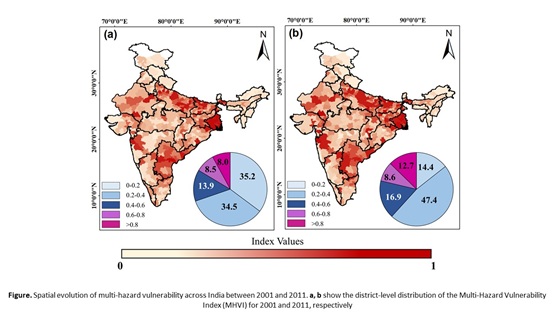
The study, published in npj Natural Hazards, a Nature Portfolio journal, analysed 591 districts across India for 2001 and 2011, based on the latest nationally consistent and granular socio-economic, demographic and infrastructure data available at the district level. Rather than examining floods and droughts independently, the research brings the two together through a Multi-Hazard Vulnerability Index (MHVI) to identify areas where underlying social, demographic, and physical vulnerabilities to both extremes are converging.
The findings reveal a marked transformation in India’s vulnerability landscape, with a substantial share of districts exhibiting heightened susceptibility to hydrological extremes. By 2011, more than one-fifth of the country’s districts were classified as highly vulnerable to floods, while nearly one-fifth showed high vulnerability to drought. The combined assessment further highlights the growing prominence of multi-hazard vulnerability, with more than one in every ten districts positioned towards the higher end of the Multi-Hazard Vulnerability Index (MHVI).
The research indicates that these changes are not uniformly distributed across the country. A growing concentration of multi-hazard hotspots was observed particularly across eastern and northern India. States including Odisha, Andhra Pradesh, Maharashtra, Rajasthan, Uttar Pradesh, Jammu & Kashmir, Bihar and Jharkhand showed increases in both flood and drought vulnerability in different districts. Uttar Pradesh, Bihar and West Bengal continued to feature prominently towards the higher end of vulnerability for both hazards.
Importantly, the study demonstrates why looking at vulnerability only at the state level can obscure significant differences between individual districts. By providing a district-level assessment, the framework offers a more granular understanding of where communities may face multiple pressures and where climate adaptation and disaster-risk reduction efforts may need greater attention.
Prof. Mohit Prakash Mohanty, who led the study, said, “Floods and droughts are often treated as separate risks, but their consequences are experienced by communities within the same social and physical systems. Our analysis shows that vulnerability to these extremes is changing and, in several regions, increasingly overlapping. A district-level understanding of these patterns can help identify where integrated approaches to preparedness and adaptation may be most relevant.”
The findings are particularly significant as climate variability and extreme hydrological events increasingly challenge infrastructure, livelihoods, water resources and local development systems. Understanding vulnerability alongside the occurrence of hazards can help move disaster-risk planning beyond a single-hazard approach and towards strategies that account for multiple and potentially interacting risks.
The study was supported by the Department of Science & Technology (DST) through the Integrated Centre for Adaptation to Climate Change, Disaster Risk Reduction and Sustainability (ICARS), IIT Roorkee, under Project No. DST-2211-WRC/23-24, sanctioned under DST/CCP/NMSKCC/CoE/236/2024(G). Computational resources were provided by the Department of Water Resources Development and Management, IIT Roorkee.
The research provides a basis for identifying spatial patterns of multi-hazard vulnerability and can support efforts towards risk-informed adaptation planning, prioritisation of resources and climate-resilient disaster risk reduction. The researchers emphasise that the Multi-Hazard Vulnerability Index represents the relative distribution and evolution of underlying vulnerability conditions and is not intended as a deterministic prediction of disaster losses or impacts.
Research Team: Priyanka Tripathy, Dev Anand Thakur, Vittal Hari and Mohit Prakash Mohanty, IIT Roorkee.
****