


ACC, the cement and building materials company of the diversified Adani Portfolio, along with the Adani Foundation, in partnership with NABARD, through the Samlapur Watershed Project at Sindri, is transforming rain-fed farming communities by solving the chronic challenges of water scarcity and low productivity.
For the farmers of Samlapur and Chhatatand, two rain-fed villages in Sindri, the relationship with the land has always been one of uncertainty. Rainfall determined what could be grown, how much could be harvested, and whether there would be enough produce throughout the year. Low farm productivity and water scarcity were not just seasonal inconveniences for the farmer communities but were structural realities that had defined agricultural life for generations.
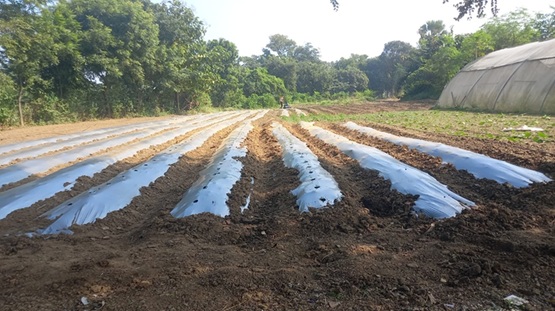
The Samlapur Watershed Project changed that equation. Supported by NABARD and Adani Foundation, the project introduced 84 small and marginal farmers to a fundamentally different way of working on their land. Across 21 acres, farmers were trained in drip-based mulch farming and trellis-based cultivation, two techniques that do far more than improve yield. They reshape how farmers think about water, soil, and crop selection entirely.
The shift to drip irrigation alone reduced water wastage significantly, making cultivation viable even when rainfall was unpredictable. Mulching improved soil conservation and reduced the labour burden that had long eaten into whatever margins these small farms could generate. And with the introduction of high-value crops such as chilli, tomato, and creeper vegetables, farmers were no longer just growing more efficiently, they were growing smarter.
The results have been striking. Across the 84 participating farmers, incomes have risen by 40 to 60 percent and their expenditure on water and labour has fallen. What was once a community defined by the anxiety of rain-fed agriculture is now one where sustainable, profitable farming is becoming the norm rather than the exception.
For Adani Foundation and ACC, the Samlapur Watershed Project is a demonstration of what happens when the right technical intervention meets the right community partnership and when farmers who have spent their lives working around scarcity are finally given the tools to work through it.