


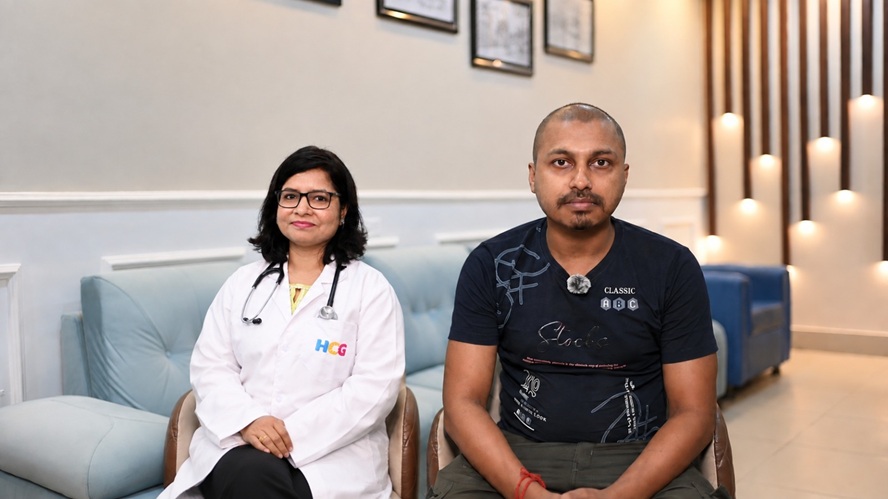
When Subhradip Baidya first arrived at HCG Cancer Hospital, Kolkata, he needed a wheelchair. Severe breathlessness, persistent cough, body pain and weakness had made walking difficult. Today, the 29-year-old is back on his feet, attending to his daily chores himself.
Baidya had undergone surgery at another hospital to remove the affected testicle. Histopathology identified a mixed germ-cell tumour, with subsequent scans showing spread to abdominal lymph nodes and both lungs. His disease was classified as stage IIIB, and tumour markers were markedly elevated.
Under Dr Debanti Banerjee, consultant, medical oncologist at HCG Cancer Centre, Kolkata, he received chemotherapy with cisplatin and etoposide. Bleomycin was avoided because his baseline lung function was poor.
“Germ-cell tumours can respond exceptionally well to chemotherapy, even when the disease is advanced. His breathing improved, his pain subsided and he regained the ability to walk and manage daily activities himself. Alongside the response on scans, this improvement in his quality of life is particularly encouraging,” said Dr Banerjee.
The initial course was challenging. Following his first cycle, low blood counts, fever and diarrhoea required hospitalisation and intensive care. Once these complications were managed, his symptoms improved, and treatment continued with dose modifications.
After six cycles, scans showed that the lung metastases had disappeared and the affected lymph nodes had shrunk to less than one centimetre. Tumour markers had normalised. He regained weight and remains under regular follow-up.
“Testicular germ-cell cancer accounts for only 1–2% of all tumours in males, yet its impact on a young person’s life can be profound. Helping patients regain mobility and everyday independence is an essential goal of comprehensive cancer care,” said Dr Rupali Basu, RBH, HCG Cancer Hospitals & MGCHRI, Vizag.
For Baidya, being able to walk and take care of himself again marks a significant recovery from the debilitating symptoms with which he first presented. His follow-up care continues.