


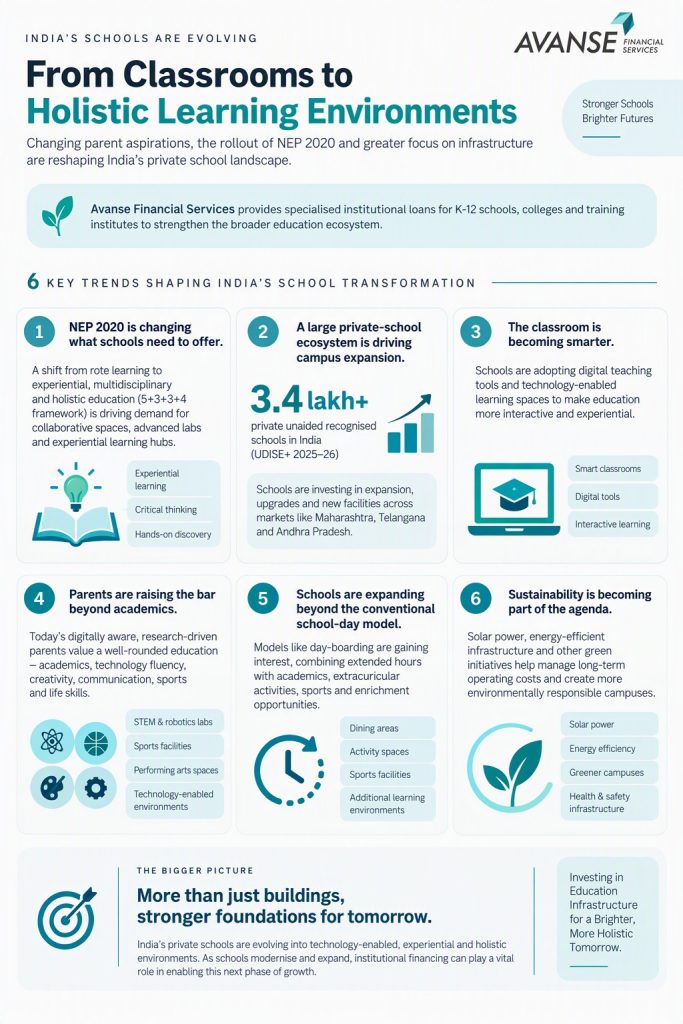
India : The Indian school experience is changing, and the transformation is increasingly visible not just in classrooms but across schools’ infrastructure. For a generation of digitally aware parents increasingly focused on their children’s holistic development, a school is no longer evaluated only by academic results. Smart classrooms, laboratories, sports facilities, technology-enabled learning, safety and sustainable infrastructure are becoming important parts of the overall proposition. This shift is prompting private schools across the country to invest in upgrading and expanding their campuses, creating a growing requirement for institutional financing. To support this momentum, Avanse Financial Services, an education-focused Non-Banking Financial Company (NBFC), provides specialised institutional loans for K-12 schools, colleges, and training institutes to strengthen the broader education ecosystem.
Through its close engagement with the sector, Avanse Financial Services has observed six key trends shaping this evolution:
- NEP 2020 is changing what schools need to offer.
The implementation of the National Education Policy (NEP) 2020 is driving a structural shift from rote learning to experiential, multidisciplinary, and holistic education. By restructuring school education into a 5+3+3+4 framework, spanning Foundational, Preparatory, Middle, and Secondary stages, the policy prioritises foundational literacy, critical thinking, and hands-on discovery. Executing this vision requires a fundamental rethink of school infrastructure. To foster active learning, campuses must transition toward collaborative, discovery-oriented spaces, including advanced science and Information & Communication Technology (ICT) labs, creative activity rooms, and experiential learning hubs. Avanse Financial Services notes that for private institutions, adapting existing facilities to meet these dynamic requirements represents both a strategic imperative and a substantial capital investment.
- A large private-school ecosystem is driving campus expansion and upgrades.
India has a sizeable private unaided school ecosystem, with more than 3.4 lakh private unaided recognised schools according to the Unified District Information System for Education Plus (UDISE+) 2025–26 report. As this extensive network responds to changing academic requirements and parent expectations, schools are increasingly looking at campus expansion, infrastructure upgrades and new facilities. Avanse Financial Services has observed growing demand for educational institution financing from schools across markets including Maharashtra, Telangana, and Andhra Pradesh, reflecting broader institutional investment to expand capacity and strengthen infrastructure.
- The classroom is becoming smarter.
The traditional classroom is giving way to a more technology-enabled learning environment. Technology adoption is no longer limited to computers. Schools are investing in digital teaching tools and technology-enabled learning spaces to make education more interactive and experiential. For institutions, this transition also means higher upfront capital expenditure, making access to financing increasingly important.
- Parents are raising the bar beyond academics.
Indian parents’ aspirations are also changing what schools need to provide. Today’s millennial parents are typically digitally aware, research-driven and exposed to global education and workplace standards. They increasingly value a combination of academic foundations, technology fluency, creativity, communication skills, sports and life skills. Consequently, schools are looking beyond conventional classrooms and investing in STEM and robotics labs, sports facilities, playgrounds, performing arts spaces and technology-enabled learning environments. Avanse Financial Services highlights that the result is a shift in school infrastructure from being purely functional to becoming an important part of the overall learning experience.
- Schools are expanding beyond the conventional school-day model.
For working parents, convenience and a safe, structured environment are becoming important considerations when evaluating schools. This is driving interest in models such as day-boarding, which can combine extended supervised hours with academics, extracurricular activities, sports, and other enrichment opportunities. For schools adopting such models, infrastructure requirements can extend beyond classrooms to include dining areas, activity spaces, sports facilities, and additional learning environments. Avanse Financial Services identifies this as another potential avenue for capital investment as institutions adapt their offerings to changing family needs.
- Sustainability is becoming part of the school infrastructure agenda.
The future-ready school is also increasingly expected to be environmentally conscious. Avanse Financial Services has observed that solar power, energy-efficient infrastructure and other sustainability measures can help institutions manage long-term operating costs while creating more environmentally responsible campuses. At the same time, schools continue to invest in expansion, health and safety infrastructure, and digital readiness as they respond to changing parent expectations.
From conventional campuses to holistic learning environments
The evolution of India’s private school sector is ultimately being driven by a simple shift: parents are asking for more from education, and schools are investing to deliver it. Schools today are no longer just places where students attend classes. They are increasingly becoming technology-enabled, experiential and holistic environments designed to support a wider range of learning and development needs.
Avanse Financial Services’ experience with educational institutions indicates that this transformation is already translating into greater financing requirements across several markets. As schools modernise campuses, expand capacity and introduce new learning environments, institutional financing can play an important role in enabling this phase of growth. India’s education infrastructure story, therefore, is no longer just about building more schools. It is increasingly about enhancing the quality, capability and relevance of the spaces in which students learn.