


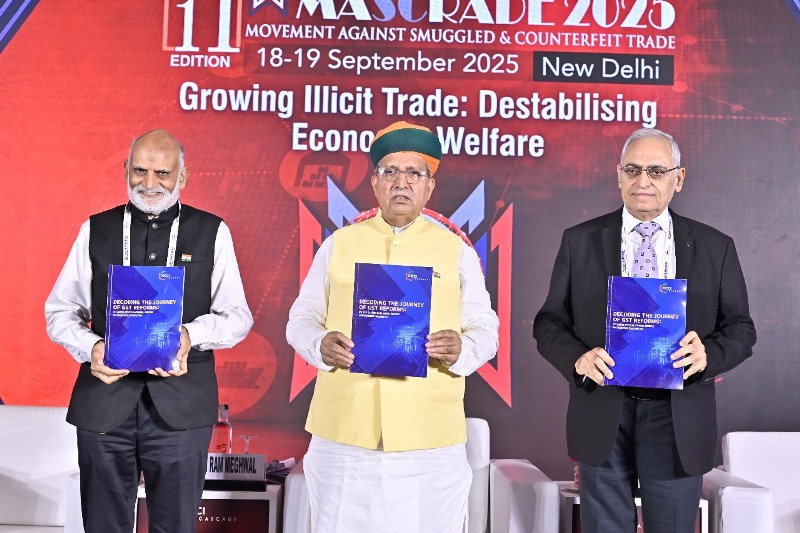
NEW DELHI: Arjun Ram Meghwal, Minister of State (Independent Charge), Ministry of Law and Justice on Thursday, while addressing the FICCI-CASCADE’s ‘MASCRADE 2025’ emphasized that GST 2.0 is not just about taxation—it is about making life easier for households and businesses. “From filing 37 GST returns in a year in 2017 to only 3 today, this reform shows how governance can truly respond to industry’s voice. At the same time, we must clearly define illicit trade and work collectively to eliminate it. I assure you that the recommendations emerging from MASCRADE 2025 will be taken to the Government and acted upon,” he added.
Mr. Anil Rajput, Chairman, FICCI CASCADE, said, “I congratulate our Hon’ble Prime Minister for announcing the historic and bold GST 2.0 reforms, which is another step toward Viksit Bharat. GST 2017 transformed our taxation landscape, and now GST 2.0 builds on that foundation with simplified rate structures and greater efficiency. GST 2.0 truly embodies the vision of ‘One Nation, One Tax.’ At FICCI CASCADE, we have long advocated for rational tax structures to reduce illicit trade. High tax rates create price gaps that fuel smuggling and counterfeiting. GST 2.0 addresses these concerns, and I urge policymakers to continue keeping the structure balanced to discourage illicit markets.
Building on the spirit and success of Operation Sindoor, which demonstrated how clarity of purpose, precision, and coordination can dismantle entrenched threats, I want to unveil a new framework for our collective action against illicit trade. ‘SHIELD’ offers a structured and strategic approach to combating illicit trade in India. S is for strategic monitoring through tech-enabled surveillance across supply chains. H stands for Harnessing Technology like AI, blockchain, and analytics to detect anomalies. I is for Industry Collaboration, urging businesses to share intelligence and support enforcement. E denotes Enforcement, calling for swift action and deterrence. L is for legal reforms, advocating stronger laws and faster trials. Lastly, D means Demand Reduction, stressing public awareness to curb consumption of smuggled and counterfeit goods and disrupt illicit markets at the root. I also want to acknowledge the tireless efforts of our enforcement agencies—Customs, BSF, CRPF, DRI, CEIB, and our intelligence services. In the past year alone, seizures of illicit goods have risen sharply, and contraband worth thousands of crores has been intercepted.”
In her video address, Ms. Gael Grooby, Director, Policy and Standards, World Customs Organization, said, “I congratulate FICCI for its leadership in tackling illicit trade through this important platform. Since our founding in 1952, the WCO has worked to support legitimate trade while countering illicit flows. This year’s WCO theme is ‘Customs Delivering on Efficiency, Security, and Prosperity’. Through initiatives like Operation STOP, we’ve disrupted counterfeit medical supply chains and protected consumers and economies alike. However, today’s landscape is changing. E-commerce has revolutionized trade, and while it creates opportunities, it also enables the rapid spread of counterfeits. To address this, we are investing in AI, real-time data sharing, and detection technologies to help customs better manage the rising volume of small packages. With India’s support, our Customs Enforcement Network (CEN) now offers enhanced data visualization tools.”
Mr. P K Malhotra, Former Secretary, Ministry of Law & Justice, Govt. of India, and Think Tank Member, FICCI CASCADE, said, “There are serious economic and social costs of illicit trade. While globalization has brought immense opportunities, it has also enabled a parallel economy—smuggling, counterfeiting, tax evasion, and trafficking that undermines our progress toward the UN Sustainable Development Goals. In India, the challenge is urgent. As we aim to become a $30 trillion economy by 2047, we must tackle this issue with sustained, coordinated action, backed by robust enforcement and clear, enforceable laws. Today’s discussions made it evident—illicit trade is no longer a fringe problem. It operates like a global, organized network, exploiting legal ambiguities and enforcement gaps. This fight cannot be won by governments alone. Industry must invest in authenticity and consumer protection. Citizens must be aware and vigilant. And we need deeper international collaboration to enable joint investigations, intelligence sharing, and harmonized standards.”
During the event, FICCI CASCADE, jointly with the Thought Arbitrage Research Institute (TARI), released its report – “Decoding the Journey of GST Reforms: GST and Its Effect on Economy, Business and Household Consumption”. The report affirms that GST 2.0 marks a landmark reform, reshaping India’s indirect tax system to directly improve ease of living for households and ease of doing business for enterprises.