


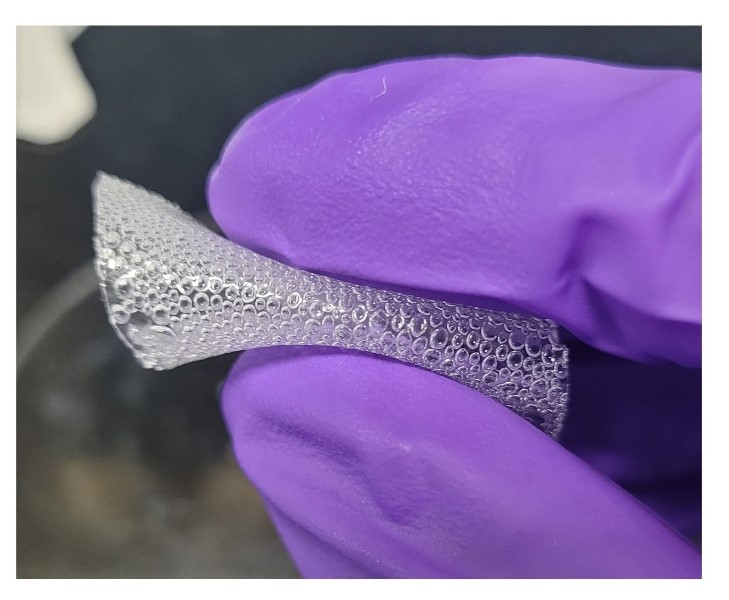
Hyderabad: A team of researchers from the International Institute of Information Technology, Hyderabad (IIITH), and King Abdullah University of Science and Technology (KAUST) has developed a new class of large-area, flexible dielectric materials that can be used as capacitive pressure sensors which are low-cost, highly sensitive, and suitable for applications in healthcare, robotics, and wearable devices.
Published in the IEEE Journal on Flexible Electronics, the study demonstrates how bubble-induced PDMS foam combined with conductive textile electrodes can be engineered into reliable and scalable pressure sensors. The sensors show high repeatability, making them especially promising for human–machine interaction, surgical robotics, and tactile wearables.
“Our fabrication approach uses everyday materials like cotton textiles and polymer foam, and still delivers performance comparable to state-of-the-art flexible sensors. The PDMS foam created in this study has far-reaching applications beyond sensors, because it is an emerging class of materials that provides more stretchability and flexibility than the base polymer,” said Dr Aftab M. Hussain, Associate Professor at IIIT Hyderabad. “This opens up opportunities for affordable and customizable materials for healthcare and assistive technologies.”
The research team also synthesised polypyrrole-coated conductive cotton textile to use as electrodes using a simple chemical oxidative process and integrated them with bubble-trapped polydimethylsiloxane (PDMS) to create a compressible capacitive structure. The resulting sensors exhibited low hysteresis, strong repeatability, and rapid response.