


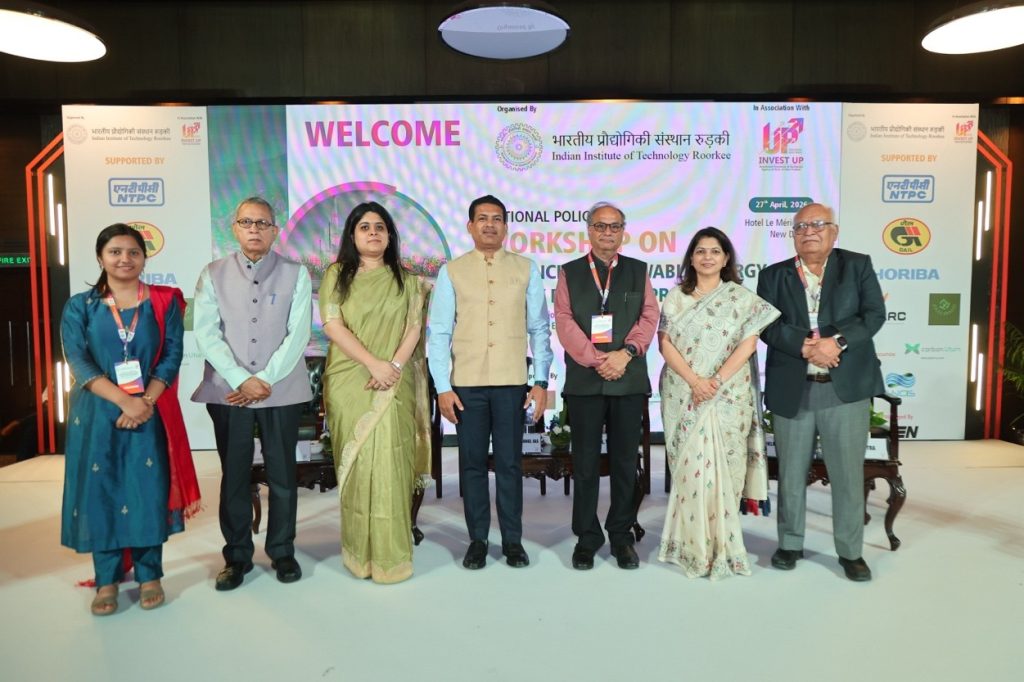
NEW DELHI – The Indian Institute of Technology Roorkee (IIT Roorkee), in association with INVEST UP, successfully hosted the “National Policy Workshop on Advancing Renewable Energy Policy for Uttar Pradesh” on April 27, 2026, at Hotel Le Méridien, New Delhi. The invite-only conference centred on the theme of “Benchmarking National Missions, Leading State Frameworks and the Emerging Net Zero Economy,” bringing together top policymakers, industry leaders, and academic researchers to chart the course for India’s sustainable energy future.
During the opening remarks, Workshop Convenor Dr. Komal Tripathi welcomed the dignitaries and emphasized that the workshop aims to go beyond discussions on renewable energy and focus on developing a practical and implementable roadmap for Uttar Pradesh’s energy transition. She highlighted that achieving Net Zero is a multidimensional problem and therefore requires an integrated approach, stressing the need to shift from reaction-centric to system-centric thinking to defossilize the chemical and energy sectors through scalable non-fossil technologies aligned with the vision of Viksit Bharat.
Delivering the Keynote Address, Chief Guest Shri Santosh Kumar Sarangi, IAS, Secretary, Ministry of New and Renewable Energy, underscored India’s rapid transition. He noted that renewable energy recently met over 32% of India’s peak electricity demand and highlighted the nation’s 274 GW of renewable energy installation. Looking forward, he emphasized the country’s trajectory toward 500 GW by 2030 and urged the adoption of a “three I” strategy – Investment, Import of technology, and Innovation and research to achieve continued economic growth. He also highlighted the potential of states like Uttar Pradesh to support energy-intensive manufacturing processes, such as polysilicon production, to solidify domestic supply chains.
Dr. V.K. Saraswat, former member of NITI Aayog, presented a strategic perspective, stating that Uttar Pradesh is at a critical inflection point in its clean energy journey. He noted that with strong policy intent, the state has the potential to evolve from a lagging adopter into a scale-driven renewable energy leader. To achieve this, he recommended converging the state’s solar, bioenergy, and green hydrogen policies into a unified clean energy strategy and establishing a State Energy Transition Fund. Furthermore, Dr. Saraswat stressed the critical need for grid modernization, including the expansion of green energy corridors and the deployment of battery energy storage systems, to ensure long-term stability.
Following this, Shri Pankaj Singh, Secretary & Chief Project Officer at UPNEDA presented a comprehensive overview of Uttar Pradesh’s policy framework, emphasizing solar energy, bioenergy, and green hydrogen. He highlighted the state’s ambitious targets, including the Solar Energy Policy 2022’s goal of 22,000 MW capacity and the Green Hydrogen Policy 2024’s objective of producing 1 million metric tonnes annually.
Prof. K.K. Pant, Director of IIT Roorkee, in his welcoming address, highlighted the pressing challenge of meeting exponentially growing energy demand while simultaneously addressing climate change concerns. Acknowledging that fossil fuels currently dominate the energy landscape, he stressed the urgent need to make their utilization cleaner through carbon capture technologies and circular economy principles. Prof. Pant underscored India’s massive biomass potential, noting an estimated availability of 452 million tonnes for energy generation. He also emphasized the importance of evaluating renewable technologies through life cycle assessments and noted that advancements in materials science will be crucial for improving the efficiency and cost-effectiveness of these systems.
Smt. Prerna Sharma, IAS, ACEO at Invest UP, emphasized how Uttar Pradesh’s demographic scale positions it as a renewable energy leader. Adding to this, Smt. Vartika Shukla, Former CMD of Engineers India Limited (EIL), provided vital perspectives during the Opening Plenary on Centre and State energy transition policies, specifically highlighting the critical role of Battery Energy Storage Systems (BESS).
The event featured profound insights from key industry figures. Dr. R. K. Malhotra, President of the Hydrogen Association of India, outlined the critical need for cost-effective storage to support the national 5-million-ton green hydrogen target and highlighted massive opportunities in Compressed Biogas (CBG).
Throughout the day, comprehensive plenary sessions explored the critical integration of Centre and State Government policies for energy transitions, alongside dedicated dialogues on Solar energy advancements, the future of Green Hydrogen, Bio Energy innovations, and the overarching challenges of achieving Net Zero. Discussions also highlighted the critical need for advanced Battery Energy Storage Systems (BESS) to stabilize variable renewable energy, and the importance of developing sustainable aviation fuels and streamlining single-window clearances for large mega-projects.
Concluding the inaugural session, a Vote of Thanks was delivered by Deputy Director Prof. U.P. Singh. The robust agenda was expertly curated by Organising Secretary Shri Akhand Pratap Singh.
Supporting partners for the workshop was NTPC, GAIL, HORIBA, V-MARC, JouleKranti, Hydrogen Association of India, Carbon Uturn, ENCIS, and ITEN.