


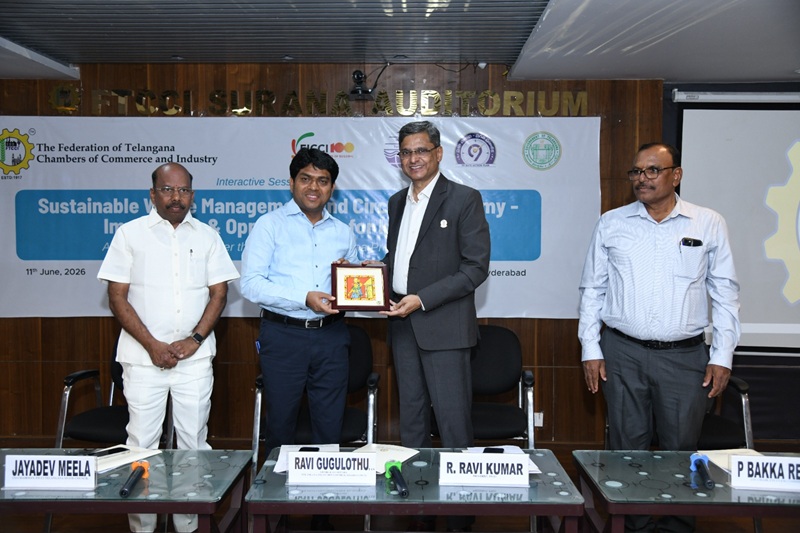
Hyderabad : The Federation of Telangana Chambers of Commerce and Industry (FTCCI), in association with the FICCI Telangana State Council and the Telangana Pollution Control Board (TGPCB), organized an interactive session on “Sustainable Waste Management and Circular Economy – Importance & Opportunities for Industry” at KLN Prasad Auditorium, Federation House, Hyderabad, on Thursday.
The programme was conducted as part of the Telangana Government’s flagship 99-Day Praja Palana Programme, aimed at promoting sustainable waste management practices, circular economy principles, and the elimination of single-use plastics across the State.
Addressing the 300 plus gathering as the Chief Guest, Sri Ravi Gugulothu, IAS, Member Secretary, Telangana Pollution Control Board, said that while plastics have become indispensable to modern industry, their indiscriminate use has created serious environmental challenges.
“Plastic pollution adversely impacts land, water bodies, ecosystems, biodiversity, and public health. Industries that manufacture, use, or market plastic products must take responsibility for collecting and recycling plastic waste generated through their operations,” he said.
Explaining the importance of scientific waste management, he highlighted the Four-Stream Waste Collection System, which segregates waste at source into Wet Waste, Dry Recyclable Waste, Domestic Hazardous Waste, and Reject Waste. Such segregation improves recycling efficiency, reduces landfill burden, prevents contamination, and promotes resource recovery.
He further observed, “The Supreme Court has repeatedly emphasized the importance of segregation of waste at source as the foundation of effective waste management. In line with these directions, local authorities have been empowered to take action against households, institutions, and establishments that fail to properly segregate waste. Compliance with source segregation is not merely a regulatory requirement; it is a civic responsibility that is essential for building a cleaner, healthier, and more sustainable Telangana.”
Welcoming the participants, Mr. R. Ravi Kumar, President, FTCCI, said sustainable waste management is no longer merely a compliance requirement but a strategic imperative capable of driving innovation, resource efficiency, cost optimization, and long-term competitiveness.
“At FTCCI, we strongly believe that economic growth and environmental sustainability must go hand in hand. As one of the oldest and most respected industry chambers in the State, FTCCI remains committed to promoting responsible industrial development, encouraging sustainable business practices, and facilitating constructive dialogue between industry and government,” he said.
In his introductory remarks, Mr. P. Bakka Reddy, Co-Chair, Environmental, Social and Governance (ESG) Committee, FTCCI, explained that unlike the traditional “take-make-dispose” model, the circular economy promotes efficient resource utilization by reducing waste, reusing materials, recycling products, and designing systems that keep resources in circulation for as long as possible.
Mr. Jayadev Meela, Co-Chairman, FICCI Telangana State Council and Managing Director, Sudhakar Group, said sustainability should be viewed not merely as a compliance requirement but as a strategic business opportunity.
“Sustainability is no longer a compliance requirement alone; it is a strategic business opportunity. By embracing circular economy principles, industries can reduce waste, improve resource efficiency, enhance competitiveness, and contribute to a greener future. Telangana’s industrial growth must go hand in hand with environmental responsibility, and collective action by industry, government, and stakeholders is essential to achieving this goal,” he said.
Mr. Meela also urged the Telangana Pollution Control Board and the Government to encourage the establishment of plastic recycling units, preferably MSME-based facilities, in every district. Such decentralized recycling infrastructure, he said, would help reduce plastic pollution, generate employment, and improve resource recovery across the State.
Delivering a detailed technical presentation, Mr. D. Narendra, Joint Chief Environmental Engineer, TGPCB, explained the provisions of the Single-Use Plastics Rules and Solid Waste Management Rules, 2026, with special focus on compliance requirements for bulk waste generators and industries. He clarified regulatory expectations and addressed participants’ queries regarding implementation and enforcement.
Mr. Krishna Rao Thota, Senior Vice President, Re Sustainability Limited, shared industry best practices and successful models of circular economy implementation. He demonstrated how organizations can convert waste into valuable resources, reduce their environmental footprint, and unlock significant economic benefits through sustainable practices.
The session witnessed active participation from industry leaders, business owners, environmental professionals, and chamber representatives. Discussions focused on plastic reduction initiatives, Corporate Environmental Responsibility (CER), sustainable industrial operations, waste segregation systems, recycling mechanisms, and emerging opportunities within the circular economy ecosystem.
Proposing the vote of thanks, Mr. K. K. Maheshwari, Senior Vice President, FTCCI, reiterated FTCCI’s commitment to supporting industries in their sustainability journey through awareness programmes, policy advocacy, and knowledge-sharing initiatives.