


Chennai: Coursera (NYSE: COUR), a leading global online learning platform, released the eighth edition of its Global Skills Report. India ranks 40th globally and 12th in Asia Pacific in the report’s new AI-Human Skills Synergy Index. AI micro-credential enrollments increased 181% year over year (YoY), exceeding global growth of 122%, while overall AI course enrollments rose 57%. The findings reveal growing demand for AI capabilities, alongside an opportunity to strengthen the human skills needed to apply them effectively.
The first-of-its-kind Index reveals how learners across 98 countries are developing AI and human skills together, while also accounting for each country’s broader readiness position. The Index draws on a subset of learning data from more than 300 million Coursera and Udemy learners, and also combines data from Oxford Insights’ Government AI Readiness Index.
India’s ambition to become a global leader in inclusive AI deployment brings workforce skills into focus. India scores above average for emerging and developing economies in IMF’s AI Preparedness Index, indicating its potential to adopt and benefit from AI. Turning that potential into workforce opportunity will require skills development at scale: EY estimates GenAI could transform 38 million jobs in India by 2030, while a report from Bain & Company projects an AI talent shortfall of one million people by 2027. Realizing this opportunity will require deeper specialist and domain-specific AI expertise alongside human skills such as critical thinking, problem-solving, and judgment – equipping both people entering the workforce and those navigating changing roles to apply AI effectively.
“India has the scale and ambition to become a global hub for AI talent, building capabilities that serve both our economy and the world,” said Ashutosh Gupta, Managing Director, India and APAC, Coursera. “India leads the world in AI learning on Coursera. Building on this momentum means deepening specialist and domain-specific AI expertise while strengthening the human skills that give our workforce a competitive edge. Investing in both will be essential to turning AI adoption into productivity and growth.”
Key India findings from Coursera’s Global Skills Report 2026 include:
• Human skills development needs greater attention alongside the AI learning momentum
o Critical thinking enrollments in India increased 65% YoY compared with 107% globally. Complex problem-solving grew 55%, against 126% globally, while innovation rose 62%, compared with 74% globally.
o The priority is to develop these capabilities alongside AI proficiency to question outputs, challenge assumptions, solve problems, and make sound decisions.
• AI learning is becoming more applied and specialized
o Learners in India across Coursera and Udemy are enrolling in GenAI content at a rate of 12 enrollments per minute, up from 6 per minute in 2025.
o AI security enrollments grew 296%, agentic workflows 238%, and GenAI 125%.
o Trending AI skill themes include AI and machine learning foundations, LLM application and modeling, and prompting and AI interaction.
• Learners are combining AI capabilities with communication and innovation
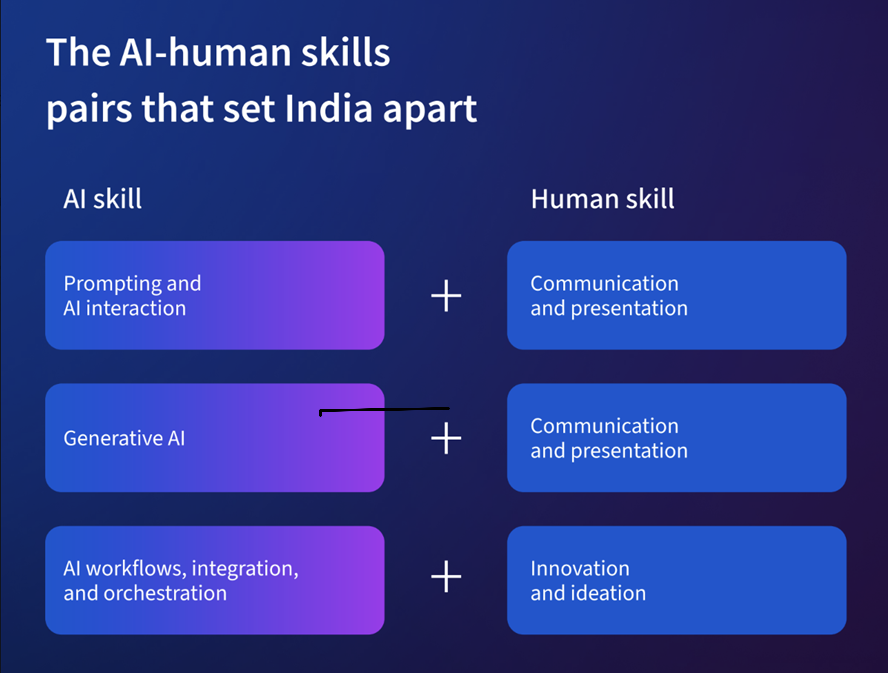
o Prompting and AI interaction pair with communication and presentation, supporting clearer instructions and better review of AI-generated content.
o Generative AI with communication and presentation connects content creation with human judgment about accuracy, clarity, and audience needs.
o AI workflows, integration, and orchestration with innovation and ideation supports generating, testing, and refining ideas for practical AI applications.
• AI credentials are becoming an increasingly important part of structured learning
o AI micro-credential enrollments in India grew 181%, outpacing global growth of 122%.
Leaders across business, higher education, and government can use these findings to connect learning with specific roles and workflows, assess AI and human capabilities together, and prepare people to navigate changes in their work.
*****