


By Suresh Unnithan
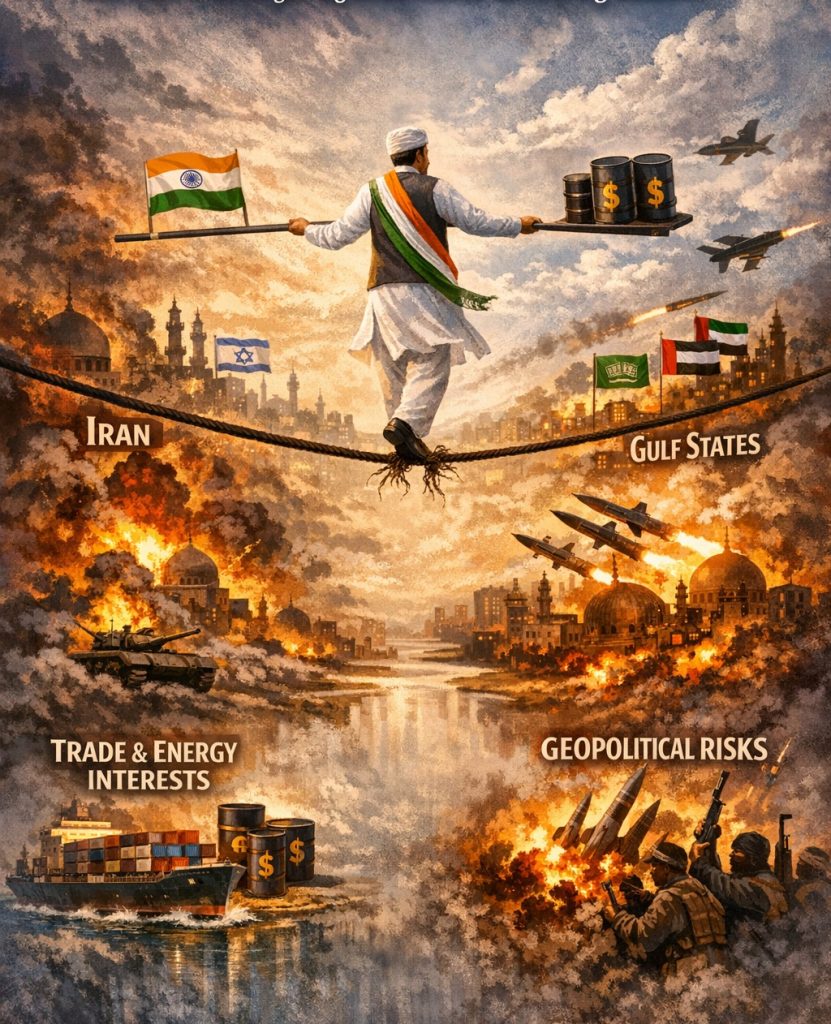
India finds itself grappling with a confluence of economic headwinds exacerbated by the ongoing West Asia conflict involving Iran, Israel, and the United States. The escalation, which intensified in late February with disruptions to the Strait of Hormuz and lingering effects from Red Sea shipping crises, has rippled through global energy markets, trade routes, and supply chains. While India’s GDP growth remained robust at around 7.4% in FY25, the conflict has introduced risks of stagflation—high inflation paired with slowing growth—highlighting vulnerabilities tied to the country’s foreign policy posture. Critics argue that the Modi government’s deepening ties with Israel and the US, framed as “multi-alignment,” have strained relations with Iran and risked Gulf stability, imperiling energy security, remittances, and export competitiveness. Yet the picture is nuanced: diversification efforts, particularly Russian oil imports, have provided buffers, even as traditional dependencies persist. This analysis examines the economic fallout using available data, the government’s response, and broader implications for India’s growth trajectory.
Energy and Trade Disruptions: A Direct Hit from Geopolitical Volatility
India imports approximately 85% of its crude oil needs, with West Asia historically supplying a significant share—around 40-50% transiting through critical chokepoints like the Strait of Hormuz and Red Sea routes. The 2026 conflict has disrupted these arteries, forcing rerouting via longer, costlier paths such as the Cape of Good Hope. Shipping costs have surged 15-20% in affected corridors, mirroring the 2023-2025 Houthi-induced Red Sea crisis that already strained logistics. Global oil prices spiked sharply in March 2026, with India’s crude basket rising over 60% month-on-month in some periods, pushing up costs for refiners and consumers alike.
Compounding this, LNG and LPG supplies from the region—accounting for substantial portions of India’s imports—faced volatility. Domestic fuel prices reflected the strain: CNG and LPG costs rose steeply in several states, contributing to broader inflationary pressures despite government subsidies cushioning some pass-through. Exporters, particularly in tea, textiles, and gems, have been hit hard. The Red Sea disruptions alone contributed to a 9% drop in certain export categories by mid-2024, with 2026 extensions worsening delays and freight expenses. About 80% of India’s Europe-bound exports rely on these routes, amplifying costs for MSMEs and eroding competitiveness.
These shocks underscore India’s energy vulnerability. While Russia has emerged as the top crude supplier (around 34% share in recent data), followed by Iraq (18%), Saudi Arabia (15%), and the UAE (11%), Gulf dependencies remain structurally embedded. The conflict’s spillover has prompted calls for rethinking over-reliance on West Asia, with ONGC’s leadership emphasizing domestic production and strategic reserves as long-term insurance.
India-Iran-Israel Dynamics: Balancing Partnerships Under Pressure
India’s strategic partnership with Israel has yielded tangible gains, with bilateral trade peaking at $10.77 billion in FY22-23 before declining to approximately $3.6-3.75 billion in FY24-25 amid regional tensions. Defense cooperation has surged, including imports of critical technologies, and diplomatic overtures—like PM Modi’s engagements—signal prioritization of security and innovation ties. However, this alignment has coincided with diminished engagement with Iran. Bilateral trade with Tehran hovers around $2.3 billion, constrained by Western sanctions and India’s compliance pressures. The Chabahar Port project, a cornerstone for bypassing Pakistan and accessing Central Asia via the International North-South Transport Corridor, faces headwinds. India renewed a 10-year operational contract in 2024 with $370 million committed, handling over 8 million tonnes of cargo by late 2024, yet US sanctions and conflict-related uncertainties have slowed progress and raised questions about sustained investment.
Critics contend that overt pro-Israel and US-leaning policies have antagonized Iran, jeopardizing Chabahar’s strategic value and potential energy diversification. At the same time, Gulf ties—vital for remittances and energy—remain resilient, with the UAE and Saudi Arabia as key partners in initiatives like I2U2. Yet the broader West Asia volatility risks eroding this balance. Remittances from the Gulf, comprising 38% of India’s total inflows (a record $135 billion in FY25), support millions of households, particularly in states like Kerala. Any escalation threatening migrant worker stability could cascade into domestic consumption shortfalls.
Inflationary Pressures and Sectoral Strain
Rising energy costs have fed into inflation, with the “electricity, gas, and other fuels” category jumping notably in March 2026. While headline CPI inflation remained moderate at 3.4% that month—thanks to buffer stocks and targeted interventions—analysts warn of second-round effects if the conflict persists. Food inflation, already elevated in prior years (above 8% in 2023-24), adds to rural distress, where job creation lags despite headline growth. Exporters face compounded challenges: higher logistics costs squeeze margins, with sectors like textiles and agriculture vulnerable to delayed deliveries and buyer resistance to price hikes.
The rupee has borne the brunt, depreciating roughly 9.5-10% in FY26 to record lows past 94-95 per USD—the sharpest annual fall in over a decade. This stems from a stronger dollar, capital outflows, and the current account pressures from costlier imports. A 10% weakening amplifies imported inflation and debt servicing burdens, even as it theoretically aids exporters.
Government Strategy: Multi-Alignment in Practice
The Modi government has described its approach as “multi-alignment,” seeking relations with all major players without rigid blocs—contrasting traditional non-alignment. In response to the 2026 shocks, PM Modi established seven empowered inter-ministerial groups in March to monitor energy supplies, inflation, and supply chains, coordinating short-, medium-, and long-term strategies. A proposed Economic Stabilisation Fund of around ₹573 billion (roughly $6.8 billion) aims to cushion affected sectors, including exporters via schemes like RELIEF for freight support. Defence ties with Israel have been bolstered, while diplomatic efforts ensure safe passage for Indian vessels and nationals in the Gulf.
These measures reflect pragmatism: diversifying crude sources, building reserves, and intervening in forex markets. However, detractors argue this tilts toward a pro-US/Israel stance, eroding leverage with Iran and exposing economic flanks. Safe passage assurances through Hormuz and Gulf engagement show continued balancing, but the conflict tests the doctrine’s resilience.
Current Economic Context: Growth at Risk
India entered 2026 with strong fundamentals—7.3-7.6% GDP growth in early 2025 driven by domestic demand and services exports. Yet risks of moderation loom: projections for FY27 dip to 6.6-7.2%, with stagflation threats from energy volatility. Unemployment hovers around 5.2%, with rural distress persisting amid high food costs. Foreign exchange reserves provide a buffer, but sustained shocks could widen the current account deficit by 0.4% of GDP per oil price surge estimates. Remittances offer resilience, but Gulf instability poses indirect threats.
The Path Forward: Lessons in Strategic Autonomy
The 2026 West Asia crisis illustrates how foreign policy decisions intersect with economic stability. Alignment with Israel has delivered defence and tech dividends, yet diminished Iran engagement and Hormuz vulnerabilities have amplified costs—higher energy bills, rupee weakness, and export pressures. A purely neutral posture might have preserved more flexibility with Tehran, safeguarding Chabahar and potential oil imports, but geopolitical realities (US sanctions, security imperatives) constrain options. India’s diversification to Russia and Gulf partnerships has mitigated worse outcomes, underscoring multi-alignment’s adaptive value.
Ultimately, the episode reinforces the need for deeper strategic autonomy: accelerating renewable energy transitions, enhancing domestic oil/gas output, and fortifying supply chain resilience. As volatility persists, sustaining growth above 7% will require not just diplomatic balancing but robust internal buffers. India’s economic heft positions it as a global player, but only if foreign policy serves—rather than undermines—stability at home. The coming quarters will test whether current measures suffice or if bolder recalibration is needed to shield 1.4 billion citizens from distant conflicts.