


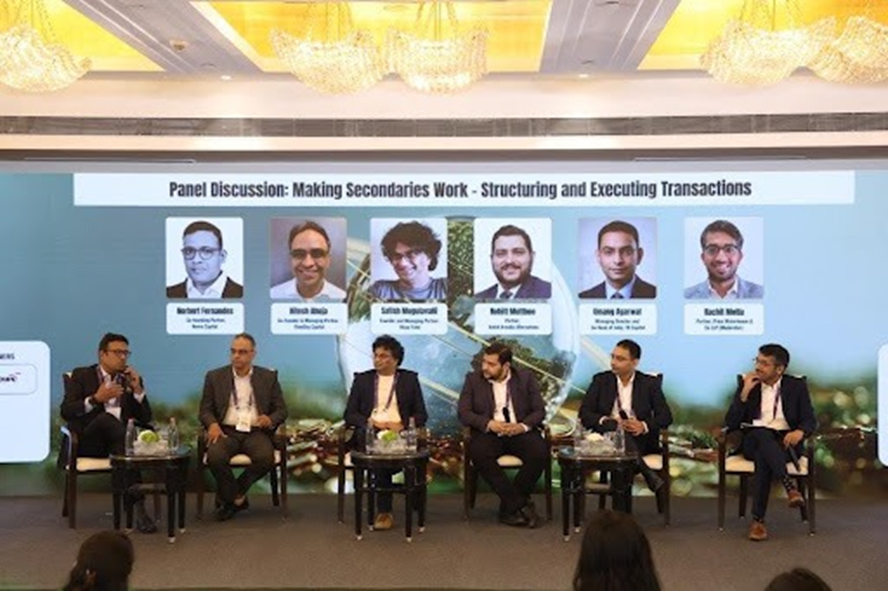
Mumbai : The Indian Venture and Alternate Capital Association (IVCA) today hosted the IVCA Secondaries Conference 2026 in Mumbai. Investors, fund managers, global experts, and industry participants gathered at the conference to deliberate on the evolving role of secondaries in India’s private markets, including on the structures and processes needed to facilitate secondary transactions and strengthen liquidity in the private capital ecosystem.
The panel discussion, “Making Secondaries Work: Structuring and Executing Transactions,” focused on the practical aspects of executing secondary deals in India, including transaction structuring, regulatory requirements, cross-border considerations and the allocation of transaction costs.
The session featured Norbert Fernandes, Co-Founding Partner, Kenro Capital; Hitesh Ahuja, Co-Founder and Managing Partner, PixelSky Capital; Satish Mugulavalli, Founder and Managing Partner, Hissa Fund; Rohitt Mutthoo, Partner, Ambit Arcadia Alternatives; and Umang Agarwal, Managing Director and Co-Head of India, TR Capital. The discussion was moderated by Rachit Motla, Partner, Price Waterhouse & Co LLP.
India recorded 305 secondary exit transactions between 2020 and August 2026, with annual transaction volumes increasing from 53 in 2024 to 58 in 2025. While the average transaction value stood at approximately $69 million in 2025, compared to $126 million in 2024, activity across different secondary structures continues to warrant attention. Notably, at least $1.78 billion in transaction value was reported across six India-focused continuation vehicle transactions with disclosed values, alongside one additional transaction for which the value was not disclosed.
As secondary transactions gain traction in India, attention is increasingly turning to the practical aspects of deal execution, including regulatory compliance, transaction structuring and pricing. The panel examined how AIF requirements, FEMA pricing rules and cross-border considerations influence transaction structures, alongside the need to manage potential conflicts of interest and protect investor interests, particularly in GP-led transactions.
Emphasising the importance of governance and transparency in GP-led transactions, Norbert Fernandes, Co-Founding Partner, Kenro Capital, said, “In GP-led continuation vehicle transactions, independent decision-making and strong governance are critical, particularly since the GP is involved on both sides of the transaction. This requires independent decision-making mechanisms for the selling and buying entities, including the involvement of external LPAC members. Recent third-party pricing benchmarks, where available, can also help establish a credible basis for valuation. Equally important is giving existing LPs the choice to exit, roll over their entire investment or retain a partial stake in the new vehicle. Together, these measures help address valuation differences and ensure greater transparency throughout the transaction process.”
The conversation also covered the commercial and operational aspects of secondary transactions, including the allocation of management fees, carried interest, transaction costs, and tax liabilities. Panellists discussed the importance of aligning the interests of selling investors, incoming buyers, and fund managers, while managing investor consent, transfer restrictions, and contractual rights.
Speaking on the capital and execution requirements of India’s emerging secondary market, Hitesh Ahuja, Co-Founder and Managing Partner, PixelSky Capital, said, “India’s secondary market is taking shape, both in capital formation and the range of liquidity solutions available. The committed capital represented across the two panels at this year’s conference has crossed US$1 billion, with approximately 10 dedicated funds focused on this strategy, reflecting the market’s progress. At PixelSky, we evaluate Tier 1 and Tier 2 assets with the same rigour as primary investments, often within significantly shorter timelines. With return expectations of 25–30% IRR, similar to those for private equity asset classes, and increasing competition for quality assets, execution speed matters. However, speed cannot come at the expense of due diligence, making the quality of data rooms critical. Greater regulatory flexibility for single-asset investment vehicles and more efficient transaction processes will be important to developing a deeper secondary market in India.”
The discussions underscored the importance of addressing regulatory and execution-related complexities as India’s secondary market develops. Greater clarity around transaction structures, stronger governance and valuation practices, and more efficient execution processes will be important in enabling secondary transactions to become a more established source of liquidity for India’s private capital ecosystem.
The IVCA Secondaries Conference 2026 was supported by 360 ONE Asset, Gaja Capital, and Foundation Private Equity as Gold Partners; Blume and Oister Global as Silver Partners; and Kirkland & Ellis and Price Waterhouse & Co LLP as Knowledge Partners.
****