


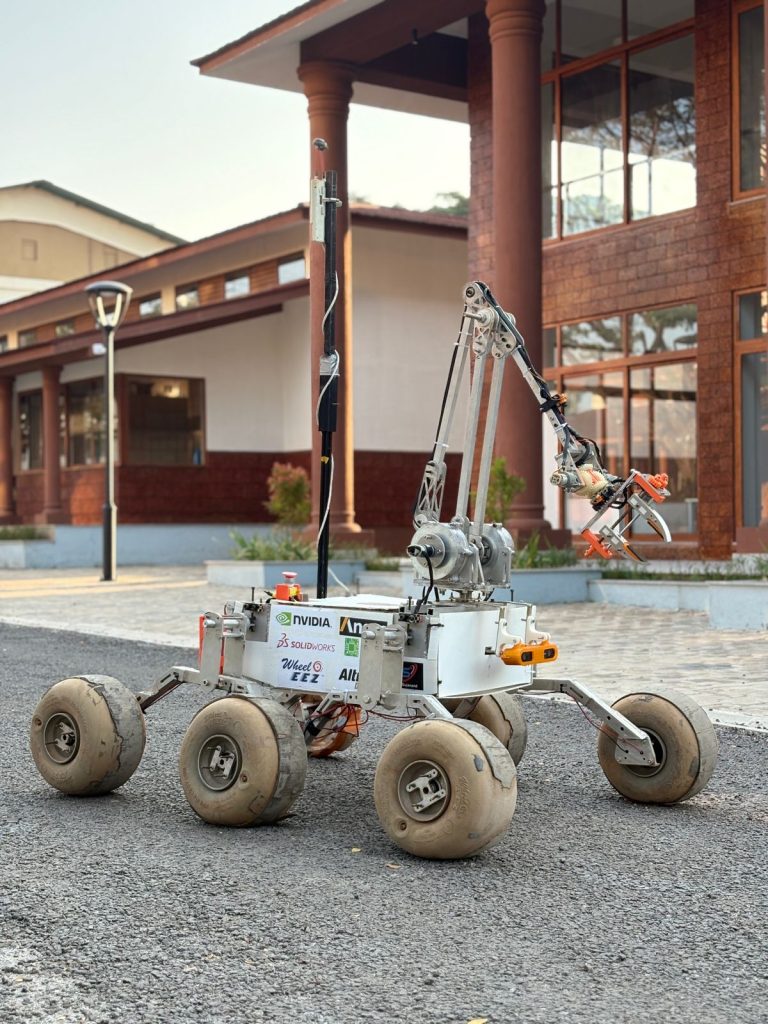
Manipal: Manipal Institute of Technology (MIT), Manipal, will host the International Rover Challenge (IRC) 2026 and the International Space Drone Challenge (ISDC) 2026 from January 28th to February 2nd, 2026. Organised by the Space Robotics Society (SPROS), the on-site finals will take place at the MIT campus, bringing together talented student teams in space robotics from across the globe. The MIT campus will be transformed into a simulated Martian environment through a specially designed Mars-analogue terrain called “Sproscape.” On this terrain, student-built rovers and aerial drones will carry out complex missions that closely resemble real-life space exploration tasks and astronaut-support operations on Mars.
Global Participation: After a rigorous multi-stage selection process, top-performing student teams from around the world have qualified for the on-site finals. International teams from Poland and Germany (TU Berlin) will compete alongside leading Indian institutions, including the Indian Institute of Science (IISc), IITs, BITS, VIT, SRM, and MIT. The event positions Manipal as a global hub for innovation and collaboration in space robotics.
Challenging Missions: IRC and ISDC are demanding engineering competitions that test students’ ability to design, build, and operate advanced space robotics systems. The missions include:
Reconnaissance & Delivery Operation (R&DO): Rovers navigate difficult terrain to locate targets and deliver payloads.
Astrobiology Expedition (ABEx): Rovers collect soil samples and analyse them to detect possible biosignatures.
Instrument Deployment & Maintenance Operation (IDMO): Rovers perform precision tasks on mock instrument panels, simulating servicing and maintenance work.
Autonomous Mission: Rovers traverse unstructured terrain independently without human intervention.
Speaking on the occasion, Dr (Cdr) Anil Rana, Director, MIT Manipal, said: “Hosting the International Rover Challenge and the International Space Drone Challenge reflects MIT’s commitment to hands-on, future-focused engineering education. These competitions provide students with a unique opportunity to apply classroom learning to real-world space exploration challenges, while also developing teamwork, leadership, and problem-solving skills that are essential for careers in advanced technology sectors.”