


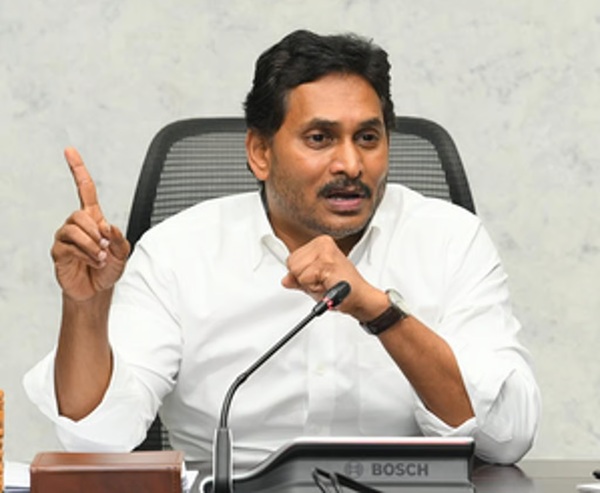
Amaravati/New Delhi: YSR Congress Party chief and former Andhra Pradesh Chief Minister YS Jagan Mohan Reddy’s public admission that his party “made a mistake” by supporting the 2023 law on appointing the Chief Election Commissioner and Election Commissioners has triggered sharp political counter-attacks and revived debate over the independence of India’s electoral institutions.
Speaking to the media on October 18 after meeting the State Election Commissioner, Jagan said the YSRCP had earlier backed the framework under which the ruling party at the Centre effectively dominates appointments. “Earlier, YSRCP supported this process of allowing the ruling party to make appointments. But today, we regret giving that support. We made a mistake,” he stated. He used a pointed analogy: “An examiner cannot be appointed by the student.” He urged the Centre to restore the three-member selection committee originally envisaged by the Supreme Court—comprising the Prime Minister, the Leader of the Opposition in the Lok Sabha, and the Chief Justice of India—and called for similar neutral mechanisms for State Election Commissioners so that chief ministers do not control their appointment.
The Chief Election Commissioner and Other Election Commissioners (Appointment, Conditions of Service and Term of Office) Act, 2023, replaced the Supreme Court’s March 2023 interim arrangement (PM, LoP and CJI) with a panel of the Prime Minister, a Union Cabinet Minister nominated by the Prime Minister, and the Lok Sabha Leader of the Opposition. This gives the government side a structural 2:1 majority. The YSRCP had supported the Bill in both Houses of Parliament when it was in power in Andhra Pradesh; only AIMIM’s Asaduddin Owaisi spoke against it in the Lok Sabha debate.
Jagan’s remarks came amid YSRCP allegations of intimidation, attacks on candidates and police interference during the nomination process for Andhra Pradesh’s local body elections (scheduled to begin around October 28). He also referenced an Indian Express investigation reporting that Election Commissioners Sukhbir Singh Sandhu and Vivek Joshi had formally objected at least 14 times over 10 months to decisions linked to the Special Intensive Revision of electoral rolls, Form 6 changes and database management under CEC Gyanesh Kumar—issues the Commission has described as normal deliberations whose outcomes were ultimately unanimous.
The political fallout was swift. Andhra Pradesh Chief Minister N. Chandrababu Naidu (TDP) accused Jagan of a convenient U-turn. “Earlier, you supported the procedure for appointing the CEC. But now, since the EC does not do what you say, you oppose it,” Naidu said at a press conference in Undavalli on October 19, also linking the comments to Jagan’s recent remarks on “Gen Z.” TDP leaders, including N. Vijay Kumar, described the shift as “political convenience” after electoral defeat and pointed to the previous YSRCP government’s own actions regarding the State Election Commission, including an ordinance targeting then-SEC N. Ramesh Kumar. BJP voices similarly questioned why the regret surfaced only now.
The episode underscores a recurring pattern in Indian politics: regional parties that extended issue-based support to central legislation when in power or alliance later reverse course after losing office. It also feeds into wider concerns about electoral-roll integrity, the Special Intensive Revision exercise, and public confidence in the Election Commission—concerns already amplified by Opposition campaigns on voter-list changes and internal Commission processes. While Jagan’s call for restoring the CJI to the selection panel aligns with long-standing critiques of the 2023 Act (itself under Supreme Court challenge), critics argue the timing—coinciding with local-election disputes in Andhra Pradesh—dilutes the force of the institutional argument.
Whether the statement marks a durable repositioning by the YSRCP or remains tactical will be tested in coming weeks as local polls proceed and national debates on electoral reforms continue. For now, it has sharpened the contest between the ruling TDP-led coalition and the YSRCP while placing the architecture of Election Commission appointments once again under political scrutiny.