


By Dr Abhilash, MD (Ayurveda), Former District Medical Officer
Kollam: The Kerala government’s decision to constitute a committee for drafting a separate AYUSH University Bill is being presented as progressive recognition of traditional systems of medicine. In reality, it risks systematically isolating Indian systems—particularly Ayurveda—from the mainstream academic, research and clinical ecosystem at the precise moment these systems are gaining genuine traction as primary, non-surgical therapies for chronic, lifestyle and degenerative conditions.
Ayurveda is no longer confined to the margins of complementary care. Across India and increasingly abroad, it is emerging as a first-line or sustained mainstay treatment for metabolic disorders, chronic pain, inflammatory conditions, stress-related illnesses, geriatric care and preventive health—domains where surgery is neither necessary nor desirable. Patients are turning to it not as a last resort but as a rational, time-tested alternative that addresses root causes rather than merely suppressing symptoms. This rising acceptance constitutes an emerging competitive challenge to sections of the modern medical establishment, the pharmaceutical industry, multi-specialty hospital chains and the high-volume diagnostic sector, all of which thrive on lifelong pharmacological dependence, repeated investigations and procedural interventions. Isolating Ayurveda into a small, under-resourced university would conveniently remove it from the shared platforms of peer scrutiny, joint research, student mobility and competitive funding—precisely the arenas where it could consolidate scientific legitimacy and expand its clinical footprint.
The move is structural, not merely administrative. By severing AYUSH from the Kerala University of Health Sciences (KUHS), the government would create a parallel, weaker institution for a handful of colleges—around two dozen AYUSH medical colleges in the state—while the far larger modern medical stream continues to enjoy the advantages of scale, infrastructure and political priority. The administrative overhead of a new Vice-Chancellor’s office, examination system, finance and IT machinery will consume scarce public resources that should instead be directed towards genuine research capacity. Teachers’ associations and professional bodies within the AYUSH sector itself have already pointed out that this demand never originated from them; it has been driven primarily by policy circles more closely aligned with modern medical administration.
Globally, the direction of travel is the opposite of isolation. Integrative medicine—defined by the World Health Organization in its Global Traditional Medicine Strategy 2025–2034 as an interdisciplinary, evidence-based approach combining biomedical and traditional knowledge—is one of the fastest-growing domains in healthcare. The global wellness economy has already reached $6.8 trillion and is projected to approach $9.8 trillion by 2029, with traditional and complementary medicine expected to grow at over 10 per cent annually. Leading centres in the United States (Cleveland Clinic, Harvard’s Osher Center, UCSF), Europe, Japan (Kampo under national insurance), China (state-supported TCM integration), South Korea and Brazil are embedding traditional systems into oncology support, chronic pain clinics, mental health programmes, lifestyle disease management and rehabilitation. BRICS nations have recently established a dedicated working group on Traditional, Complementary and Integrative Medicine under India’s chairmanship. The WHO strategy itself prioritises strengthening the evidence base, ensuring safety and quality, and integrating traditional systems into national health systems and Universal Health Coverage—not walling them off into separate, smaller silos.
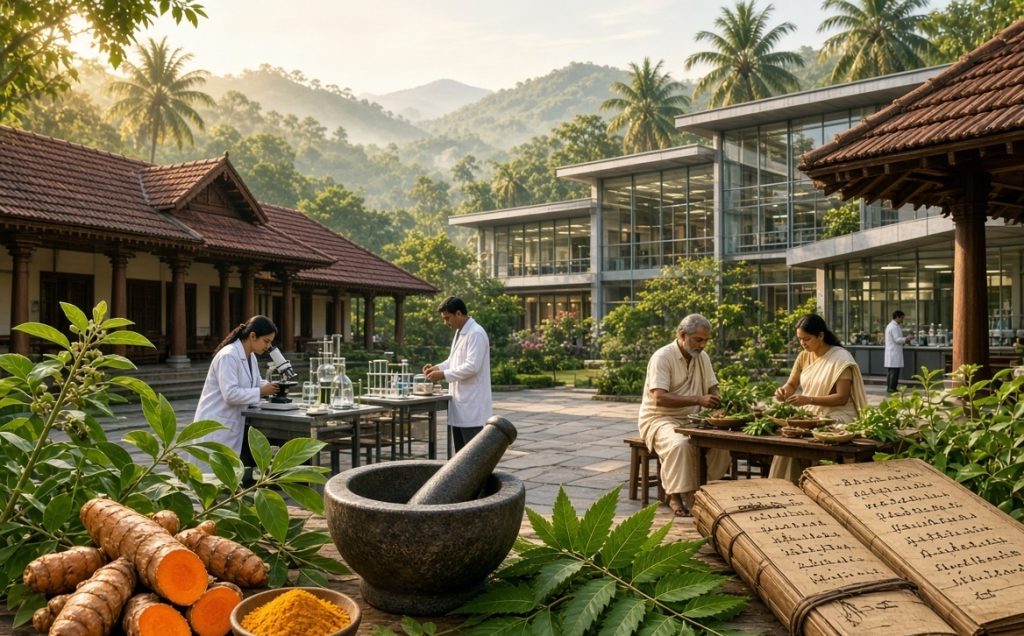
Kerala’s own International Research Institute of Ayurveda (IRIA) at Kalliad, Kannur, offers a far more promising path. Inaugurated in February 2026 by the Chief Minister, Phase I has been completed at a cost of approximately ₹200 crore on a 300-acre campus. It already houses a 100-bed research hospital and Model Patient Care Centre, a Manuscript Studies Centre focused on digitising and translating rare palm-leaf texts (with AI-assisted search capabilities), and a medicinal plant nursery and research facility. Its initial research thrust is directed at ageing and cancer—precisely the areas where integrative approaches hold the greatest clinical promise. Six specialised departments have been established, including Ayurvedic Biology and Translational Ayurveda, which apply genetics, cell biology and modern laboratory methods to classical principles. Collaborations are under discussion or development with CCRAS, CSIR, ICMR, the Rajiv Gandhi Centre for Biotechnology, NIIST and IISER; more than forty international institutions have expressed interest; and the Malabar Cancer Centre has signalled readiness for joint work in integrative oncology. A Japanese university has also indicated willingness for academic cooperation. IRIA’s stated vision—“Delineating Ayurveda; Redefining Health”—is exactly the evidence-generating, globally competitive research ecosystem that Ayurveda needs.
Yet instead of completing and adequately funding this institute, and instead of strengthening the School of Fundamental Research in Ayurveda (SFRA) at Tripunithura and the existing AYUSH faculty within KUHS, the government proposes to create another administrative structure—possibly even on the SFRA campus itself. The opportunity cost is clear: resources that could accelerate multi-centre clinical trials, phytochemical standardisation, AI-driven pattern recognition in classical texts, drug development pipelines, international fellowships and technology transfer will be diverted into bureaucratic replication.
National policy frameworks reinforce the same conclusion. The National Education Policy 2020 privileges multidisciplinary education and research. The National Health Policy 2017 calls for deeper integration of AYUSH into the public health system. The NCISM Act focuses on academic standards and research excellence without recommending separate universities. India’s broader health sciences university model—followed in Karnataka, Maharashtra, Tamil Nadu, Andhra Pradesh and elsewhere—keeps modern medicine, dentistry, nursing, pharmacy and AYUSH under one institutional roof precisely to enable joint curricula, shared research platforms and student-teacher exchange.
Kerala’s greatest strength in Ayurveda has always been its living tradition of practice combined with a relatively advanced academic base. That advantage can be converted into global leadership only through rigorous research infrastructure, not through administrative separation. A separate AYUSH university will give the state another set of offices and a few more appointments. It will not give Ayurveda the laboratories, the interdisciplinary collaborations, the clinical trial capacity or the international visibility required to answer its critics with data and to meet the growing public demand for non-surgical, root-cause-oriented care. The choice before Kerala is therefore stark. It can pursue a short-sighted isolation that weakens the very system it claims to promote, or it can commit to a coherent policy of “One Health University—One Global Ayurveda Research Ecosystem”: strengthen KUHS and its AYUSH faculty, complete and expand IRIA, develop SFRA as a foundational research node, pursue an All India Institute of Ayurveda, and foster genuine integrative platforms. Anything less risks turning a living medical heritage into an administratively quarantined relic at the very moment the world is beginning to take it seriously.