


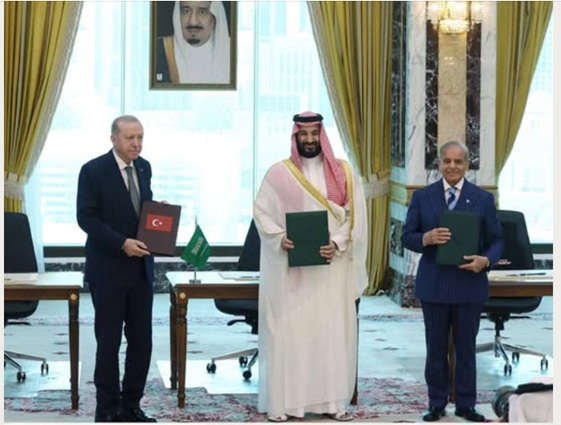
Dubai: In a significant realignment of regional security architecture, the leaders of Saudi Arabia, Türkiye and Pakistan on Friday signed a trilateral mutual defence agreement in the holy city of Mecca, declaring that an armed attack on any one of them would be treated as an attack on all three.
Saudi Crown Prince and Prime Minister Mohammed bin Salman, Turkish President Recep Tayyip Erdoğan and Pakistani Prime Minister Shehbaz Sharif formalised the Mecca Joint Defence Agreement at Al-Safa Palace following the Makkah Al-Mukarramah Summit for Joint Defence. The pact builds on a bilateral Strategic Mutual Defence Agreement concluded between Riyadh and Islamabad in September 2025 and extends a collective-defence commitment to include Ankara.
A joint statement issued after the summit stated that the agreement “is intended to strengthen collective deterrence against any act of aggression, and stipulates that any armed attack against any one of the three States shall be regarded as an attack against them all.” It further provides for the enhancement of defence cooperation across all domains, including coordination, training, technology and industry collaboration. Officials emphasised that the arrangement is purely defensive in nature, not directed against any specific country, remains open to other regional states, and does not replace existing bilateral or multilateral commitments.
The timing is deliberate. The agreement comes amid a wider regional conflict that erupted after US and Israeli strikes on Iran in late February 2026. Iranian forces and allied groups have since launched repeated missile and drone attacks on Saudi Arabia and other Gulf states, while disrupting shipping through the Strait of Hormuz and the Red Sea. Energy exports critical to the global economy have been threatened, and Gulf capitals have grown increasingly concerned about the reliability of traditional security guarantees.
The pact carries significant implications for the balance of power in the Middle East and beyond. By binding three of the Muslim world’s most consequential military and economic powers, it creates a formal collective-defence framework that strengthens deterrence against external aggression, particularly at a time when Saudi Arabia has faced direct attacks and energy infrastructure risks.
For Riyadh, the agreement diversifies its security architecture beyond primary reliance on the United States. It signals a pragmatic response to questions over the durability of American security guarantees while Gulf states absorb the costs of the ongoing Iran-related conflict. The inclusion of Türkiye’s large conventional forces and Pakistan’s nuclear-armed status adds layers of strategic weight that pure bilateral arrangements lacked.
Pakistan gains deeper embedding in Middle Eastern security structures. The deal reinforces Islamabad’s role as a key security partner for Gulf states and provides additional diplomatic and military leverage amid its own regional tensions. Analysts note that closer defence-industrial and training ties with both Saudi Arabia and Türkiye could yield tangible benefits in technology transfer, joint production and interoperability.
Türkiye expands its influence as a regional security actor and defence exporter. The pact opens avenues for greater military cooperation, joint exercises and industrial partnerships, complementing Ankara’s existing NATO membership while enhancing its independent regional posture. Turkish officials have highlighted opportunities in joint production, technology collaboration and greater military interoperability.
The agreement also carries broader geopolitical ripple effects. It presents a more cohesive Sunni-majority security front at a moment of heightened Iran-related instability, even as the signatories insist it is not a sectarian bloc. Iran has already reacted critically, with a lawmaker dismissing it as a “paper agreement” that would not deliver real security. India has stated it is closely monitoring the development, given Pakistan’s involvement and the potential shift in regional alignments. Some Israeli commentators have expressed concern over the emerging coordination among states that have taken critical positions on recent conflicts.
Maritime security is another area of potential impact. Both Pakistan and Türkiye have voiced support for Saudi-led efforts to protect shipping lanes, and the collective-defence clause could lend greater credibility to future coalition operations in the Red Sea and Gulf waters.
Despite the strong language, the full text of the agreement has not been made public. Specific obligations, consultation mechanisms, geographic scope and response thresholds remain unclear, leaving open the question of how quickly or decisively the “attack on one is an attack on all” principle would be activated. Previous bilateral arrangements have not always produced automatic military responses, and implementation will determine the pact’s practical value.
Symbolically, the choice of Mecca and the Friday timing underscore Islamic solidarity and historical ties. Practically, the deal marks one of the most consequential security arrangements among leading Muslim-majority states in recent decades. Whether it evolves into a durable deterrent, a platform for deeper military integration, or primarily a political signal will depend on subsequent steps and the trajectory of the wider regional conflict.
For now, Riyadh, Ankara and Islamabad have publicly committed to standing together against external aggression while deepening practical defence cooperation—an unmistakable statement of intent in a turbulent strategic environment.