


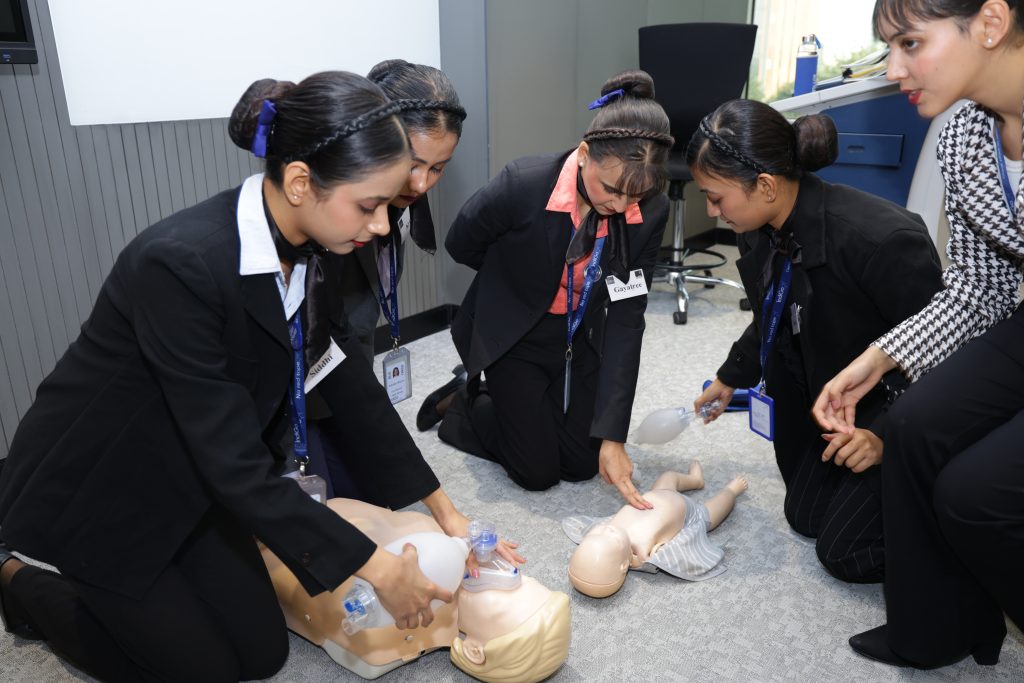
At 35,000 feet, the calm voice guiding passengers through turbulence, helping during a medical situation, or stepping in during a security concern may appear natural and effortless. In reality, these moments go far beyond just instinct. Each cabin crew goes through rigorous training and preparation to develop these qualities in themselves. On International Cabin Crew Day, here is a glimpse into the journey of becoming a cabin crew professional, where young individuals transform into confident professionals, capable of handling both people and pressure with ease.
Much More Than Service
Cabin crew are trained to be first responders, crowd management professionals, and crisis communicators, who also happen to serve customers.
Aviation is a highly regulated sector across the globe and like all other aspects, even the minimum standards for cabin crew are defined by the respective regulator(s) covering safety and emergency procedures, handling dangerous goods, first aid certification, and aviation security. These requirements exist because the consequences of unpreparedness at altitude can be irreversible. Yet airlines have consistently gone beyond compliance, recognising that technical readiness alone does not create a capable crew member.
What Training Really Looks Like
The training spanning a minimum of twelve weeks is structured around several disciplines. The foundation is laid by acquainting trainees with aviation regulations, aircraft systems, emergency equipment, and the legal and operational frameworks. This is followed by aircraft-type specific training, where crew are qualified on the aircraft they will operate.
Emergency preparedness is the most demanding component. They are trained to manage fires onboard, decompressions, medical events, evacuations, bomb threats, and hijack situations. They learn dangerous goods regulations, first aid for CPR, asthma attacks, panic episodes, epilepsy, and childbirth, and water evacuation and survival, including deployment of raft and other survival equipment. This training does not happen in classrooms alone. It is delivered through mock aircraft cabins, firefighting drills, water survival exercises, and full slide evacuation practice. The goal is to ensure that in a crisis, responses are quick and natural.
Sheetal Rana, Lead Cabin Attendant with IndiGo, reflects on her training days at ifly, the learning academy of the airline. She says, “I thought the role was about service. I was amazed to learn that service is only a small part; we are trained to step up when it matters most, which may be in any kind of situation. We shoulder a lot of responsibility when we step into that aircraft.”
Trainees at ifly undergo assessments benchmarked significantly above the regulatory minimum standards and must complete supervised familiarisation flights before they are rostered as operational crew.
The high intensity of simulation-based trainings is by design. Neha Pancholi, another cabin crew member at IndiGo describes her first firefighting drill: “The cabin was filled with smoke, instructions were rapid, and we had to act instantly. It was intense. But it taught me how to stay focused under pressure.”
The Human Factor: Communication, Empathy, and Presence
Emotional intelligence, communication, and composed presence are central to cabin safety. Cabin crew interact with passengers from different backgrounds, sometimes even in stressful situations. Training in active listening, cultural sensitivity, inclusive language, and tone of voice ensures that interactions are handled with both professionalism and warmth. At IndiGo this approach is described as “Service from the Heart”, where genuine care is treated as a professional skill that is practised and perfected. Trainees practise on real-world case studies: managing a nervous first-time flyer, assisting an elderly passenger, handling a complaint with grace while under operational pressure and a lot more.
Imtinaro Jamir, Lead Cabin Attendant, IndiGo recalls, “During training, we’re taught structured ways to handle difficult situations — starting with listening and acknowledging the passenger’s concern, then responding with empathy before moving towards a solution. These techniques help us manage our own emotions and stay calm, even when someone is frustrated or overwhelmed. We also learn to ‘bury the no’, so instead of focusing on what we can’t do, we try and guide the conversation towards what we can do to help.”
A Journey of Transformation
Many who enter training programmes have limited professional experience and no prior exposure to high-pressure environments. Many begin with hesitation in engaging with unfamiliar people. Gradually, they learn to read emotions, understand unspoken cues, and respond with empathy. The training journey simultaneously builds technical competence, professional identity, and psychological readiness. The poise, posture, tone, and presence that passengers experience are rigorously cultivated through coaching, feedback, and practice.
Learning Never Stops
Aviation regulators mandate annual training to ensure that skills and emergency responses remain sharp and updated. If a crew member is away from flying for a long period, they must retrain before returning.
At IndiGo, every crew member returns each year for formal reassessment across safety procedures, first aid, communication, and service delivery. This commitment to continuous readiness is an acknowledgement that in aviation, there is no margin for a skill to weaken.
Recognising the Effort Behind the Ease
International Cabin Crew Day is a reminder that the calmness and confidence that customers see onboard come from months of preparation, repeated practice, and internalisation of standards that leave no room for error.
Behind every reassuring smile is a professional who can lead in moments of unpredictability, ensuring that every journey remains safe and comfortable.