


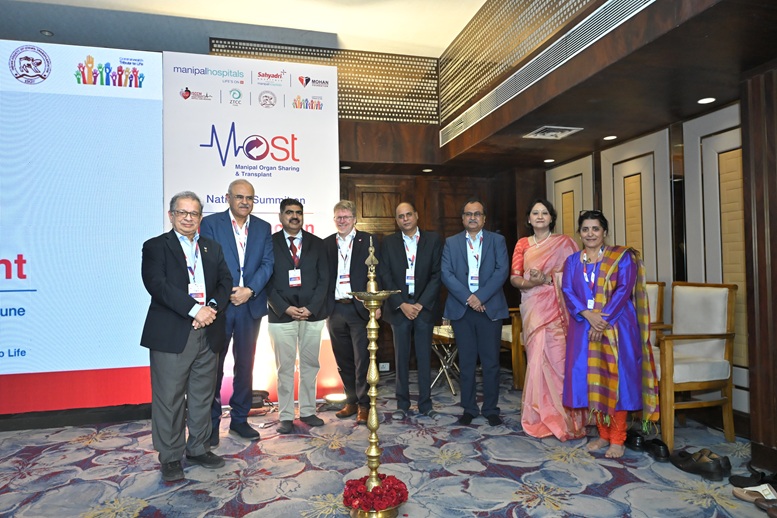
Pune : Manipal Organ Sharing & Transplant (MOST) hosted the National Summit on Excellence in Organ Donation & Transplant on November 20 and 21, 2026, in Pune. The summit was organised in association with MOHAN Foundation, ZTCC Pune, ISCCM, ISOT and Commonwealth Tribute to Life. The two-day summit brought together transplant specialists, policymakers and international experts from India, the UK and the US. The discussions focused on developments in organ donation, challenges in transplantation and ways to strengthen India’s transplant ecosystem.
The need to expand organ donation in India was an important focus of the discussions. According to data shared by the Ministry of Health and Family Welfare, India performed 20,019 organ transplants in 2025. However, as of March 3, 2026, 89,839 people were on the national waitlist for major organ transplants. The figures highlight the continuing gap between the need for organs and their availability, and the importance of strengthening deceased organ donation alongside living donation.
The summit featured discussions on Donation after Circulatory Death (DCD), Normothermic Regional Perfusion (NRP), Donation after Brain Death (DBD), withdrawal of life-sustaining treatment (WLST), quality assessment and ethical considerations. Experts from India, the UK and the US shared experiences from their respective transplant programmes, with a focus on how international practices could be adapted to the Indian healthcare system.
Dr. (Col) Avnish Seth, VSM, Country Head, Manipal Organ Donation and Transplant, said, “India has thus far focussed on organ donation after brain death and made slow but steady progress over the years. The availability of donated organs continues to be a major challenge. Donation after Circulatory Death (DCD) is the way forward but the issue is that unlike in brain death, here the heart has stopped so there is no circulation to organs. One has to move quickly to restart circulation after 5 minutes of death, a process called Normothermic Regional Perfusion (NRP). Manipal Health Enterprise carried out the first successful NRP in the country recently and there is a need to spread this technology across the country.”
A key area of discussion was the potential of DCD to increase the availability of organs for transplantation. While India has established practices for organ donation following brain-stem death, DCD gives another pathway that is being used in several countries. The sessions examined international experience, donor and recipient selection criteria, the role of transplant coordinators and the clinical and ethical considerations involved in introducing and expanding these practices. Discussions on NRP also covered its role in organ preservation and the experience of programmes in the UK and the US.
Globally, DCD is an established part of deceased organ donation programmes. The Global Observatory on Donation and Transplantation reported that DCD accounted for 28% of deceased donation activity worldwide in 2024. Sharing the UK experience at the summit, Dr. Dale Gardiner, Medical Director, Deceased Organ Donation, NHSBT, Nottingham University Hospital NHS Trust, UK, said,
“Donation after Circulatory Death has become an important part of organ donation programmes in several countries. Its development depends on clear clinical protocols, careful donor assessment, strong coordination and public trust. Sharing experiences between countries is valuable because it helps healthcare teams understand both the opportunities and the practical challenges involved. The discussions at MOST provide an opportunity to exchange this experience and consider how established practices can inform the development of organ donation in India.”
The summit also focused on improving quality across the organ donation process. A dedicated session brought together perspectives from the UK and India on quality assessment, including the importance of identifying potential donors, evaluating suitability, coordinating organ retrieval and ensuring that organs are allocated and transplanted through established processes. The discussions highlighted the need for consistent practices, documentation, monitoring and coordination among hospitals and organ donation networks.
Dr. Anil Kumar, Director, National Organ and Tissue Transplant Organisation (NOTTO), said, “India’s transplant programme has grown over the years, but the demand for organs continues to be much higher than their availability. Strengthening the deceased organ donation programme requires coordinated efforts by hospitals, transplant teams, State and Regional Organ and Tissue Transplant Organisations and the public. It is equally important to improve awareness, follow established protocols and make people aware of the support available through government schemes. Platforms such as MOST help bring different stakeholders together to discuss these priorities and work towards improving access to transplantation.”
Making transplantation more affordable and accessible was another important part of the summit. A dedicated session discussed government schemes that support patients undergoing transplantation, along with the role of fundraising initiatives in helping patients meet treatment costs. Experts also discussed the need for better awareness of available support and stronger coordination to help patients access timely treatment.
Mr. Saghir Siddiqui, Regional Director – West Region, Manipal Hospitals, said, “Organ donation and transplantation require the combined efforts of healthcare institutions, medical teams, government organisations and the community. While clinical expertise and infrastructure are important, coordination and awareness are equally necessary to strengthen the system. Through initiatives such as MOST, we aim to bring stakeholders together, encourage the sharing of knowledge and contribute to improving access to quality transplant care. It is important that these discussions translate into stronger systems and better support for patients who need transplantation.”
The scientific programme also covered transplantation across the liver, kidney, pancreas, heart and lungs. Sessions included clinical experiences in DBD and DCD transplantation, donor and recipient selection, challenges in multi-organ transplantation and the role of transplant teams in improving outcomes. Experts also discussed the use of artificial intelligence in transplantation and ethical considerations around end-of-life care and organ donation.
The National Summit on Excellence in Organ Donation & Transplant brought together clinical expertise, policy perspectives and international experience on a common platform. The discussions reinforced the need for continued collaboration, stronger quality processes and wider awareness to support the growth of organ donation and transplantation in India.
As part of the summit, Manipal Hospital Baner also hosted a demonstration on Normothermic Regional Perfusion (NRP) for Donation after Circulatory Death (DCD) on November 20. The session included two case scenarios demonstrating the use of NRP in the ICU and the operation theatre. The programme began with welcome addresses by Dr Sonal Dixit, Regional Head Medical Services, North, and Dr Sunil Rao, Regional Head Medical Services, North-West. The demonstrations brought together experts from India, the UK and the US, including Dr (Col) Avnish Seth, VSM, Country Head, MOST, and specialist teams from Manipal Hospital Delhi and Baner. The event also saw the unveiling of ‘The Tree of Life – A Tribute to Our Organ Donors’, an installation displaying the names of organ donors as a mark of respect and gratitude for their contribution in saving lives.
*****