


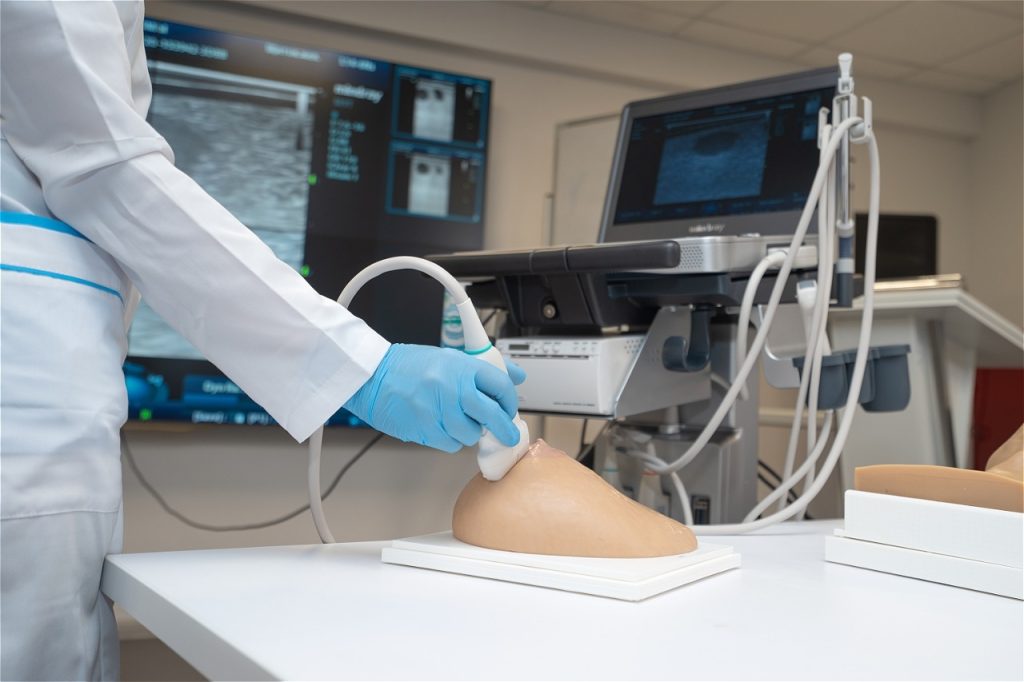
Moscow’s healthcare system continues to strengthen a key priority: early cancer diagnosis. In addition to upgrading diagnostic equipment, the city is investing in specialist training. Recently, Moscow oncologists began practicing ultrasound‑guided trephine biopsy using next‑generation phantoms that can recover after multiple punctures.
Core biopsy is one of the most informative methods for tumour diagnosis. Unlike screening modalities such as ultrasound or mammography, which detect suspicious findings, biopsy provides histopathological confirmation of a lesion’s nature. The procedure involves obtaining a tissue sample with a biopsy needle under ultrasound guidance and submitting it for laboratory analysis. Precision during the procedure is critical: a deviation of even a few millimeters may compromise the diagnostic yield of the sample. Consequently, practical, hands‑on training is critical for maintaining and improving clinician performance.
To address this need, the Personnel Center of the Moscow Healthcare Department has launched a specialized training course, “Ultrasound-Guided Breast Trephine Biopsy.” The curriculum follows a progressive, stepwise structure – from theory to intensive hands-on practice, enabling trainees to practice standard and complex clinical scenarios.
“The course comprises theoretical and practical modules. Participants will refine their knowledge of pre-procedural preparation and biopsy execution. The training is intended for general oncologists, specialists in breast cancer diagnosis and treatment, and physicians working in outpatient oncology care centers,” stated Anastasia Kamasheva, Director of the Personnel Center.
A central component of the training is the use of realistic medical phantoms developed by the Center for Diagnostic and Telemedicine. These models mimic a range of lesions, including cysts and solid tumors, enabling trainees to practice needle placement and concurrently improve their sonographic image interpretation.
“The phantoms were developed on the principle ‘by doctors for doctors,’ reflecting real‑world clinical needs,” said Yuri Vasiliev, Chief Officer of Radiology at the Moscow Health Care Department and Medical Director of the Center for Diagnostic and Telemedicine. “They support differential diagnosis and ultrasound‑guided biopsy. The use of advanced, high-durability materials ensures wear resistance and structural recovery after multiple punctures, while accurately reproducing clinical scenarios. This technology results from extensive scientific research and has proven its utility in practice.”
Materials for the phantoms were selected to mimic ultrasound acoustic properties, so training conditions closely resemble examinations of real patients. Unlike earlier simulators that lost shape and usability after a few punctures, the new self‑healing models retain functionality after repeated use. The Personnel Center has approximately 100 such simulators available for courses.
During training sessions, participants complete all procedural stages: lesion visualization, selection of needle trajectory, puncture technique, and sample collection. Repeated practice aims to build procedural confidence and improve sampling accuracy.
The program is already active: several dozen specialists have completed the course, and the target is to train over 300 oncologists. Enhanced educational practices are expected to improve care quality by reducing diagnostic delays, lowering the need for repeat procedures, and accelerating initiation of treatment – critical benefits in oncology where time to diagnosis influences outcomes.
Moscow continues to systematically expand its oncology care infrastructure, from screening programs to advanced therapeutics. Within this framework, ongoing specialist training is recognized as a foundational component for improving diagnostic accuracy and treatment outcomes.