


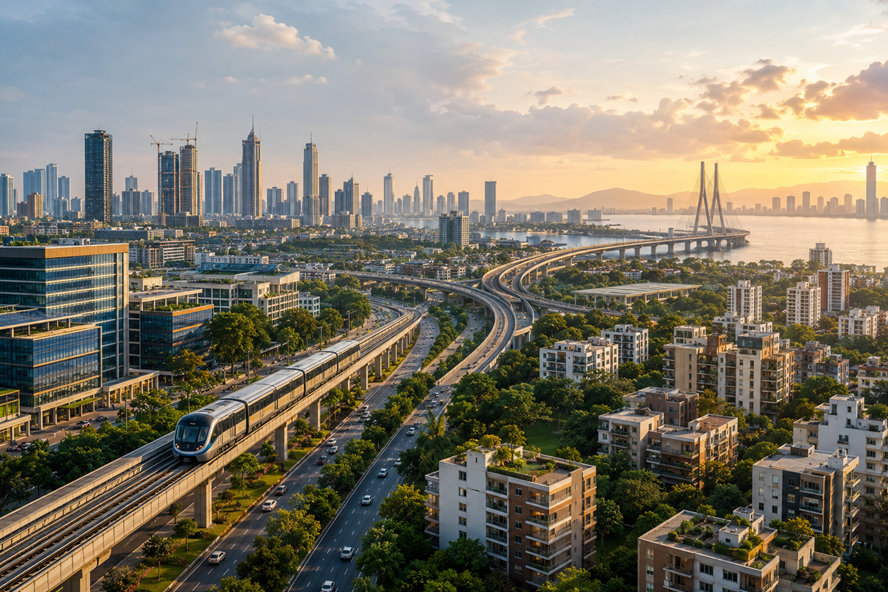
Mumbai’s growth is no longer about a single, island‑centric story but the multi‑pronged expansion that has been propelled by distinct micro‑markets. The city’s emerging growth corridors are spread across diverse micro-markets. From Mulund’s balanced liveability and Thane’s commercial momentum to Mira Road’s affordability and the Sion-Matunga corridor’s redevelopment phase, each neighbourhood is ready for the next phase of growth.
Transportation upgrades, targeted infra spend and changing employer footprints are patterns that are contributing to the economics and value propositions of these emerging growth corridors. As major infrastructure projects improve connectivity across the Mumbai Metropolitan Region (MMR), a new generation of residential and commercial corridors is taking shape. The most notable of Mumbai’s next phase of growth is a decentralised urban landscape where individual micro-markets are evolving into self-sustaining destinations. The expansion of Mumbai’s infrastructure is set to transform the city’s real estate landscape.
The broader market data backs this shift. ANAROCK’s Residential Market Viewpoints Q2 2026 report reveals that the average residential price across the Mumbai Metropolitan Region (MMR) rose to Rs 17,780 per sq ft during Q2 of 2026, marking a 4 per cent increase year-on-year. The report also noted that MMR dominates India’s residential market, with growth increasingly being driven by emerging micro-markets rather than being limited to the city’s traditional business districts.
The Metro network will eventually span over 100 kilometres, complemented by the Coastal Road, the Mumbai Trans Harbour Link (MTHL) and several new road corridors. Together, these developments are influencing how both homebuyers and businesses evaluate locations. The focus has increasingly shifted from established addresses to neighbourhoods that combine accessibility, employment opportunities, social infrastructure and long-term liveability.
The changing preferences are also reflected in market activity. The ANAROCK report found that MMR retained its position as India’s largest residential market during the quarter, as it remained the highest among the major markets, with close to 28,700 units sold during the quarter, accounting for around 32 per cent of total residential sales in India.
Mulund is among the micro-markets that has benefitted from this intra-led transformation, with its sustained infrastructure development and an established civic ecosystem continuing to support residential demand.
Chintan Sheth, Chairman and Managing Director, Sheth Realty, said, “Mulund has steadily evolved into one of Mumbai’s most promising growth corridors, driven by robust infrastructure, excellent connectivity and a well-established social ecosystem. What sets the micro-market apart is its ability to balance urban development with a high quality of life. As homebuyers increasingly seek locations that offer long-term value alongside everyday convenience, Mulund continues to emerge as a preferred residential destination, shaping the next phase of Mumbai’s growth story.”
Most developers believe that similar trends are visible across the wider metropolitan region, with each micro-market being shaped by a different combination of economic activity, infrastructure and housing demand. Nishant Deshmukh, Founder and Managing Partner, Sugee Group, said, “Mumbai’s growth story is no longer defined by a single business district. Today, multiple micro-markets are emerging as independent economic and residential hubs, each driven by a distinct mix of infrastructure, connectivity, employment, and lifestyle.”
Pointing to Thane’s changing profile, he explained, “Thane is a strong example of this transformation. While it has firmly established itself as a residential destination, its commercial ecosystem is now evolving to match that momentum, with a growing demand for quality Grade A office spaces reflecting the city’s next phase of business growth. As these growth corridors mature, the integration of high-quality commercial developments will be critical in creating self-sustained urban centres that support both businesses and residents.”
Along the western corridor, Mira Road has managed to sustain interest backed by connectivity improvements and relatively affordable pricing. The micro-market continues to attract both end-users and investors. Aditya N. Shah, Director at Mayfair Housing, revealed, “Mira Road has evolved into one of the most compelling residential and investment destinations in the Mumbai Metropolitan Region. With its strategic location in the western corridor and rapidly improving infrastructure, Mira Road is well-positioned for sustained long-term growth.”
Shah feels that “As Mumbai expands beyond its traditional hubs, Mira Road offers a compelling combination of affordability, accessibility, and long-term appreciation potential. With strong demand fundamentals and sustained infrastructure-led growth, it is well-positioned to be one of the most promising residential growth corridors in the Mumbai Metropolitan Region.”
Meanwhile, central Mumbai has continued to retain its relevance as redevelopment has led to the unlocking of housing supply in established neighbourhoods. Rajendra M. Rajan, Founder, TransIndia Group, said, “The Sion-Matunga corridor is emerging as one of Mumbai’s most compelling residential growth corridors because it brings together the advantages that today’s homebuyers value most—central connectivity, established social infrastructure and long-term livability.”
Giving weightage to how the Sion-Matunga belt benefitted from being established neighbourhoods, Rajan elaborated, “Unlike newer locations that are still developing their ecosystem, this micro-market offers the rare combination of heritage, strong community living and seamless access to the city’s key business districts through an extensive road, rail and Mumbai Monorail network. The neighbourhood is defined by enduring landmarks such as Five Gardens, Sion Fort, Sri Shanmukhananda Hall, Sion Circle and King’s Circle, all of which have shaped its rich cultural identity over decades. Equally important is the presence of sports clubs, recreational facilities and open green spaces that encourage an active, wellness-oriented lifestyle. With redevelopment introducing contemporary housing into this land-constrained neighbourhood, the corridor is entering a new phase of growth that strengthens its appeal among both end-users and long-term investors.”
The decentralisation of Mumbai’s commercial market has actually found pace as a result of a series of transport upgrades, encouraging businesses to expand beyond traditional central business districts. Gagan Mehta, Director, AGM Vijaylaxmi Group, opined, “Post-COVID, Mumbai has witnessed a shift from the traditional CBD-centric office and residential markets to a more decentralised growth model. With recent infrastructure upgrades improving connectivity from Mumbai’s suburbs to established commercial zones such as Lower Parel, BKC and South Mumbai – Metro Line 3, the Aqua Line, has been the biggest gamechanger for this shift, creating a direct underground link between the western suburbs and the city’s core business districts – Mumbai is witnessing the emergence of new office districts in the Andheri-Goregaon stretch.”
Mehta outlined, “The upcoming Versova-Bandra Sea Link will further ease access to Bandra and South Mumbai, by seamlessly connecting with the broader Coastal Road Network. This shift is unlocking newer residential and commercial markets whose growth is being propelled by professionals who are keen to live close to their place of work.”
Across the city, improving metro connectivity, the Mumbai Trans Harbour Link, and other transport networks are helping Mumbai in creating the new growth corridors as well.
“This, in turn, is leading to the emergence of premium localities that command significantly higher values than surrounding tertiary markets, driven by superior connectivity, convenience and a growing preference for a shorter commute. Goregaon East, where we operate, is a clear example of this shift already playing out — commercial and residential demand are rising together here, in a location once considered peripheral that is now being evaluated on the same terms as Mumbai’s established business districts,” Mehta highlighted.
Developers say Andheri continues to be among the strongest examples of how improved infrastructure can transform a location into a major commercial destination.
Rohit Garodia, Founder and Managing Partner, Pecan Realty, observed, “Andheri’s evolution as one of Mumbai’s strongest commercial growth corridors has been driven by a combination of strategic infrastructure investments and its central location. Enhanced metro connectivity, improved road networks and seamless access to the airport have significantly strengthened the suburb’s appeal for businesses seeking operational efficiency and workforce convenience.”
He added, “As companies increasingly prioritise accessibility, connectivity and a well-established business ecosystem over traditional business districts, Andheri continues to reinforce its position as a preferred destination for commercial real estate and an important contributor to Mumbai’s next phase of economic growth.”
Market confidence may be reflected in property values it commands, but they will not define the success of these emerging corridors. Their real achievement will be in becoming neighbourhoods where people can live, work and access essential services with ease. As that vision becomes a reality, these emerging corridors of Mumbai will play a defining role in shaping the city’s future.