


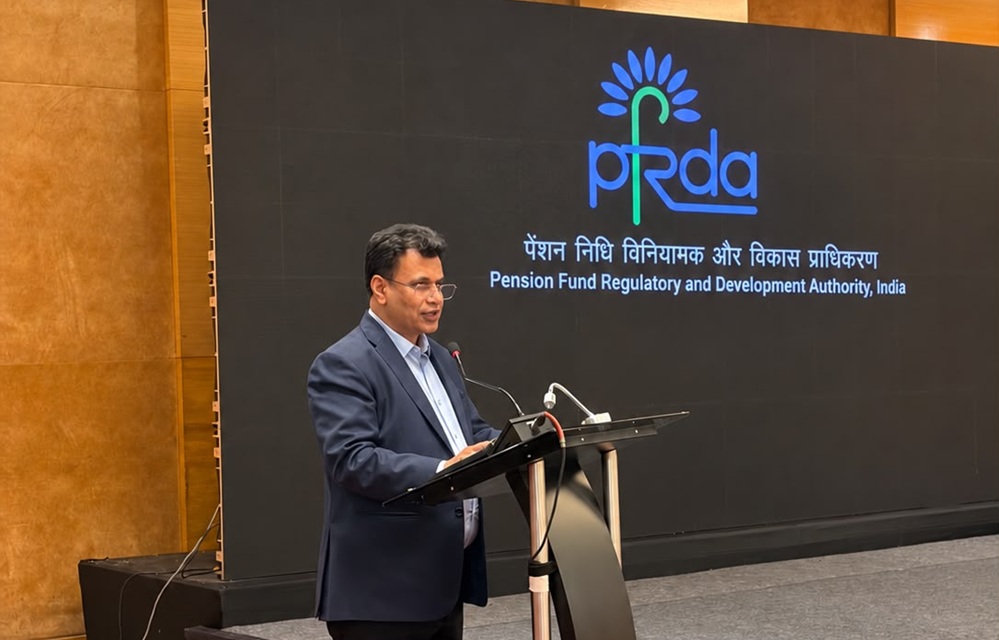
Pune : The Pension Fund Regulatory and Development Authority (PFRDA) is strengthening pension inclusion through new National Pension System (NPS) initiatives, simplified digital enrolment, awareness programmes and tools to support informed retirement planning. The initiatives aim to expand access to pension savings among government and private-sector employees, self-employed individuals, gig and platform workers, entrepreneurs, women and children.
India’s changing demographic profile reinforces the need for long-term retirement planning. The proportion of the population aged 60 and above is projected to rise from approximately 10% to 19.5% by 2050, while life expectancy at birth is expected to reach 75 years.
Shri Sanjay Pandey, Whole-Time Member (Finance), PFRDA, outlined these initiatives during a media interaction in Pune ahead of the Authority’s outreach programme on NPS and StAR NPS for mutual fund distributors.
“India’s pension landscape is evolving, and expanding coverage requires us to make pension products simpler to access, easier to understand and relevant to people across different stages of life. Through initiatives such as NPS Sanchay, Pension Sakhis, NPS Vatsalya and PRIDE-DISHA, we are working to strengthen both access and awareness. Our focus is not only on bringing more people into the pension ecosystem but also on helping subscribers make informed decisions and develop a long-term approach to retirement planning,” said Shri Pandey.
Pune’s growing contribution to pension savings
Across five key centres in Maharashtra – Pune, Mumbai, Thane, Nagpur and Raigad. Corporate NPS has 3,26,980 subscribers and ₹33,528 crore in assets under management (AUM). Pune leads these centres in subscriber numbers, while Mumbai records the highest AUM.
Corporate NPS: Regional data
| Centre | Subscribers | AUM |
| Pune | 1,13,036 | ₹9,107 crore |
| Mumbai | 1,01,913 | ₹13,380 crore |
| Thane | 70,782 | ₹6,566 crore |
| Nagpur | 21,441 | ₹2,195 crore |
| Raigad | 19,808 | ₹2,280 crore |
| Total | 3,26,980 | ₹33,528 crore |
The All Citizen NPS model, which enables eligible individuals to build retirement savings independently of employer-linked arrangements, has 4,71,796 subscribers and ₹12,929 crore in AUM across the same five centres.
All Citizen NPS: Regional data
| Centre | Subscribers | AUM |
| Mumbai | 1,68,539 | ₹6,118 crore |
| Pune | 1,40,518 | ₹3,064 crore |
| Thane | 95,531 | ₹2,568 crore |
| Nagpur | 37,740 | ₹534 crore |
| Raigad | 29,468 | ₹645 crore |
| Total | 4,71,796 | ₹12,929 crore |
Together, the two models account for 7,98,776 subscribers and ₹46,457 crore in AUM across these five centres. Pune contributes 2,53,554 subscribers and ₹12,171 crore in combined AUM.
NPS Sanchay and Pension Sakhis to expand access
NPS Sanchay targets gig and platform workers, self-employed individuals, entrepreneurs and MSME owners who may lack employer-linked retirement benefits. Tatkal NPS is designed to simplify digital onboarding through a three-click process. The framework outlined during the interaction includes an entry contribution of ₹250, UPI top-ups from ₹10 and a stated portfolio allocation of 25% to equity.
PFRDA is working with UPI agents to widen access. It has also signed an MoU with the Ministry of Rural Development to promote enrolment through Pension Sakhis, strengthening pension awareness and access among rural households and women.
Recalling the adoption of digital payments, Shri Pandey said, “You didn’t have to tell anybody how to operate UPI.” The same simplicity, he noted, is the principle behind NPS Sanchay.
NPS Vatsalya encourages early savings
NPS Vatsalya enables parents and guardians to open NPS accounts for minors, encouraging families to start long-term financial planning early. Parents, guardians and relatives can contribute, subject to scheme provisions, and the account transitions to the regular NPS framework when the subscriber reaches adulthood.
Across Pune, Mumbai, Thane, Nagpur and Nashik, NPS Vatsalya has 23,558 subscribers and approximately ₹50 crore in AUM. Pune leads the five centres in subscriber numbers.
NPS Vatsalya: Regional data
| Centre | Subscribers | AUM |
| Pune | 7,679 | ₹18 crore |
| Mumbai | 7,558 | ₹21 crore |
| Thane | 5,292 | ₹8 crore |
| Nagpur | 2,117 | ₹2 crore |
| Nashik | 912 | ₹1 crore |
| Total | 23,558 | ₹50 crore |
Retirement Income Scheme and PRIDE-DISHA
PFRDA is also developing options to help subscribers manage retirement savings after they stop working. The Retirement Income Scheme (RIS) is designed to allow eligible subscribers to remain invested during retirement, transitioning from accumulation to decumulation without further contributions.
Its two payout approaches are Systematic Payout Rate (SPR), which provides structured payouts based on a defined rate, and Systematic Unit Redemption (SUR), which involves redeeming a specified number of units. PFRDA has also outlined revised exit provisions allowing eligible non-government subscribers to withdraw up to 80% of their corpus as a lump sum, subject to applicable rules; government subscribers continue under the relevant 60:40 framework.
PRIDE-DISHA enables subscribers to compare historical net asset values across pension funds and schemes. Scheme risk meters further support understanding of investment risk. These tools aim to improve transparency and informed decision-making, although historical returns do not guarantee future performance.
Strengthening awareness and distribution
PFRDA is engaging mutual fund distributors through StAR NPS to broaden pension awareness and distribution. The Authority is also developing technology-enabled support and new offerings, including Pension Sahayak, an AI assistant designed to answer queries by text or voice in 22 languages, NPS Swasthya, an add-on health-cover offering, and NPS Central, a centralised onboarding platform under development.
Shri Pandey highlighted the need to improve awareness of PFRDA and pension products, particularly among younger people. Through simplified onboarding, community-level outreach, digital tools and distributor partnerships, PFRDA aims to make retirement planning more accessible across employment categories and stages of life.
****