


Chennai : In a continued push towards strengthening institutional arbitration and promoting technology-driven frameworks for Online Dispute Resolution, Presolv360 hosted The Online Dispute Resolution Summit: Technology and Institutional Arbitration in Chennai on November 17, 2026 Tuesday, the closed-door event brought together retired and sitting judges, former government officials and legal figures, and leading legal heads from the lending industry to deliberate on the future of dispute resolution in India.
The summit featured a plenary session with addresses from Hon’ble Mr. Justice Kannan Krishnamoorthy, Former Judge, Punjab and Haryana High Court and Madras High Court, who was the Chief Guest; Hon’ble Mr. Justice N. Anand Venkatesh, Judge, Madras High Court, who was the Guest of Honour; and Dr. T.K. Viswanathan, Former Law Secretary, Government of India, who was the Special Guest. It also included a panel discussion on Online Dispute Resolution for Lending Disputes.
Welcoming the gathering and setting the tone for the evening, Ms. Namita Shah, Co-Founder, Presolv360, said, “Why should dispute resolution be limited to places where there is a courtroom, a law firm or a metro city? It should reach people wherever their disputes exist, and that is what ODR has done. At Presolv360, our idea has never been to replace the human element in dispute resolution, but to advance it at scale.”
Delivering the Chief Guest address, Hon’ble Mr. Justice Kannan Krishnamoorthy remarked, “India does not suffer from a shortage of dispute resolution mechanisms. It suffers from a shortage of accessible, credible and scalable dispute resolution institutions. The NBFC sector presents perhaps one of the strongest cases for making ODR an integral part of our justice delivery system.” Concluding his address, he said, “The true measure of ODR is not the number of proceedings conducted digitally, but the number of lives and commercial relationships it helps put back to work.”
Guest of Honour Hon’ble Mr. Justice N. Anand Venkatesh suggested two steps to address the challenges facing arbitration in India. First, arbitrators must be properly trained, since arbitration requires a completely different mindset; Second, courts should accredit and recognize arbitral councils and institutions that maintain panels of reliable arbitrators, so that disputes can be referred to them directly.
Speaking as the Special Guest, Dr. T.K. Viswanathan said, “Technology is now taking us into the virtual reality, whether you like it or not if you can’t keep pace with technology, you can’t live if you depend upon legislation or government support, it may not be forthcoming immediately. Your private initiative will take the clue.”
The event also witnessed the launch of Presolv360’s Clause Analyser in the presence of these dignitaries. Presolv360’s Clause Analyser evaluates the clause, identifies potential legal and procedural risks, and provides an overall risk assessment. More importantly, it explains what the issue is, why it matters and what needs to change. The analyser also provides actionable recommendations, suggests the amendments required and generates a comprehensive recommended arbitration clause addressing key aspects of the arbitration Agreement. Though Clause Analyser is free and accessible to everyone on the website of Presolv360, it is one more step towards democratizing access to better arbitration clauses.
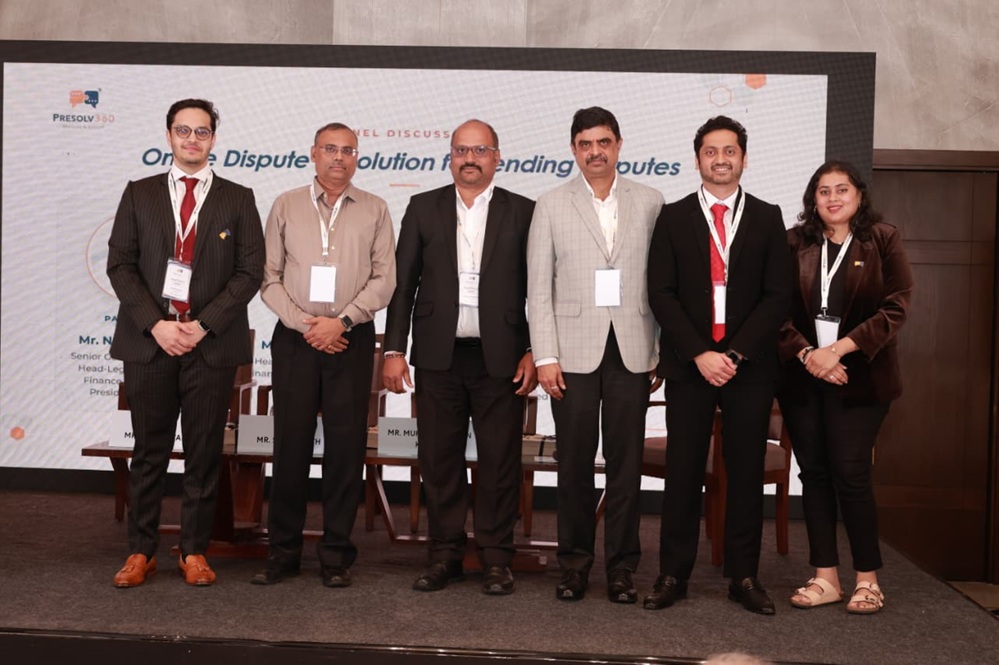
The plenary session was followed by a panel discussion on Online Dispute Resolution for Lending Disputes, moderated by Mr. Aman Sanghavi of Presolv360. The panel featured Mr. N. Narayanan, Senior General Manager & Head-Legal, Sundaram Finance Limited, Mr. S. Sreenath, Head-Legal, Consumer Finance Division, IndusInd Bank Limited; and Mr. Muppuri Naveen Kumar, Business Legal Head, TVS Credit Services Limited. The panel brought together legal heads from some of India’s leading lenders to discuss how ODR can help resolve high volumes of lending and recovery-related disputes efficiently, while preserving fairness and trust in the process.
***