


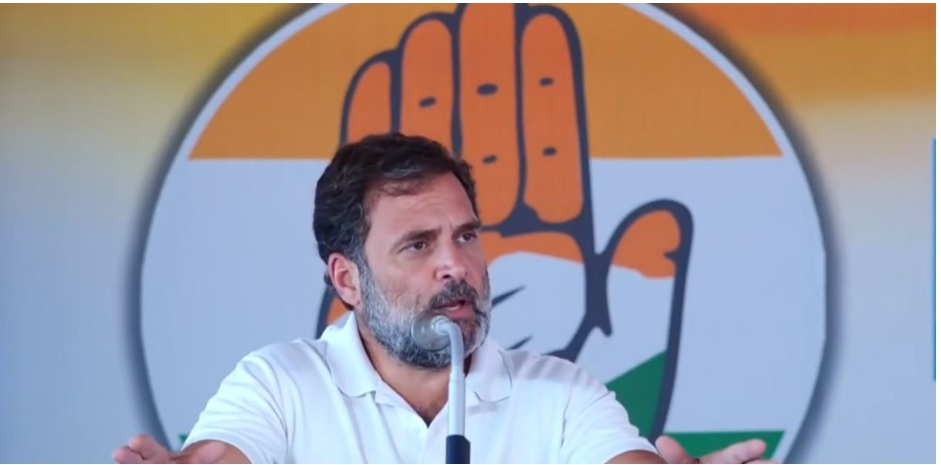
New Delhi: Leader of Opposition in the Lok Sabha Rahul Gandhi on Wednesday met a group of young protesters from different states and strongly condemned what he described as the non-stop harassment, threats and physical assault they faced during demonstrations against the education system. Addressing the media after the meeting, Gandhi said he was proud of the youngsters for defending the Constitution, the idea of India and the country’s future.
“We had a freewheeling conversation with some of the young protesters. They mentioned to me how they were assaulted, beaten, threatened,” Gandhi said. “I am very proud of them. I am very proud of what they have done, what thousands of young Indians like them have done. They have defended the Constitution. They have protected the idea of India; they have protected India’s future.”
He rejected any suggestion that the protesters needed to apologise. “You have done nothing wrong and the question of accepting your apology does not arise. You do not have to apologise to anybody,” he told them. Gandhi described the education system as “flawed… collapsing… useless” and said complaining about it or seeking an end to exam leaks was not a crime. He criticised the practice of sending “gundas” to the homes of protesters, including a 15-year-old girl, to force apologies and then accepting those apologies.
Several protesters shared their experiences. Riya Ahir, who said she had prevented the unlawful detention of 20 children in Mumbai, told the media that she was facing severe harassment and online abuse, including claims that she was selling her body. She said she had registered a crime on 27 July but had still not received a copy of the FIR. “Please change your narrative,” she said, adding that media and citizens had a responsibility to stand for one another.
Nutan Toppo from Jharkhand said she had been hit by a pellet gun during the Jantar Mantar protest. “I saw the gun pointed towards our side with my own eyes… I was fired at from behind,” she stated, rejecting claims that pellet guns were not used. Farah Naz, a graduation student from Uttar Pradesh, said police had beaten peaceful protesters chanting “Vande Mataram” and “Bharat Mata ki Jai,” kept her in a bus for three hours, and later labelled her anti-national because of her Muslim name. “Are we anti-national because we protested peacefully?” she asked.
Kumar Bharat Banait from Nagpur described 20 July as the “black day” of his life. He said he had helped put bleeding students into ambulances and witnessed severe brutality, including broken limbs and head injuries. Muskan Sharma said a male RAF officer had struck her with a baton in an inappropriate manner despite rules against hitting women on the thighs. She also noted that many assumed she was Muslim because of her first name and that the assumption itself fed an anti-national narrative.
Responding to questions, Gandhi said the young people standing before the press showed more courage than Home Minister Amit Shah or the Prime Minister. He held Shah directly responsible for the violence. “The person who is responsible for this violence… is Mr Amit Shah, he is the Home Minister of India,” Gandhi said. “Either he did not know… in which case he is incompetent. Or he ordered the shooting of the pellet gun… which means he is culpable. Either way, he is responsible.”
Gandhi ended by praising the protesters’ eloquence and courage under pressure, calling them exactly the kind of young people the country needs.