


From Our Special Correspondent
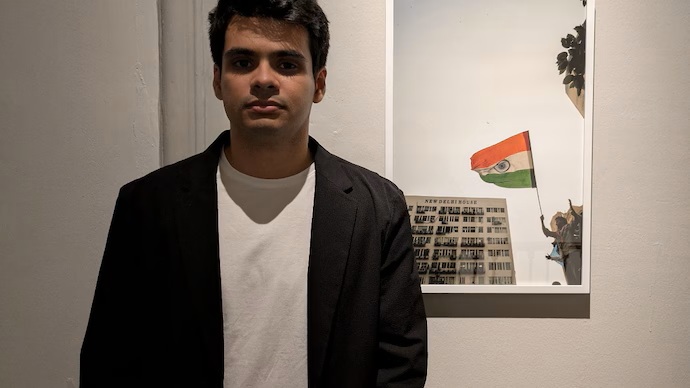
New Delhi: Until the afternoon of 22 October, Raihan Rajiv Vadra was a 25-year-old photographer whose name rarely left art circles. Son of Priyanka Gandhi Vadra and Robert Vadra, he had exhibited at Bikaner House before, focused on wildlife and abstracts, and stayed clear of politics. Hours before the opening of his solo show No Idea Is Final, the management of the Rajasthan government-run venue ordered 70 to 75 of his 105 photographs removed. The images showed peaceful youth demonstrations at Jantar Mantar. Authorities called them “political.” Two frames featuring the Tiranga were also targeted; Raihan refused to take them down. Staff later removed at least one in his absence. The show opened with blank walls and roughly 40 remaining pictures.
Nothing in the record suggests the exhibition would have registered beyond the venue. Raihan had submitted a layout earlier; no objection was raised then. The demand arrived only hours before the 7 pm opening, with the warning that the show would be cancelled if the photographs stayed. By the next morning he was a national news maker. The bureaucratic decision that was meant to keep “political” content off the walls had instead placed the empty walls on every news channel and website.
Priyanka Gandhi Vadra responded at once. She said authorities were trying to muzzle the voices of young creators. Former Rajasthan chief minister Ashok Gehlot went further. In a public statement he called the removal “a direct attack on democracy” and “a clear example of censorship.” He noted that Bikaner House is property of the Rajasthan government and that “a young artist’s creativity was stifled under the BJP government’s watch.” He added that a government rattled by photographs of youth movements was trying to conceal its own actions, and that Raihan’s refusal to remove images of the national flag showed “there can be no compromise when it comes to respecting the Tricolour.”
BJP spokespersons answered with the opposite reading. Gaurav Bhatia and CR Kesavan described the episode as a Gandhi-family attempt to “launch” Raihan. One remark on social media asked why there were not “other ways of launching” a son. The Bikaner House Management Society later said the photographs were inconsistent with its policy. The political argument, however, had already moved past the venue’s guidelines. The fact that the bulk of the exhibition was ordered down at the last moment, after earlier clearance, became the story. Critics pointed out that the same venue had hosted Raihan before without incident. The sudden purge of protest photographs, and the attempt to remove the flag images, looked less like routine administration and more like an over-correction that backfired.
The result is a classic self-goal. Had the photographs stayed, the exhibition would almost certainly have closed after its scheduled run with little national attention. The decision to empty most of the walls converted an obscure artist into a symbol of free-speech restriction under a BJP state government. The Modi government now finds itself answering charges of censorship that it did not need to invite. Opposition voices have used the empty frames to argue that the administration cannot tolerate even photographic records of peaceful dissent. BJP responses that reduce the episode to a “political launch” have kept the controversy alive rather than closed it.
Raihan has maintained he is an artist, not a politician. Educated at The Doon School and SOAS, he has described photography as his chosen path and has spoken of a cricket injury that left him blind in one eye and shaped his later work. None of that mattered until the bureaucracy intervened. In a single day the last-minute order turned a local gallery show into a national argument about what a government-run cultural space is allowed to display. The photographs that were removed are no longer on the walls. They are, instead, the reason Raihan Vadra’s name is now known far beyond the rooms where his remaining pictures still hang. The government is left explaining a controversy that would not have existed if the exhibition had simply been allowed to open as planned.