


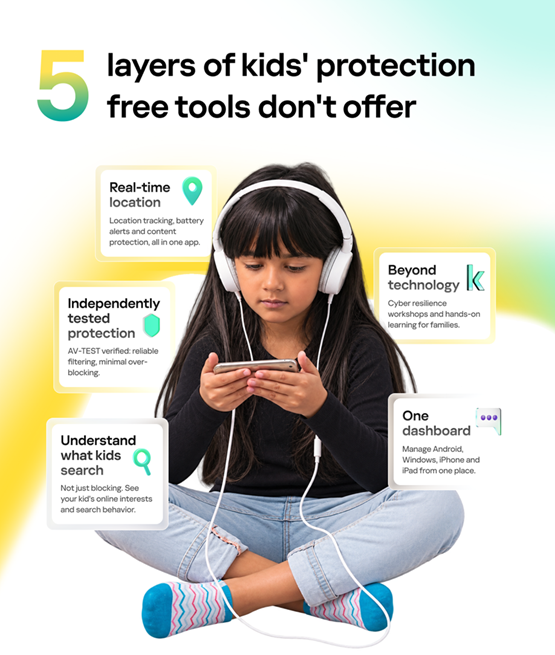
India : Indian children are growing up online earlier than any generation before them. School assignments, gaming, YouTube, and social applications are now a routine part of childhood. Many families already use free tools like Google Family Link or Apple Screen Time to manage this, and they do a reasonably good job for basic screen-time limits. But as children’s digital lives span multiple devices, platforms, and operating systems, some gaps are worth understanding before assuming one free tool has it fully covered. Here’s where Kaspersky Safe Kids closes five of them.
Cross-Platform, Single-Dashboard Oversight: For families juggling more than one device ecosystem
Google Family Link works best within the Android/Google ecosystem, and Apple Screen Time is built specifically for iOS. Both are strong within their own environment, but neither is designed to give parents one unified view when a household mixes an Android phone, a Windows laptop, and an iPad, which is common in Indian families. Kaspersky Safe Kids is built to work consistently across Windows, Android, and iOS from a single dashboard, so parents aren’t checking three different apps to get the full picture.
Independently Verified Filtering Accuracy: Filtering that’s been tested, not just claimed
Most parental control tools describe their own filtering as effective, but that’s rarely verified by an outside party. AV-TEST’s 2026 Parental Control evaluation independently tested Kaspersky Safe Kids and found it consistently effective at blocking child-inappropriate content across all three major platforms, with very low over-blocking, giving parents third-party evidence, not just a feature list to rely on.
Search-History Visibility, Not Just Search Blocking: Understanding what kids are curious about, not only stopping it
Free tools generally enforce SafeSearch as an on/off setting which is useful, but it tells parents little about what their child was actually searching for. Kaspersky’s Kids Report 2026, drawn from a year of anonymized data across Google and YouTube search behavior, reflects the kind of visibility Kaspersky Safe Kids gives parents directly – genuine insight into a child’s interests and curiosities over time, not just whether inappropriate content was blocked.
Real-Time Location Awareness Alongside Content Protection: One less app to manage
Some free tools separate location tracking into an entirely different app from content filtering, especially across mixed-device households. Kaspersky Safe Kids includes real-time location tracking and battery-level alerts in the same app that manages content and screen time. This means families with children commuting independently to school or tuition don’t need to juggle separate tools.
Family Digital Literacy Programs: Building judgment, not just relying on filters
This is where free tools generally stop entirely. Kaspersky runs workshops for parents and teachers across the region through its 2026 Kids Cyber Resilience Project. These sessions help children build lasting digital judgment. No app-based tool, free or paid, is designed to do this on its own.
Free tools like Family Link and Screen Time remain solid starting points, especially for single-platform households. But for families navigating multiple devices, wanting independently verified reliability, or looking to build lasting digital habits rather than just switching on a filter, Kaspersky Safe Kids is built to go a step further.
That commitment extends beyond software, too. Kaspersky has brought its Cyber Investigation Centre, a hands-on cybersecurity role-play experience for children to KidZania Mumbai and Delhi NCR, helping kids learn about phishing, identity theft, and online safety in a format built for them. As part of this partnership, Kaspersky is offering a 30-day free trial of Premium protection, up to 40% off, plus a complimentary one-year Safe Kids subscription worth ₹1,439, available at kaspersky.co.in.
****