


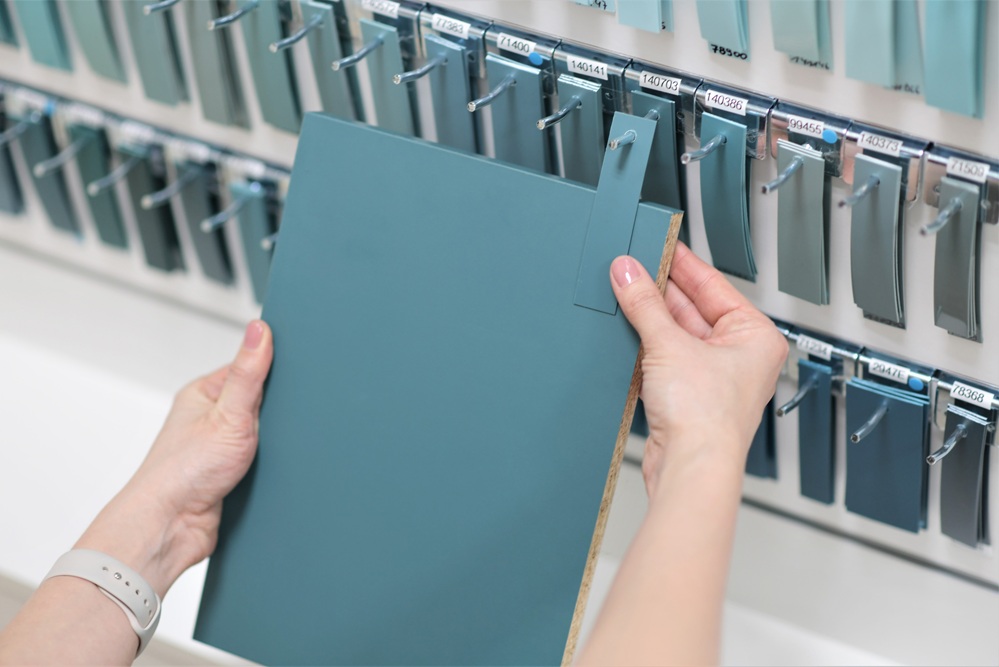
Selecting an edgeband for furniture has traditionally involved a fairly straightforward set of considerations i.e., colour, thickness, finish and price. As furniture design becomes more refined and usage expectations rise, the edge itself is demanding greater attention. REHAU has released a new application guide to help architects, interior designers, furniture manufacturers and other professionals select the right edgeband according to the furniture category, operating environment, manufacturing process and expected service life.
The guide addresses a practical gap in furniture specification: an edgeband that looks right on a sample may not necessarily be the right choice for every application. A kitchen edge encounters moisture, heat, cleaning and repeated handling. Wardrobes and storage systems see continual opening, closing and contact. Workstations face regular abrasion, while commercial and hospitality furniture can experience sustained daily use. The guide brings these differences into the selection process, placing greater emphasis on the conditions an edgeband has to withstand after the furniture leaves the factory.
“An edgeband is a relatively small component, but it sits at one of the most exposed points of a furniture panel. Its performance has a direct bearing on protection, appearance and the life of the finished furniture. The purpose of this guide is to help professionals make a more informed choice based on the application rather than treating edgebanding as a purely finishing decision,” said Tushar Verma, Executive Vice President, REHAU India & Subcon.
A key focus of the guide is the distinction between General Purpose Edgebands and High Performance Edgebands. While General Purpose Edgebands address generic requirements, High Performance Edgebands are engineered for applications where greater demands are placed on durability, precision, aesthetics and long-term performance. The distinction becomes particularly relevant for premium kitchens, luxury wardrobes, hospitality interiors, commercial workspaces, healthcare environments and other furniture exposed to sustained use.
The guide also looks at the technical factors behind edge performance. Material composition influences processing behaviour, colour consistency and the ability of an edge to withstand everyday stresses. PVC, ABS, PP and PMMA are among the materials used across furniture applications, with selection depending on the application, design requirement and manufacturing process. REHAU’s current portfolio spans standard and premium applications, including a standard collection of more than 1,200 colours and a select collection of 75 colours across ABS, PMMA, veneer, metallic and embossed formats. Its liner collection for carcass applications offers more than 50 colours.
Bonding is another critical consideration. The edgeband and panel function as a bonded system, making adhesion important to long-term joint integrity. REHAU’s PermaGrip™ Primer is engineered to support stronger bonding and reliable adhesion, while ProArc™ Technology uses a precision-engineered pre-tension to create a convex profile that supports conformity and controlled adhesive distribution. These characteristics can influence joint precision and glue-line visibility during processing.
Colour consistency receives similar attention in the guide. Trimming and machining can expose the internal structure of an edgeband, making full-depth colour consistency particularly important in premium furniture. SolidCore™ Composition uses high-quality resins and pigments without fillers to provide consistent colour through the depth of the material. A four-step printing process builds colour, pattern, texture and depth in controlled layers, supporting detailed and consistent décor reproduction.
Material formulation is also addressed as part of responsible specification. REHAU’s ToxFree™ Formulation is developed without lead, DOP, cadmium and mercury, bringing material composition into the wider evaluation of furniture components.
The guide also considers the relationship between edgeband selection and manufacturing. Machining, trimming, substrate preparation, adhesive compatibility and machine calibration can all influence the finished edge. This application-led approach allows manufacturers to consider the complete furniture assembly rather than evaluating the edgeband as an isolated component.
The release of the guide comes as REHAU continues to expand its edgeband manufacturing capabilities in India. The company’s Vadodara facility is described by REHAU as India’s largest edgeband facility and employs more than 200 skilled professionals. The plant incorporates a four-step printing process and forms part of REHAU’s wider German Engineering and manufacturing network. REHAU currently describes its broader edgeband offering as comprising more than 1,400 colours and designs, creating more than two million possible edge-surface combinations.
The application guide is intended to give professionals a practical framework for assessing an edgeband through the complete lifecycle of furniture from material selection and processing to everyday use and long-term appearance. The central premise is straightforward and that is the right edgeband should be selected according to the life the furniture is expected to lead, with performance, design, manufacturing requirements and lifecycle value considered together.