


Ghaziabad : Most student innovations begin with a solution. Few begin with a problem. Across engineering colleges, students often spend months building sophisticated prototypes only to discover that the problem they set out to solve either does not exist, affects very few people, or lacks real-world relevance. It is a gap that has quietly limited the potential of countless promising ideas. Samsung Solve for Tomorrow is attempting to change that.
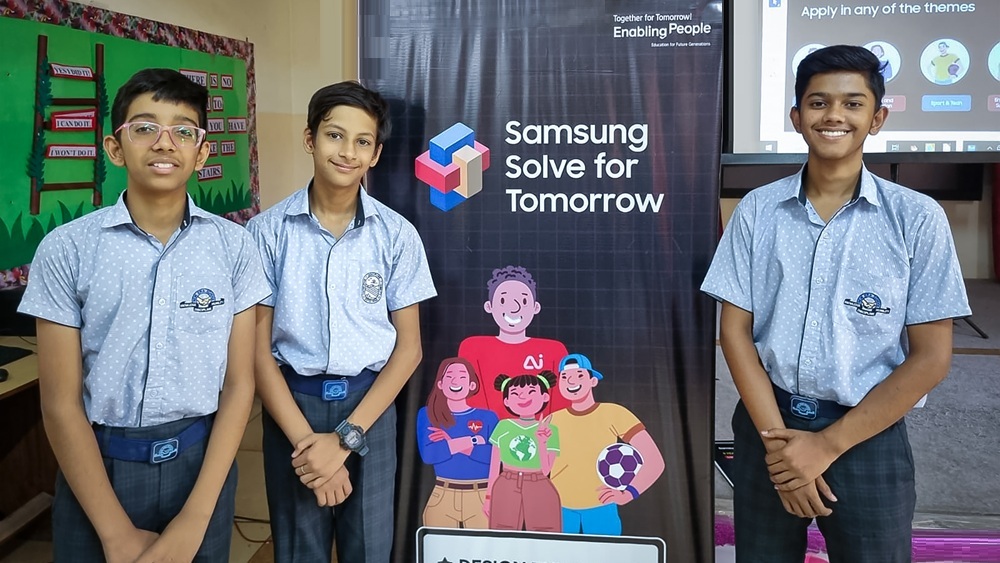
As digital platforms continue to transform the way Indians access everyday services, young innovators are increasingly exploring how emerging technologies can create more seamless, efficient and user-centric experiences. At Samsung Solve for Tomorrow’s Design Thinking Workshop held at New Era School, Ghaziabad, students examined how Artificial Intelligence (AI) can help shape the future of India’s rapidly growing digital delivery ecosystem.
Samsung Solve for Tomorrow is Samsung India’s flagship education and innovation programme designed to empower the country’s next generation of innovators to build technology-driven solutions for real-world challenges. Open to youth aged 14–22, the initiative encourages participants to transform ideas into impactful innovations across four themes: Artificial Intelligence (AI), Health & Education, Environmental Sustainability, and Sport-Tech.
More than 300 students participated in the workshop, where they were introduced to Samsung’s Design Thinking methodology — a human-centred approach that encourages participants to deeply understand user needs before developing solutions.
Among the participants were science students Disha Garg and Rashi Sharma, who chose to explore opportunities within the evolving digital delivery ecosystem. Rather than beginning with a predefined solution, the duo focused on understanding the experiences of customers, delivery partners and service providers to identify areas where technology could further enhance convenience, transparency and user experience.
Using insights gathered through empathy mapping, stakeholder analysis and problem-definition exercises, they conceptualized an AI-enabled application designed to facilitate better information flow and decision-making across different stages of the delivery journey.
“Through Samsung Solve for Tomorrow, we learned to look at people before looking at technology. The Design Thinking Workshop helped us understand how innovation starts with identifying real needs and understanding different perspectives,” said Disha Garg, a student at New Era School, Ghaziabad.
“The workshop challenged us to validate every idea through user insights. It showed us how AI can be applied thoughtfully to improve everyday experiences and create meaningful impact,” added Rashi Sharma.
As Samsung marks 30 years in India, the company is significantly expanding the scale of Solve for Tomorrow 2026. Through Design Thinking Workshops being conducted across 100 cities spanning Bharat, Samsung is equipping thousands of young people with the skills to identify grassroots challenges, develop human-centred solutions and transform ideas into scalable innovations. The initiative reflects Samsung’s belief that the next wave of innovation can emerge from every corner of the country.
The programme will culminate with the top four winning teams receiving incubation grants worth INR 2 crore, helping them further develop and scale their ideas. Participants will also receive mentorship, training, prototyping support and exposure to India’s broader startup and innovation ecosystem.
By bringing Design Thinking directly into classrooms and campuses, Samsung Solve for Tomorrow continues to inspire young Indians to transform observations into opportunities and ideas into impactful solutions.
Applications for Samsung Solve for Tomorrow 2026 remain open until July 3, 2026, for youth aged 14–22 who are ready to build solutions that address real-world challenges through innovation and technology.