


By Suresh Unnithan
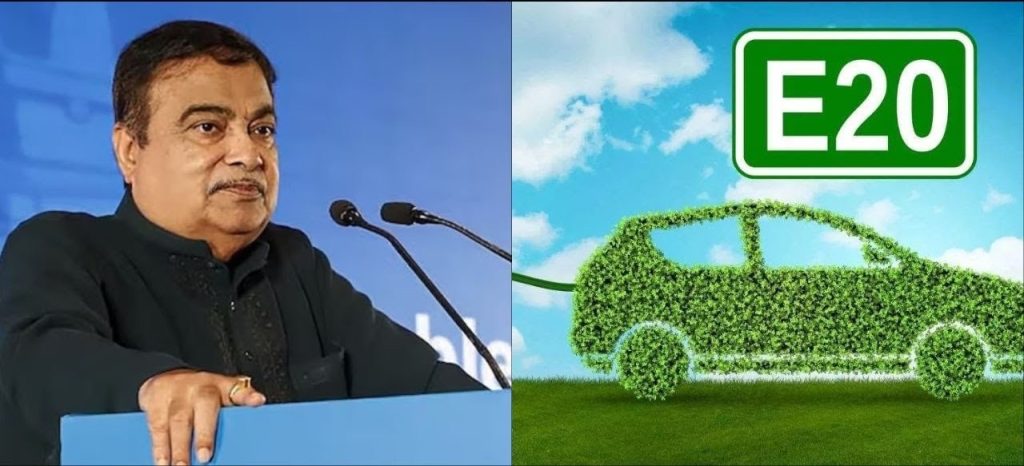
The E20 fuel policy, mandating a 20% ethanol blend in petrol, has erupted controversy, culminating in a Public Interest Litigation (PIL) filed in India’s Supreme Court in August this year. The PIL challenges the policy’s mandatory implementation, citing issues like vehicle incompatibility and lack of consumer choice. Union Minister for Road Transport and Highways Nitin Gadkari, a key advocate for E20, and his son Nikhil Gadkari, linked to ethanol-producing businesses, have become the “victims” of a targeted campaign. The allegation is, the Union minister was vocal for E20 to promote his son’s “ethanol based business.”
It is fact, “the share price of CIAN Agro Industries & Infrastructure Ltd (BSE: 519477), managed by Nikhil Gadkari (son of Union Minister Nitin Gadkari) and involved in ethanol production among other agro activities, closed at ₹50.35 on August 31, 2023. The most recent closing price as of August 31, 2025, is ₹736.55. This represents a growth of ₹686.20 over the past two years. The percentage increase is 1,363(rounded to the nearest whole number).
Allegations against Nitin Gadkari is that he has been vociferously campaigning for the E20 policy, emphasizing its benefits like reduction in crude oil imports by 30 million barrels annually, saving ₹1.40 lakh crore in foreign exchange since 2014, and boosting farmer incomes through ethanol production from sugarcane and maize. While advocating for E20 the union minister dispelled the “misinformation” spread in the market discouraging the spread of ethanol blended auto fuel.
According to him the disinformation campaign that Ethanol mixed fuel could lead to engine damage, mileage drop or both and he attributes this “false propaganda” to a “petroleum lobby”. Gadkari claims tests by the Automotive Research Association of India (ARAI) over 100,000 km showed no damage to older vehicles, citing Brazil’s 27% ethanol blending (E27) as a successful precedent. The Minister has also alleged a “political conspiracy” fueled by social media outrage, pointing to organized efforts, including phone calls encouraging negative posts on X.
The PIL on E20 policy, filed by advocate Akshay Malhotra is scheduled for hearing on September 1, 2025, before Chief Justice B.R. Gavai. The petitioner in his plaint argues that E20’s mandatory rollout violates consumer rights by eliminating ethanol-free (E0) options and risks damaging non-compliant vehicles (pre-2023 models). Though the petitioner has not explicitly named Gadkari in his PIL, political observers view it as an attack on his leadership. Posts on X describe the PIL as a “political move” to undermine Gadkari, known as the “Expressway Man of India” for his infrastructure achievements. Critics on X also highlight public discontent, with a survey of 36,000 vehicle owners showing 66% opposition to E20 due to mileage losses (5-20% reported) and engine issues like corrosion and gasket failures..
Gadkari’s claim of a petroleum lobby targeting him stems from the policy’s threat to fossil fuel demand, with ethanol blending saving ₹1.20 lakh crore in payments to farmers since 2014. He feels oil companies, facing reduced petrol sales, may be orchestrating criticism, though no direct evidence is provided in any recent report. “His past political controversies, like the 2012 irrigation scandal and 2009 Yogita Thakre case, where allegations were raised but not proven, suggest a pattern where policy disputes become personal attacks,” a supporter of the BJP commented.
According to reports Nikhil Gadkari’s CIAN Agro Industries & Infrastructure Ltd., entered the ethanol sector in February 2024. The company’s revenues reportedly grew from ₹17 crore in June 2024 to ₹510 crore by June 2025, with 67% of shares held by promoter-linked entities tied to the Gadkari family. Another son, Sarang Gadkari, is linked to Manas Agro Industries and Power, part of the Purti Group, which includes ethanol-related ventures like Purti Power and Sugar Ltd.
Hwoever Gadkari has denied these allegations and noted that ethanol blending began in 2001 under Atal Bihari Vajpayee, predating his family’s involvement, and emphasized that “E20 is a national policy backed by multiple ministries and the Prime Minister’s Office,” not his personal initiative.
Automobile experts suggest that the E20 controversy hinges on ethanol’s properties: its lower energy density (26.9 MJ/kg vs. petrol’s 44.4 MJ/kg) reduces mileage by 5-10%, and its hygroscopic nature (absorbing up to 100% water) risks corrosion in non-compliant vehicles, especially pre-2023 models. Automakers like Toyota and MG Motor have advised against E20 for older models, warning of warranty voids and issues like fuel tank rusting or gasket failures. The PIL argues that forcing E20 without E0 options or clear pump labeling harms consumers, indirectly spotlighting Gadkari’s role as the policy’s face.
Ethanol (C₂H₅OH) is a renewable alcohol fuel derived from biomass, primarily sugarcane in India. Detailing the properties of ethanol mechanical engineers experienced in automobile engines says “Ethanol blended fuel can be used only in petrol engines. Its (ethanol) research octane number (RON) is 108-110, significantly higher than petrol 91-95, improving knock resistance and allowing higher compression ratios in compatible engines. Ethanol contains 34.7% oxygen by weight, promoting cleaner combustion but requiring richer air-fuel mixtures (stoichiometric ratio of 9:1 for ethanol vs. 14.7:1 for petrol), which can stress non-optimized fuel systems.”
He further said that due to its hygroscopic nature “Ethanol absorbs water (miscible up to 100%), increasing risks of phase separation and corrosion in fuel systems not designed for high ethanol content. Ethanol’s Reid Vapor Pressure (RVP) is lower than petrol’s (6-8 kPa vs. 45-90 kPa), but blending can create azeotropic effects, increasing evaporative emissions if not managed.”
The expert said “Ethanol’s high latent heat (904 kJ/kg vs. petrol’s 349 kJ/kg) cools the intake charge, enhancing volumetric efficiency but complicating cold starts in non-adapted engines.” These properties, he said, make ethanol a viable petrol additive but necessitate engine and fuel system modifications for optimal performance and durability.
Scientists are in agreement with Nitin Gadkari’s argument that E20 will reduce environmental pollution due to automobile emission. “The high oxygen content reduces carbon monoxide (by up to 30%), hydrocarbons (by 20%), and CO₂ emissions,” supporting India’s climate goals.
The critics of however, are vocal of the disadvantages of E20 as an Automotive Fuel
To counter the Minister they have picked up the following points:
· Reduced Fuel Efficiency: The lower energy density (E20’s heating value ~40 MJ/kg vs. 44.4 MJ/kg for E0) reduces mileage by 5-10%, increasing fuel costs.
· Corrosion and Damage: Ethanol’s hygroscopic nature and 34.7% oxygen content can corrode steel (at rates up to 0.2 mm/year in non-coated systems) and degrade rubber seals in pre-2023 vehicles.
· Compatibility Issues: Older engines may require ECU recalibration or upgrades to fuel lines and injectors to handle ethanol’s solvent properties, risking warranty issues.
· Lack of Consumer Choice: Mandatory E20 without E0 options or clear labeling frustrates users, especially those with non-compliant vehicles.
· Performance Trade-offs: High latent heat and altered air-fuel ratios can cause knocking or misfires in non-optimized engines, reducing lifespan.
For now, the discussions are animated not on the technical issues relating to E20, but against the Union Minister. Of course the genuine public concerns over mileage losses, engine risks, and lack of fuel choice are to be cleared. The Supreme Court hearing on September 1, 2025, is likely to clarify whether the high octane debates is a targeted attack on the Minister or a broader policy critique. As of now the allegations against Gadkari appear disproportionately amplified by our polarized political climate and to some degree the E20 policy’s tangible impact on many millions of vehicle owners.