


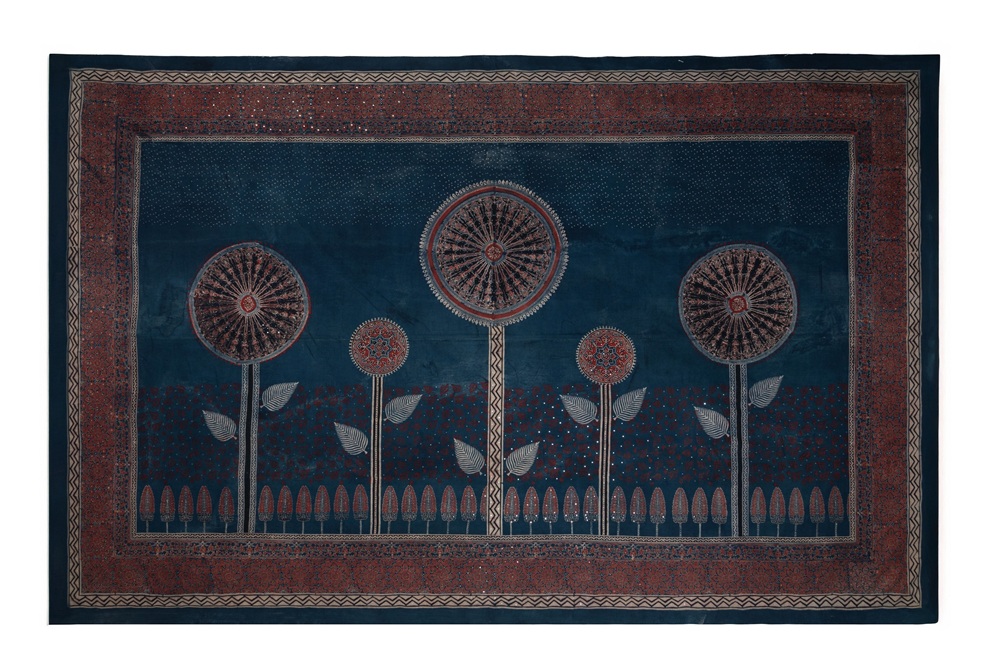
India : Artist Shelly Jyoti presents Indigo: The Blue Gold II (2008–2026), an exhibition tracing her eighteen-year artistic engagement with indigo as colour, material, history and memory. Curated by Prof. Lisa Trivedi, Professor of History at Hamilton College, New York, the exhibition will be on view from 27 October to 1 November 2026 at the CAA Building, Ground and First Floors, Bikaner House, New Delhi. The exhibition is supported by Good Earth Heritage Foundation as Patron Partner and Indira Gandhi National Centre for the Arts (IGNCA) as Knowledge Partner.
Bringing together works created between 2008 and 2026, Indigo: The Blue Gold II follows indigo from ancient textile traditions and colonial plantations to global trade, forced labour, migration, displacement and contemporary cultural regeneration. Jyoti’s early works revisit indigo cultivation in India, the exploitation of farmers and Mahatma Gandhi’s Champaran Satyagraha, before expanding into the wider histories of indigo as the coveted “blue gold” whose circulation became intertwined with colonial expansion, slavery, indentured labour and the displacement of communities across continents.
At the heart of the exhibition is khadi, which forms the consistent material foundation of Jyoti’s practice. Working with hand-spun and handwoven khadi, natural indigo dyeing, Ajrakh resist block printing, embroidery, mirror work and symbolic imagery, the artist brings together recurring motifs of ships, charkhas, fish, globes, faceless figures, seeds, roots and trees. These elements connect individual histories with larger movements of people, knowledge and cultural traditions.
Exhibition Details
Exhibition- Indigo: The Blue Gold II (2008–2026)
Artist- Shelly Jyoti
Curator- Prof. Lisa Trivedi, Professor of History, Hamilton College, New York
Preview- Tuesday, 27th October 2026
Time- 5:30 – 9:00 PM
Venue- CAA Building, Ground & First Floors, Bikaner House, New Delhi
The exhibition is open to all from 28th October to 01st November 2026 11 AM – 7 PM at CAA Building, Ground & First Floors, Bikaner House, New Delhi.
“Over eighteen years, my engagement with indigo has evolved from exploring the exploitation of indigo farmers and Gandhi’s Champaran Satyagraha to examining the global histories of colonial trade, slavery, indentured labour and human displacement. With Indigo: Migration Through Time, I am looking at migration not only as the physical movement of people, but also as the passage of memory, cultural knowledge and identity across generations.” says Shelly Jyoti.
A New Body of Work: Indigo: Migration Through Time
The exhibition introduces Jyoti’s new 2026 body of work, Indigo: Migration Through Time, which extends her long-standing enquiry into the interconnected histories of human displacement, cultural transmission and ecological regeneration. The series unfolds through three interconnected movements: Faceless Journeys, Displaced Ecologies and Unresolved Geographies.
Faceless Journeys explores the experiences of enslaved, indentured and migrant communities whose labour enabled the global movement of indigo, while drawing attention to the many individual lives that remain absent from written histories.
Displaced Ecologies turn to seeds, plants, roots and trees as metaphors for communities that take root in unfamiliar landscapes, adapt and transmit memory across generations. The survival and transformation of Ajrakh across centuries and migrations similarly becomes a reflection of how cultural knowledge travels and regenerates.
Unresolved Geographies move into abstraction, where boundaries between body, landscape, water and movement begin to dissolve. Here, indigo becomes an expansive field of memory, with migration understood not only as geographical displacement but also as movement through time, identity and consciousness.
Together, the works move from histories of exploitation and resistance towards questions of displacement, adaptation and regeneration, examining how textile can function simultaneously as witness, archive and a carrier of collective cultural inheritance.
Textile as Witness and Living Archive
Jyoti’s sustained collaboration with Ajrakh master artisans of Kutch remains central to her practice. For the artist, Ajrakh extends beyond a textile technique to become a living archive carrying inherited knowledge, migration histories, ecological wisdom and intergenerational memory.
“I work with hand-spun and handwoven khadi, natural indigo, Ajrakh resist block printing, embroidery and mirror work. My sustained collaboration with Ajrakh master artisans of Kutch remains central to my practice. Through this journey, I view textile as both witness and living archive—holding histories of loss while affirming resilience, continuity and renewal,” says Shelly Jyoti.
Jyoti’s engagement with indigo began in 2008, through a collaboration with Japanese American artist and Professor Emerita at DePaul University, Chicago, Laura Kina. Over the following eighteen years, her inquiry has expanded from India’s colonial history and the exploitation of indigo farmers to the global circulation of indigo through colonial trade, slavery, indentured labour and human displacement.
An Outreach Programme Around Indigo
The exhibition will be accompanied by an outreach programme titled “Indigo as a Living Classroom”, designed to extend the exhibition’s enquiry through conversations, demonstrations, student projects and guided interpretation.
The programme includes:
● Opening Reception: 27 October, 5:30–9:00 PM
● Artist–Curator Conversation with School Students: 28 October, 11:00 AM–2:00 PM
● Curator + Artist Gallery Walk: 28 October, 4:00–6:00 PM
● Panel Discussion – “Indigo on Motion”: 29 October, 2:00–4:00 PM, followed by tea
● Talk and Ajrakh Workshop with Master Craftsman Juned M. Khatri: 30 October, 11:00 AM–5:00 PM, followed by tea
● Gallery Walk with Artist Shelly Jyoti – “Reading Indigo Through Time”: 1 November, 2:00 PM onwards