


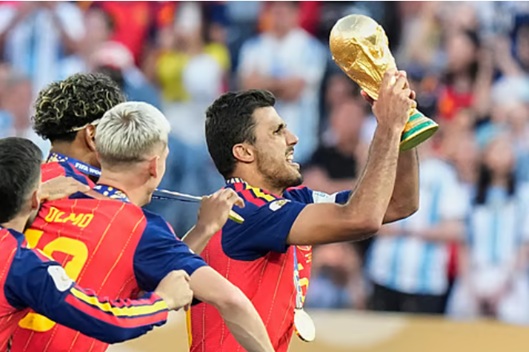
EAST RUTHERFORD, New Jersey: Under the blazing lights of MetLife Stadium on a historic Sunday , Spain etched their name into football immortality once more. In a pulsating, extra-time thriller that had 80,000 hearts pounding in unison, La Roja defeated defending champions Argentina 1-0, with Ferran Torres rising like a phoenix in the 106th minute to deliver a strike that will echo through generations.
This was more than a victory born of individual brilliance — it was the culmination of Spain’s profound tactical evolution under Luis de la Fuente. From the tiki-taka purists of 2010 to a modern juggernaut blending possession dominance with verticality, defensive steel, and lethal transitions, this La Roja side has matured into something beautifully complete.
De la Fuente inherited a talented but sometimes fragile group and refined it with layers of versatility, compactness, and emotional control. Gone were the days of passive possession; instead, Spain deployed fluid 4-3-3 formations that morphed into 3-2-5 attacking structures, with full-backs surging forward and Rodri anchoring as the midfield conductor. They controlled rhythm and tempo through intricate triangles and positional play, while adding directness — exploiting spaces behind defenses with the explosive pace of Lamine Yamal and Nico Williams.

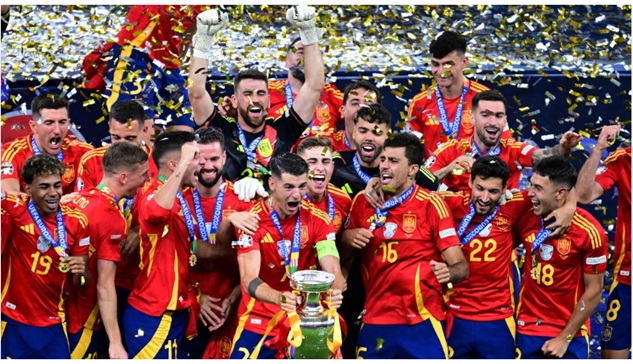
Their pressing was relentless yet disciplined, recovering the ball high to launch quick counters. Defensively, the partnership of young Pau Cubarsí and experienced partners brought solidity that saw Spain concede just once all tournament — a record of resilience. In the final, this evolution shone brightly: 65% possession, 20 shots to Argentina’s 2, and a suffocating grip that reduced Lionel Messi’s side to near-silence.
For 105 grueling minutes, the match hung on a knife-edge. Argentina defended with the desperation of champions. Emiliano Martínez produced heroics — 11 saves, a World Cup final record. But Spain refused to yield. Then, the moment arrived. Pedro Porro whipped in a cross. Nico Williams nodded it back across goal. Torres smashed it home. The stadium erupted. Spanish flags waved like a red-and-yellow sea. Torres sank to his knees as teammates piled on, tears flowing freely.
“I cannot believe it,” Torres said, voice cracking. “This is for every kid back home dreaming big, for every sacrifice.”
Argentina were reduced to 10 men late on, but even then they fought valiantly. Rodri, the Golden Ball winner and midfield maestro, dictated the game with calm authority. As the final whistle blew, emotions overflowed. Players collapsed in ecstasy, hugging and pointing skyward in tribute to the 2010 heroes. Captain Rodri lifted the trophy amid confetti and cheers. For de la Fuente, the oldest coach to win the World Cup, it was poetic justice. “We grew together — talent, commitment, and values,” he said, eyes glistening.
This triumph is redemption and renewal. Spain, already European and women’s world champions, became the first to win consecutive men’s and women’s titles. A golden generation — Yamal’s wizardry, Williams’ fire, Cubarsí’s poise — delivered not just silverware but a new identity: patient yet ruthless, technical yet direct.
In the streets of Spain, millions danced into the night — fathers lifting sons, grandmothers wiping proud tears. For Argentina, the pain is raw, but Messi’s legacy endures. As fireworks lit the sky, one truth rang clear: Spain are world champions again, their tactical evolution complete. ¡Campeones del Mundo!