


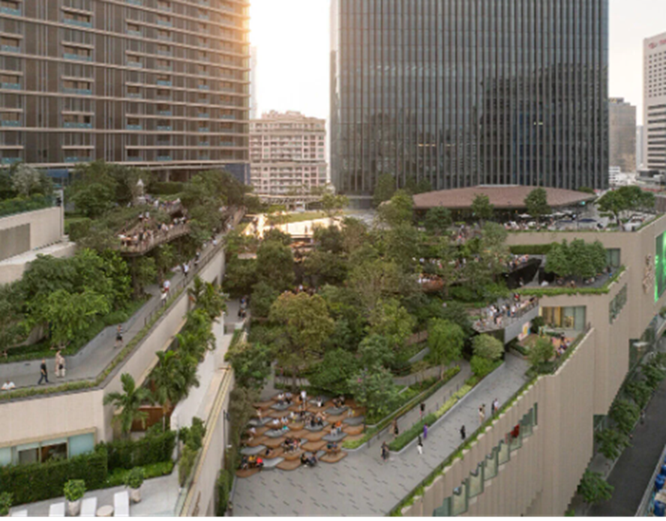
BANGKOK, THAILAND : Following its first anniversary on 3 September 2026, Suan Dusit Arun – the 11,200 sq m public rooftop park at Dusit Central Park in the heart of Bangkok – has released its first set of visitor, community, and environmental performance data. The figures demonstrate strong public demand for accessible green space in the Thai capital, with an average of 2,621 unique daily visitors during the 12-month reporting period.
The largest public rooftop park in Bangkok’s central business district, Suan Dusit Arun is a defining feature of Dusit Central Park and provides elevated views across Lumpini Park, one of the city’s most important green spaces. It was designed as a practical response to critical urban challenges facing Bangkok, including rising temperatures, limited access to green space, and declining biodiversity.
Open to all, the park offers the luxury of space, nature, and calm in the centre of Bangkok. Its public use and programming are thoughtfully managed to protect the landscape, preserve a comfortable atmosphere, and ensure that visitors can continue to enjoy the park without compromising the qualities it was designed to provide.
Combining beautiful views with a strong social and environmental purpose, the park serves as the unifying landscape connecting the principal elements of Dusit Central Park: the flagship Dusit Thani Bangkok hotel, Central Park Offices, the Central Park shopping centre, and a 69-storey residential tower comprising the ultra-luxury Dusit Residences and contemporary Dusit Parkside.
The design of Suan Dusit Arun reflects the wider architectural philosophy of Dusit Central Park, responding to wind flow and solar orientation while drawing on Feng Shui principles to foster harmony, balance, and a positive flow of energy between people and their surroundings.
With approximately 98% of its layered landscape dedicated to green space, the park combines 184 plant varieties, including 48 Thai species, with accessible areas for recreation, learning, community gatherings, and quiet reflection. Its planting includes native shade trees, flowering varieties, and climate-adapted plants.
The planting includes nine tree species in the three threatened categories of the IUCN Red List – two Critically Endangered, two Endangered, and five Vulnerable. It also reflects Thailand’s cultural heritage through sacred spirit trees, species referenced in classical Thai literature, and jasmine, a symbol of Mother’s Day in Thailand. Pollinator-friendly species include mangrove apple and queen’s crape myrtle.
Water management is another important part of the park’s operation. Harvested or recycled water supplies approximately 25% of irrigation demand, supported by an automated, timer-controlled irrigation system. The planted landscape is estimated to reduce stormwater runoff entering the city’s drainage system by 30–50% compared with a conventional hard-surfaced roof.
While assessment of the park’s environmental performance is ongoing, monitoring conducted within and outside the project area on 13 and 14 March 2026 provided an initial snapshot of conditions. Air temperature within Suan Dusit Arun was recorded at 31°C, compared with 33°C outside the project area. Suspended particulate matter concentrations were also approximately 35% lower within the park during the monitoring period.