


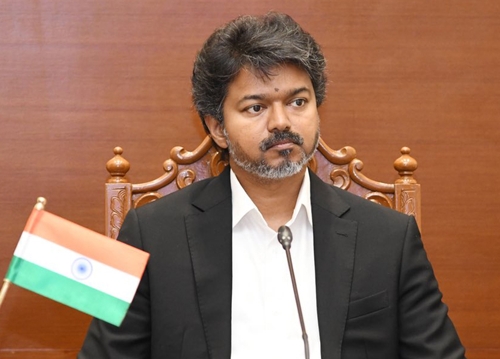
Chennai: Yesterday Tamil Nadu completed 100 days under a chief minister who did not come from the two parties that had ruled it, almost without interruption, since 1967. On 17 August, C. Joseph Vijay’s Tamilaga Vettri Kazhagam government marked that quiet but historic line. An actor who once filled cinema halls now occupies Fort St. George. A party barely two years old had broken the Dravidian duopoly that had defined the state’s politics for six decades. The emotion of that fact has not yet faded.
What followed the oath on 10 May was unusual not because it was flawless, but because it was fast, visible and less bound by the organisational habits of the previous administration. On his first working day Vijay signed three orders that earlier governments had treated as longer campaigns: 200 units of free electricity for eligible households, a specialised Singapenn force for women’s safety, and statewide anti-narcotics units. Soon after came the closure of 717 TASMAC outlets standing near schools, temples and bus stands. These were not incremental adjustments. They were early, public deliveries that set a different tempo from the more measured, party-mediated style of M.K. Stalin’s DMK government.
Farmers received one of the clearest early signals. A ₹6,000 crore crop-loan waiver, later refined, reached more than 14 lakh cultivators. Skill training was launched for 12 lakh students and one lakh youth. The Kamarajar breakfast scheme was expanded to another 15.14 lakh children. Allocations followed for laptops, school bicycles, housing and support for disadvantaged women. Where the previous government had operated inside a familiar welfare architecture, the new one tried to compress visibility and speed into the opening weeks.
Investment formed another contrast. The government reported commitments exceeding ₹1 lakh crore, including a major conclave that produced dozens of MoUs. An early White Paper on state finances, live telecast of full Assembly proceedings, and talk of an anti-bribery helpline added a vocabulary of transparency that the older Dravidian order had not always practised with the same urgency. The difference was not that Stalin’s administration lacked welfare schemes. It was that Vijay’s first 100 days felt less like the continuation of a well-rehearsed script and more like an attempt to write a new one in public view.
Difficulties remain. The Cauvery dispute is a legacy wound. Power complaints, law-and-order questions and coalition management have already tested the cabinet. The opposition has argued, not without reason, that several programmes are expansions or rebrandings of earlier initiatives. Those criticisms matter. Yet the unusual achievement of these 100 days is the demonstration that a government outside the two-party inheritance could act with unusual haste on safety, liquor control, farm relief and investment outreach.
Stalin’s government had the advantage of institutional memory and a dense party structure. Vijay’s has the disadvantage of inexperience and the advantage of fewer inherited obligations. That difference produced a first hundred days that Tamil Nadu has not seen in living memory: a government that is neither DMK nor AIADMK, moving at a pace that the old order rarely matched in its opening chapters.Yesterday’s milestone therefore carries mixed feeling. There is the satisfaction of a historic break, the evidence of files signed and shops closed, and the knowledge that 100 days is only a beginning. Tamil Nadu has watched film stars become chief ministers before. It has not, until now, watched the entire Dravidian spell interrupted by a new formation that then tried to govern this quickly. Whether that experiment lasts will be decided in the years ahead. For one day, at least, the state could look back on a hundred days that did not belong to the old order.