


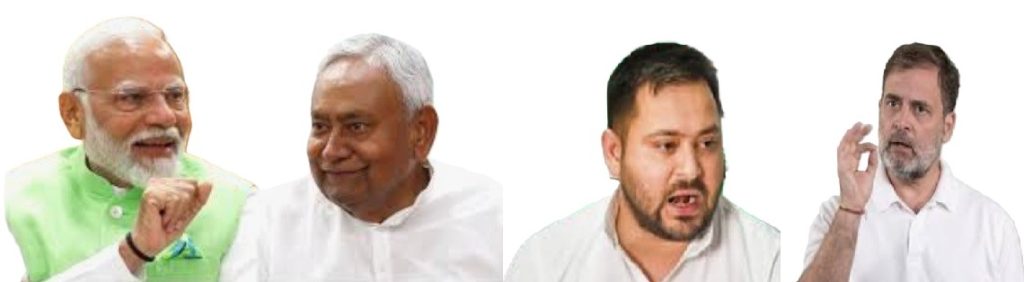
Kolkata: Bihar’s 2025 Legislative Assembly elections exposed the perils of overconfidence and strategic missteps by the Mahagathbandhan (MGB). The alliance’s underestimation of the National Democratic Alliance (NDA)’s game plan—marked by disciplined consolidation, spoiler elimination, and targeted caste realignment—triggered a devastating collapse. Voters perceived Congress leader Rahul Gandhi as lacking seriousness and RJD’s Tejashwi Yadav as arrogant, eroding credibility. While RJD’s vote share held steady, the NDA gained nearly 10 percentage points overall. The real damage stemmed from splinter parties and Congress’s weak performance, which fragmented anti-NDA votes and crippled seat conversion in a first-past-the-post system.
The NDA, led by BJP and JD(U), secured a landslide 202 seats out of 243, with BJP emerging as the single-largest party at 89 seats and JD(U) at 85. In contrast, the MGB limped to 35 seats, with RJD claiming just 25—its worst since 2010. RJD topped vote shares at 23.00%, ahead of BJP (20.08%) and JD(U) (19.26%), yet its strike rate plunged to 17.5%. NDA allies like LJP(Ram Vilas) added 4.97% and 19 seats, while MGB’s Congress managed only 8.71% for six seats. Third-party interlopers, including JSP (3.5%) and AIMIM (2.1%), siphoned 5.6% from MGB fringes without winning seats, amplifying fragmentation.
This outcome flipped the 2020 script, where MGB’s higher vote share nearly toppled the NDA amid spoilers and anti-incumbency. In 2025, NDA’s reintegration of allies, EBC consolidation under Nitish Kumar, and welfare-driven women’s turnout (71%) erased those vulnerabilities. MGB’s internal rifts—12 friendly fights—and failure to expand beyond the Yadav-Muslim core plateaued its appeal, while NDA’s efficiency turned a 9-point vote lead into a 167-seat gulf.
2020 vs. 2025: A Side-by-Side Comparison
| Metric | 2020 (NDA: 125 seats) | 2025 (NDA: 202 seats) | Change |
| RJD Vote Share | 23.11% | 23.00% | -0.11% |
| RJD Seats | 75 | 25 | -67% |
| BJP Vote Share | 19.46% | 20.08% | +0.62% |
| BJP Seats | 74 | 89 | +20% |
| JD(U) Vote Share | 15.39% | 19.26% | +3.87% |
| JD(U) Seats | 43 | 85 | +98% |
| Congress Vote Share | 9.48% | 8.71% | -0.77% |
| Congress Seats | 19 | 6 | -68% |
| NDA Total Vote Share | ~37.33% | 46.52% | +9.19% |
| MGB Total Vote Share | ~42.54% | 37.64% | -4.90% |
| Turnout | 57.29% | 67.13% | +9.84% |
2020 data sourced from Election Commission of India and Wikipedia; MGB in 2020 included Left parties (16 seats, ~6% votes). 2025 figures from ECI final tally as of November 16, 2025, 11:20 AM IST; cross-verified with India Today, The Tribune, Indian Express, and NDTV. Total valid votes in 2025: ~50.5 million.
From Near-Miss to Rout: The MGB’s Strategic Blunders
In 2020, MGB’s 42.54% aggregate outpolled NDA’s 37.33%, with LJP rebels splitting NDA votes in 40 seats to gift RJD 75 wins, including upper-caste upsets. Tejashwi’s job promise fueled a “tsunami” amid COVID-19 discontent, forcing Nitish’s post-poll flip back to BJP. Anti-incumbency after 15 years of Nitish rule nearly ended his era.
By 2025, overconfidence blinded MGB to NDA’s countermeasures. Rahul Gandhi’s campaigns were dismissed by voters as unserious, while Tejashwi’s perceived arrogance alienated non-core groups. RJD’s static 23% signaled a capped Yadav-Muslim base (31% ceiling), unable to penetrate EBCs (36% population) or women voters. Congress’s vote drop and meager tickets (40 contested, 13 EBC for RJD/Congress combined) highlighted its drag, with splinter outfits like JSP and AIMIM diluting opposition further.
NDA, meanwhile, surged via LJP(RV) reintegration (adding Dalit votes, swinging 34/38 SC seats), Nitish’s EBC loyalty, and Modi’s welfare sops (PM-KISAN, Ujjwala). JD(U)’s 3.87-point gain doubled seats through women’s support; BJP’s urban focus added 15. Strike rates soared to 85%+, with triangular contests down to 23. The 10-point turnout jump reflected mobilized beneficiaries prioritizing stability over MGB’s rhetoric.
Caste Realignment and the FPTP Trap
Bihar’s mandal politics sealed MGB’s fate: all groups except Yadavs and most Muslims swung to NDA. Upper castes held for BJP; EBCs returned to JD(U); Dalits consolidated under LJP(RV). In 59 RJD-JD(U) clashes, Nitish won 50-9 via social engineering. MGB’s diffuse votes—spread over 143 RJD seats—yielded a 17.5% strike rate, while NDA’s focused allocation hit 88.1% (BJP) and 84.2% (JD(U)). Median winning share: 47.8%, punishing fragmentation.
Lessons in Unity and Delivery
The NDA’s “tsunami” rewards consolidation and governance, but strains may emerge with BJP’s ascendancy. For MGB, revival demands ditching overconfidence, broadening beyond “MY,” and sidelining weak partners like Congress. Splinters invite oblivion; Bihar’s voters chose stability amid 22% youth unemployment. As 2029 looms, delivery—not arithmetic—will decide. In Bihar, alliances win, miscalculations lose.