


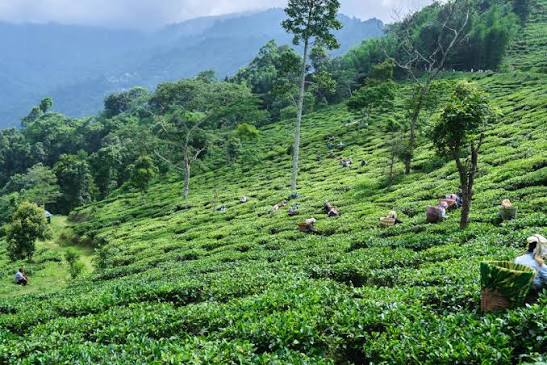
For generations, Darjeeling tea occupied a rare place in the global market. Grown on the steep slopes of West Bengal’s hills, it was one of the few Indian teas that could command respect alongside the finest Chinese and Japanese leaves. That standing is now under serious pressure. Production in the Darjeeling hills has fallen by more than 60 percent since 1990—from 14.49 million kg to roughly 5.6 million kg in 2025. Across the wider belt of Darjeeling, Terai and Dooars, organised gardens face costs that consistently exceed auction prices, a growing number of closed estates, and workers who often wait months for wages that were already modest.
India as a whole continues to produce large volumes—about 1,383 million kg in the last financial year, with Assam and West Bengal together accounting for more than 80 percent. West Bengal itself produced roughly 373 million kg in 2024, a 14 percent drop from the previous year. Dooars and Terai supply nearly all of that volume. Darjeeling, once the region that defined the brand, has become a small and shrinking share. C. Murugan, Deputy Chairman of the Tea Board of India, noted earlier this year that the Board was “closely monitoring the production” as January–November figures already showed an 8.79 percent decline compared with 2024.
The Numbers That No Longer Add Up
The causes are well known and have proved difficult to reverse. Many bushes are old. Rainfall has become less reliable—studies cited by the Indian Tea Association (ITA) point to a 37–43 percent decline in annual rainfall between 2010 and 2025 in some areas. Extreme heat, heavy downpours and pest attacks have reduced yields. At the same time, cheaper tea from Nepal has entered the market in large quantities. In 2025, India imported 11.7 million kg of Nepalese tea—more than double Darjeeling’s entire output that year. Vikash Kandoi of Jay Shree Tea has observed that after the second flush, “most of the Indian demand is met by them.” Blends that combine Nepalese leaf with a small proportion of Darjeeling and still carry the name have further undercut genuine gardens.
The financial arithmetic is stark. Recent auction averages for Darjeeling leaf have hovered near ₹420 per kg, while the estimated cost of production stands around ₹650. National auction prices have lingered in the ₹180–200 range for much of the recent period. Hemant Bangur, chairman of the ITA, has said that more than 80 percent of organised estates reported cash losses last year, with 2025 bringing “further decline in prices triggering negative EBITDA margins.” Over a longer period, tea prices rose at only about 2.88 percent a year while input costs climbed 10–12 percent. Arijit Raha, the ITA’s secretary general, has warned that when supply outruns demand, “prices collapse. This is financially crippling for producers.”
National exports offer a partial counter-narrative. India shipped a record 282 million kg in FY 2025-26 and earned ₹8,719 crore. Roughly 84 percent of the country’s tea is consumed domestically. Darjeeling’s own exports, however, have roughly halved in a decade—from 3.95 million kg in 2015 to 2.13 million kg in 2025. Once overseas buyers switched during the long 2017 closure and later found cheaper alternatives, many did not return.
Workers, Arrears and the Limits of Relief
The human consequences run parallel to the numbers. Several hundred thousand people in West Bengal depend on tea gardens for work. Daily wages in many places remain around ₹250. Statutory dues—provident fund and gratuity—have accumulated in numerous estates. Hospitals on some closed or barely functioning gardens no longer operate; housing has deteriorated; clean water is scarce. In November 2026 the state government transferred a one-time festive payment of ₹5,000 each to about 19,524 workers from closed gardens (roughly ₹9.76 crore in all) and indicated that the monthly rice ration might rise from 35 kg to 50 kg. These measures provide temporary relief. They do not clear years of unpaid statutory obligations or reopen gardens that have remained shut.
Bangur has spoken with unusual candour about the industry’s own record. At a major convention he said he stood “with my head in shame” over the sector’s failure to meet workers’ expectations on wages, living conditions and consistent payments. High absenteeism—sometimes 40–50 percent—has become common, as younger people leave for better-paid work elsewhere.
The Tea Board and the state government both have defined responsibilities. The Board, under the Union Commerce Ministry, handles promotion, quality rules and certain development schemes. The state government is responsible for labour law enforcement and local welfare. Industry bodies have submitted detailed white papers seeking an annual support package of about ₹113 crore for Darjeeling (covering orthodox production support, interest subvention, transport, mechanisation, provident-fund contributions, replanting and factory upgrades) and roughly ₹50 crore for Dooars-Terai. They have also sought seasonal-industry status for Darjeeling, a cost-linked Minimum Sustainable Price, tighter controls on under-priced imports, and stricter enforcement of the Geographical Indication.
Murugan has acknowledged the import problem directly. “Cheap and poor quality imports of tea are taking place from countries like Nepal and Vietnam,” he said in January 2026. He added that the Board was setting up infrastructure for 100 percent testing of imported tea: “We are creating the infrastructure towards this. It will take 15 to 20 days. Thereafter, legal opinion would be obtained, followed by approval of the ministry.” A later Tea Board stakeholder meeting in Siliguri listed dedicated relief for hill estates, climate resilience measures, checks on imports and “enforced Minimum Benchmark Pricing” among priorities.
Union Minister of State Jitin Prasada has listed steps the Tea Board is already taking—planting drought-tolerant cultivars, better farm management, integrated nutrient and pest management, mulching, improved drainage and rainwater harvesting. These are useful technical measures. Industry leaders argue they have not yet closed the large gap between costs and prices or reversed the long decline in Darjeeling output.
Raha has summarised the industry’s position: the tea sectors of Assam and West Bengal are “in distress.” The ITA is asking for action on price volatility, pest management under climate stress, import controls and export support. “The persistent decline in prices, pest challenges, and import pressures pose an existential threat,” he has said. A Minimum Sustainable Price linked to costs, he argues, is essential for fair competition and long-term viability.
A Way Forward That Matches the Scale of the Problem
A practical revival package would need to address three linked problems at once. First, introduce a transparent floor price or Minimum Sustainable Price for made tea, especially GI orthodox grades, while using minimum import prices or targeted duties to limit the cheapest foreign supplies. Second, provide time-bound capital support for replanting and factory modernisation, tied to clear targets, and consider seasonal-industry status for Darjeeling so that fixed costs do not overwhelm gardens during the long lean months. Third, clear existing wage, provident-fund and gratuity arrears promptly and strengthen monitoring so that new arrears do not accumulate. Extending broader social-security and health schemes to plantation workers would also reduce the non-wage burden that currently falls only on estates.
None of this is new. The production figures, the auction-cost gap, the import volumes and the condition of workers have been documented for years. What remains is whether the Centre and the state will treat the organised tea economy of West Bengal as a sector that still matters—both for a globally recognised brand and for the rural livelihoods that depend on it—or allow the slow contraction to continue. The numbers, and the public statements of both industry leaders and Tea Board officials, now point in the same direction. Without coordinated action on pricing, trade protection, investment and labour obligations, Darjeeling risks becoming a heritage name rather than a living industry, and the wider North Bengal tea belt will continue to shed formal employment. The window for a measured recovery is still open; it will not remain open indefinitely.