


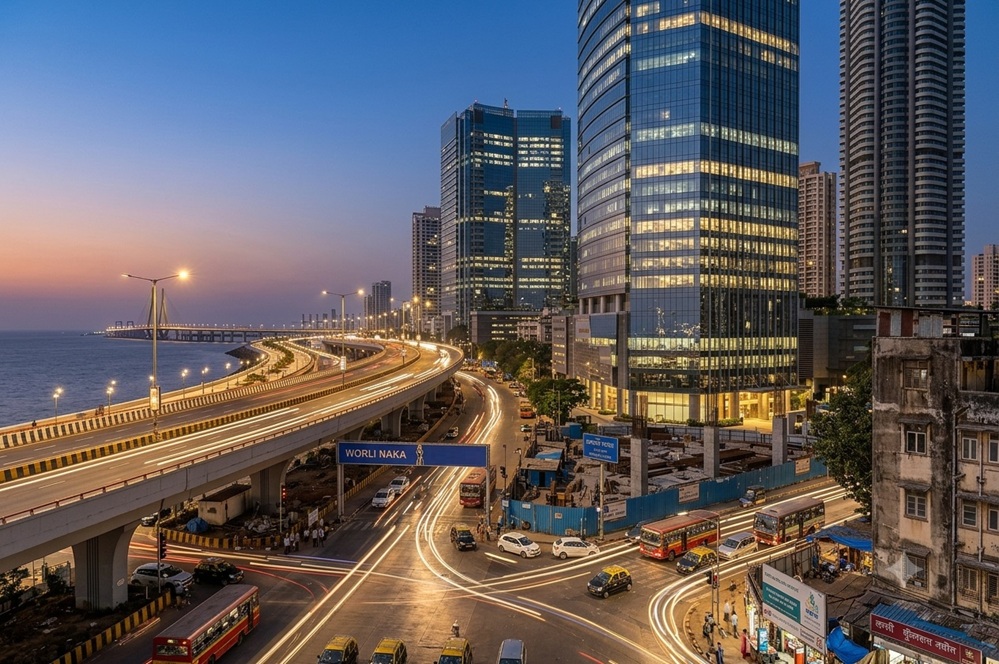
Mumbai : For most of its modern history, South-Central Mumbai operated under a persistent real estate paradox. Despite its central location and premium appeal, commercial occupiers routinely factored in a heavy discount for the hours lost navigating severe road congestion and bottlenecks along the Western Express Highway and Dadar. Worli was traditionally viewed as a destination you drove to and then waited in traffic to leave. That long-standing narrative is now undergoing a dramatic structural transformation as the physical mobility map of the financial capital is systematically redrawn.
At the core of this transition is the strategic convergence of three massive infrastructure projects landing within roughly two kilometres of a single junction at Worli Naka. Metro Line 3, the city’s first fully underground metro line, now seamlessly connects Cuffe Parade in South Mumbai through Worli and the Bandra-Kurla Complex directly to the international airport and Aarey. Simultaneously, the Mumbai Coastal Road offers direct, high-speed arterial connectivity linking Worli to Marine Drive in minutes, while integrating smoothly with the Bandra–Worli Sea Link to service the western suburbs. Completing this multi-modal network is the Sewri–Worli Elevated Connector, expected to open in early 2027, which will bridge Worli to Sewri and the Atal Setu, bringing Navi Mumbai and its new international airport within effortless reach.


Highlighting the long-term strategic significance of this shift, Mr. Vedanshu Kedia, Director, Prescon Group, noted “Real estate undergoes a complete re-rating whenever fundamental access changes. The access at Worli Naka has changed more in two years than in the previous twenty, with the Metro, the Coastal Road, and the Sewri–Worli connector all converging at this location. The firms making office decisions today are choosing for the next decade, and the Mumbai of the next decade is unequivocally organized around this junction.”
What makes Worli Naka exceptional in Mumbai’s urban landscape is that very few addresses in the city can offer an underground rapid transit metro, a coastal expressway, and a trans-harbour link from the exact same front door. For corporate employers and institutional real estate investors, this infrastructure convergence fundamentally expands the talent catchment area. A Grade A office asset situated around Worli Naka can now draw staff by metro from the eastern and western suburbs, by road from South Mumbai, and soon from Navi Mumbai, all without the historical penalty on commute times. For visiting executives and international clients, the convenience of a direct metro ride to the airport eliminates one of the biggest friction points of doing business in Mumbai.
Echoing this perspective, a senior real estate analyst observed, “The Grade A commercial demand consistently moves toward nodes that eliminate friction in workforce mobility. The rare infrastructure trifecta unfolding around Worli Naka is collapsing commute times across South Mumbai, the Bandra-Kurla Complex, the eastern suburbs, and soon Navi Mumbai. Consequently, Worli is rapidly evolving from a luxury residential belt into a core central business node, positioning institutional-grade commercial assets in the micro-market for sustained capital appreciation and premium rental yields as corporates plan their long-term footprint.”
As Mumbai’s transit network shifts from fragmented road projects to a unified, multi-modal ecosystem, Worli Naka stands out as the ultimate beneficiary. For developers and institutional investors, the micro-market represents one of the most compelling long-term Grade A commercial real estate opportunities in South-Central Mumbai.
****