


India : Financial expertise remains fundamental to banking and financial services. Yet, as financial institutions adopt AI, automate operations and build data-led business models, the capabilities expected of finance professionals are expanding. Understanding financial systems is still essential, but so is understanding how technology is changing the way they work.
The shift is already visible in India’s financial services sector. According to EY’s 2025 AIdea of India report, 74% of financial services firms had initiated generative AI proof-of-concept projects, while 42% were actively allocating budgets to AI initiatives. The report estimates that generative AI could improve productivity in Indian financial services by 34–38% by 2030. Source: EY India
Where finance meets technology and data
From digital payments and lending to insurance and wealth management, technology is influencing how financial services are designed, delivered and evaluated.
• Banking and lending: Data analytics and AI can support credit risk modelling, customer insights and lending decisions.
• Insurance: AI applications include underwriting, fraud detection and claims processing.
• Wealth management: Robo-advisory and algorithmic trading are changing how investment insights are generated and applied.
• Digital finance: Blockchain, smart contracts, open banking APIs, cloud computing and robotic process automation are enabling new business models and operating efficiencies.
For finance professionals, this means looking beyond individual technologies to understand how they affect financial performance, customer outcomes and strategic decisions. Traditional financial knowledge provides the foundation; technology fluency adds another layer to it.
AI adoption brings questions of risk and responsibility
Adopting AI is only part of the challenge. Financial institutions must also determine where it can deliver meaningful value, how reliable its outputs are and what safeguards are necessary.
McKinsey’s November 2025 global AI survey found that 88% of respondents reported regular AI use in at least one business function, but nearly two-thirds said their organisations had not yet begun scaling AI across the enterprise. The findings underline the gap between adoption and implementation at scale. Source: McKinsey
In financial services, closing that gap requires professionals to consider more than efficiency. Regulatory compliance, cybersecurity, data privacy, algorithmic bias and AI governance are integral to responsible adoption. Understanding RegTech, ethical considerations and emerging risks is therefore becoming as important as identifying potential applications.
Sustainability and financial inclusion add further considerations, particularly as digital financial services reach new customer segments. The ability to balance innovation with accountability is increasingly relevant across banking, insurance, FinTech and investment management.
Developing an integrated understanding of finance and technology
As these capabilities converge, executive education can help experienced professionals connect established financial knowledge with emerging technologies and their business applications.
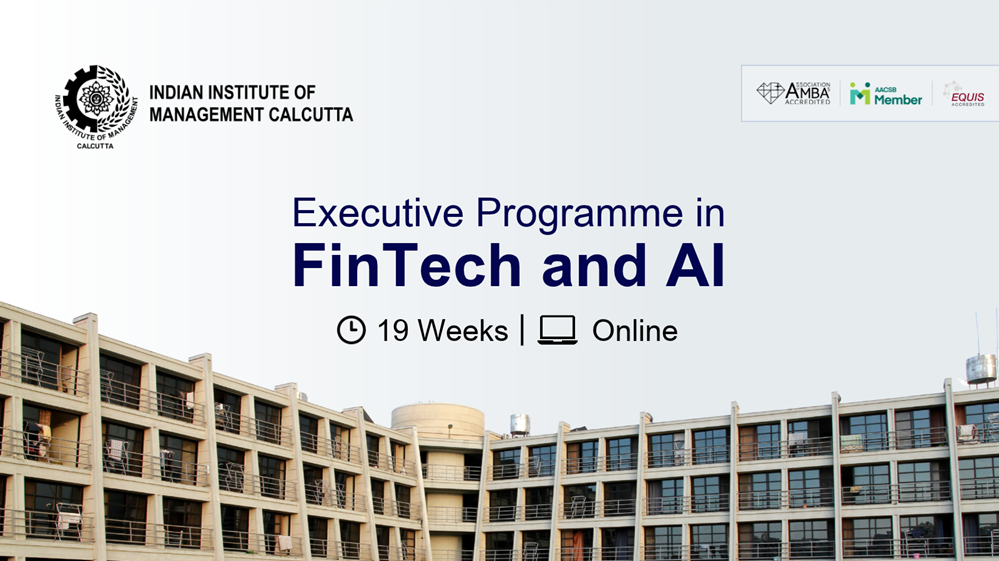
The Executive Programme in FinTech and AI by IIM Calcutta addresses this intersection through a 19-week online curriculum designed for working professionals. Its integrated approach combines financial services fundamentals with AI, data strategy and emerging financial technologies.
Key areas of learning include:
• Digital payments, digital lending and digital insurance.
• AI and generative AI applications in credit risk modelling, underwriting, fraud detection, robo-advisory and algorithmic trading.
• Blockchain, decentralised finance, smart contracts and open banking.
• Data strategy, cybersecurity, cloud computing and automation.
• AI governance, risks, ethics and sustainable finance.
Case-based learning, online faculty sessions and live doubt-clearing sessions connect these concepts with practical challenges. A capstone project provides an opportunity to apply learning to a comprehensive financial services scenario. Participants can also opt for a one-day networking event at IIM Calcutta and earn an IIM Calcutta certificate upon programme completion.
Extending financial expertise for a changing industry
The World Economic Forum’s Future of Jobs Report 2025 estimates that 39% of workers’ core skills will change by 2030, with AI, big data and cybersecurity among the skills expected to grow in importance. Source: WEF
For finance professionals, continuous learning is becoming a practical response to this changing landscape. The ability to evaluate technology-led business models, interpret data, assess risks and connect innovation with commercial outcomes can help them contribute more effectively to evolving financial services organisations.
The emerging professional is not one who leaves financial expertise behind, but one who builds on it, combining sound financial judgement with technology awareness and a clear understanding of the responsibilities that come with increasingly data-driven decisions.
****