


By Suresh Unnithan
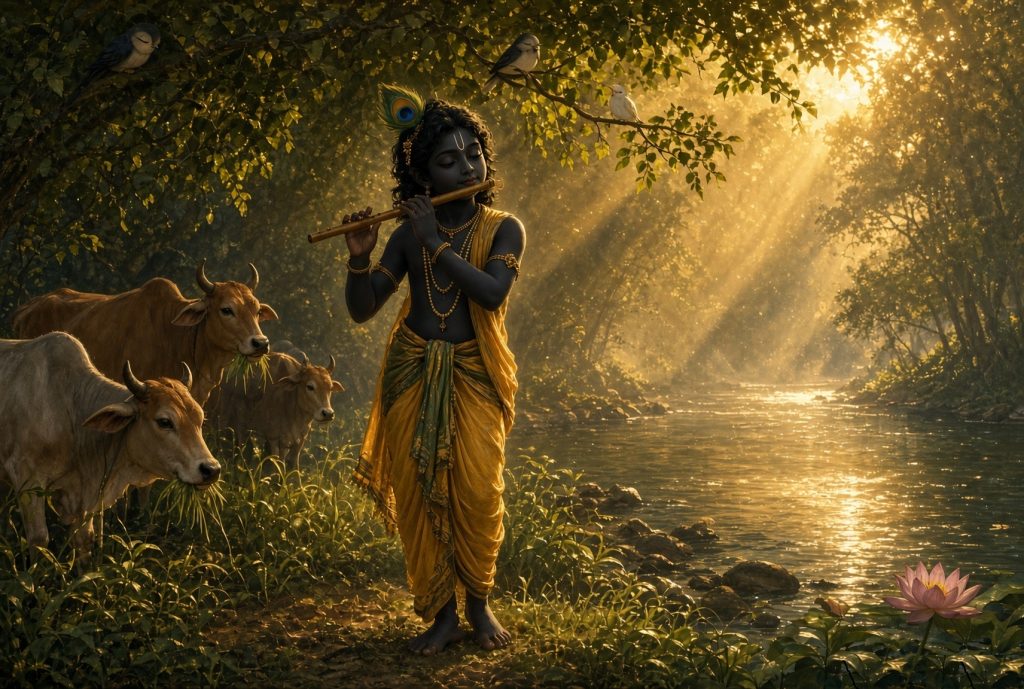
The Gopalakrishnan of Brindavan lives in the hearts of millions as Lord Krishna. In Kerala He is Guruvayoorappan—GuruvayoorUnni Kannan—who shelters His devotees from misery. On the seven hills He is Venkatachalapathi. ISKCON adores Him as the Lord of love. Temples exalt the protector, the butter-thief, the charioteer, the beloved of Radha. Yet almost none name what He was from His earliest years beside the Yamuna: a healer whose sweet and enchanting reed music awakened the mundane world. He roused the sleeping mind.
That silence around His musicianship is itself a kind of forgetting. Modern physical medicine can mend bone, cool fever, and still a bleeding vessel. It is far less sure before illnesses that have no wound to show—anxiety that will not loosen its fist, grief that walks in circles, the fatigue of a thought that cannot rest. Psychology has given these states names. Krishna, with a hollow bamboo and the living breath of Vayu, gave them a cure. His consulting room was the forest path. His prescription was melody. His patients were tired cowherds, love-stricken gopis, and every heart whose inner weather had grown stormy. He awakened the mundane world with His sweet and enchanting reed music.
When Breath Became Benediction
A flute is nothing until air consents to enter it. Hollow and unadorned, the bansuri waits like a soul emptied of self-importance. When Krishna sets it to His lips, Vayu ceases to be weather and becomes prana—the companion of consciousness, the subtle wind on which thought itself rides. When the mind is unwell, it is often this inner wind that has grown too loud, too hurried, too scattered.
Krishna’s mastery was not the vanity of a virtuoso. It was the wisdom of a physician who treats like with like. He did not scold the agitated mind. He took the same element that disorders thought—air—and transfigured it into nada, sacred sound. Worry’s own breath was returned to the listener as peace. Krishna opened both doors of that sanctuary. His flute was audible music that woke inaudible silence. The hollow reed is a parable. Only what is vacant can carry the Divine. A mind stuffed with comparison, grievance, and unfinished stories has no chamber left for healing. Those who heard the bansuri were made like the instrument itself—emptied of noise, filled with a music they had not composed.
The Weather Inside Vraja
Vrindavan was never a painted idyll. It was a working village of dust, cattle, and long walking. Cowherd boys rose before light, guarded restless herds, and came home with fatigue in the bone and a mind still pacing the day’s small alarms. The gopis bore household custom and a love so fierce it bordered on anguish. Separation from Krishna—viraha—is not polite nostalgia in the Bhagavatam. It is a storm of attention: speech fails, work slips, memory circles one face until the ordinary world grows thin. This is mental suffering in its oldest costume.
Then the reed spoke. Cows stood as if painted, grass unchewed between their teeth. Birds closed their eyes in a stillness no technique had taught them. Rivers seemed to hesitate, as though current had remembered it was also listening. If even unconscious nature could be so rearranged, what mercy was this for the human mind? The gopis, hearing the venu-gita, found their inner chatter stolen by a sweetness more commanding than duty. Tasks fell from their hands because a higher order had entered the nervous system of love. The music did not deny restlessness. It transmuted it. Agitation became prema: longing gathered into a single, luminous attention. That is a kind of sanity the clinic rarely names—the mind no longer torn among a thousand fears, but collected into one holy listening. Here is food for thought: the mind may not be healed by being emptied of feeling, but by being given a feeling vast enough to hold it.


The Tired, the Proud, and the Entangled
The sakhas—Krishna’s boyhood companions—were children with dusty feet and wandering thoughts. The flute called the herd home, and in the same breath called the boys back to themselves. Fatigue is not only muscular. It is the suspicion that life is heavy and unheld. The bansuri answered without a sermon. It said, in sound: you are held.
Scripture records that the vibration could break even the proud meditation of sages. A mind locked in its own austerity and spiritual performance is still a clenched mind. Krishna’s music interrupted self-importance. For the overthinker, that is liberation. For the lonely, companionship without interrogation. The gopis confessed a mystery every anxious age will recognize: once the flute had nested in the ear, no lesser sound could fully enter. Modern speech would say attention or rumination. Bhakti says the Beloved took lodging in the inner ear and would not leave. The same faculty that loops on fear can loop on the Name. Krishna did not punish the looping mind. He gave it a finer song.
From Vayu to Raga
India would later write Raga Chikitsa—melody as remedy—and practise Nada Yoga as a discipline of consciousness. Certain ragas were understood to cool heat, lift heaviness, settle the windy mind, ease grief, or restore courage. The bansuri is the archetype of raga: not a frozen tune, but a living mode that meets the hour, the season, the listener. Air carries the tone. Tone rearranges breath. Breath rearranges feeling. Feeling rearranges thought. The healer works from the finest end of the chain.
It is more than coincidence that modern keepers of Indian music therapy have worn Krishna’s own names—Padma Bhushan Dr. T. V. Gopalakrishnan and the late Dr. M. Balamuralikrishna—carrying voice and raga into the vocabulary of our century. The river did not begin in their laboratories. It began when a cowherd set bamboo to His lips and the mundane world remembered it could listen.
An Invitation, Not Only a Hymn
We inhabit another Vrindavan now: notifications, comparison, sleeplessness, the private wars of memory. Mental distress wears new clothes and old bones. A tablet may blunt a symptom. Krishna’s art asks a sharper question: can the mind be retuned rather than merely subdued? Sit as if the Yamuna were still within hearing. Become, for a little while, hollow.
The spiritual claim includes the psychological one and exceeds it. Krishna’s music does not only soothe. It suggests that the mind’s deepest malady is forgetfulness of its own Beloved. Anxiety is often the soul knocking from inside a locked room. The flute does not break the lock. It sings until the door, of itself, consents to open. When moving beings grew still and still beings seemed to awaken, scripture was describing the reversal of a sick mind: the frantic gathered, the numb made alive. That is healing. That is yoga through sound. That is why Gopalakrishna is not only the Lord of love, not only the guardian of Guruvayoor, but the physician of consciousness, the healer temples praised in every other form and almost never named as this.
He awakened the mundane world with His sweet and enchanting reed music. The world, if it is willing, may yet be awakened.