


By Suresh Unnithan
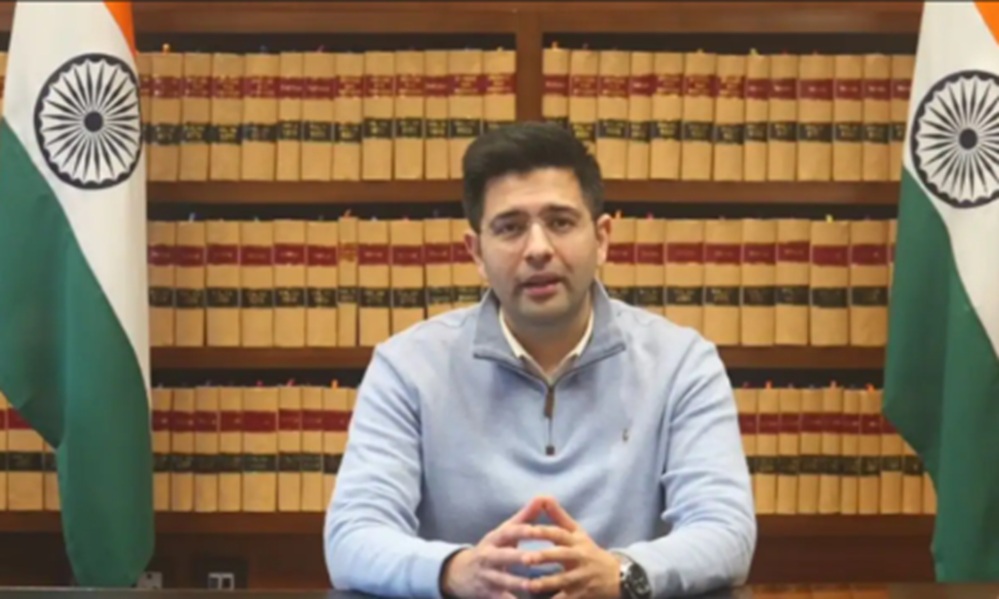
The recent move by seven Aam Aadmi Party (AAP) Rajya Sabha members, led by Raghav Chadha, to merge with the Bharatiya Janata Party (BJP) has triggered a major debate on India’s anti-defection law. The group — which also includes Swati Maliwal, Sandeep Pathak, Ashok Mittal, Harbhajan Singh, Vikram Sahney, and Rajinder Gupta — claims to represent more than two-thirds of AAP’s 10-member strength in the Upper House. They have formally submitted a letter to the Rajya Sabha Chairman, citing constitutional provisions to switch allegiance while retaining their seats.
This development puts the Tenth Schedule of the Indian Constitution under the spotlight. The Tenth Schedule was introduced through the 52nd Constitutional Amendment in 1985 to check the frequent party-hopping that had destabilised governments in the 1960s and 1970s.
Understanding the Anti-Defection Law
The primary objective of the Tenth Schedule is to promote political stability and enforce party discipline. According to Paragraph 2, a Member of Parliament or a state legislature can be disqualified if he or she:
Voluntarily gives up membership of the original political party, or
Votes or abstains from voting in the House against the party’s whip or directive, without permission.
Disqualification petitions are decided by the presiding officer of the House. In the case of Rajya Sabha, this authority lies with the Chairman. The law was further strengthened by the 91st Constitutional Amendment Act of 2003, which removed the earlier exception for splits (where one-third of members could break away without facing disqualification). Today, the only significant safeguard against disqualification is the merger provision.
The Crucial Exception: Paragraph 4 of the Tenth Schedule
Paragraph 4 provides protection in cases of merger. It states that a member shall not be disqualified under Paragraph 2 if his or her original political party merges with another political party, and the member joins the merged entity or chooses to function as a separate group.
The most important part is sub-paragraph (2), which defines when such a merger is recognised under the law. It says: “For the purposes of sub-paragraph (1) of this paragraph, the merger of the original political party of a member of a House shall be deemed to have taken place if, and only if, not less than two-thirds of the members of the legislature party concerned have agreed to such merger.”
In this context, the “legislature party” means the party’s elected members in that particular House — here, the Rajya Sabha. AAP currently has 10 Rajya Sabha MPs. Two-thirds of 10 is approximately 6.67. With seven members joining the BJP, the group comfortably crosses this threshold.
The defecting MPs argue that once this two-thirds majority of the legislature party agrees to the merger, a “deemed merger” is triggered. This protects them from disqualification even if the broader AAP organisation under Arvind Kejriwal does not formally merge with the BJP.
Differing Views Among Legal Experts
Legal opinion on this issue remains divided. Former Lok Sabha Secretary General PDT Achary has maintained that a mere faction of the legislature party cannot claim a valid merger without the consent of the original political party as a whole. He believes the law intends a genuine merger of the party organisation, not just its legislative wing in one House.
On the other hand, several senior advocates, including Mukul Rohatgi, Neeraj Kishan Kaul, and Maninder Singh, contend that the plain reading of Paragraph 4(2) favours the seven MPs. They argue that once the required two-thirds of the legislature party agrees and proper documentation is submitted, the Chairman should recognise the move and shield the members from disqualification.
AAP has strongly criticised the development, terming it a betrayal. The party is expected to file disqualification petitions before the Rajya Sabha Chairman. The Chairman is required to follow principles of natural justice, hear both sides, and pass a reasoned order. Any decision can be challenged before the Supreme Court.
Broader Implications
This case highlights both the purpose and a potential weakness in the anti-defection framework. The merger clause was meant to allow genuine large-scale political realignments. However, when applied only to one House without the party’s organisational merger, it enables a substantial group of legislators to cross over while keeping their seats. This raises questions about accountability to voters and the spirit of the law.
Critics argue that such moves encourage political poaching and weaken inner-party democracy. Supporters point out that disqualifying members in cases of mass dissent would lead to unnecessary by-elections and suppress legitimate differences of opinion.
In practical terms, AAP’s strength in the Rajya Sabha has dropped sharply to just three members. The development gives a numerical boost to the ruling NDA in the Upper House. It also comes at a time when AAP is facing internal challenges and preparing for important electoral battles, including in Punjab.
The Way Forward
The final verdict rests with the Rajya Sabha Chairman’s quasi-judicial decision. Legal experts expect the matter may eventually reach the Supreme Court, where it could further clarify the scope of the “deemed merger” provision under Paragraph 4 of the Tenth Schedule.
This episode once again brings into focus the strengths and limitations of India’s anti-defection law. While the law has successfully reduced opportunistic defections, its exceptions continue to allow creative political manoeuvres. Many observers believe there is a need to review the Tenth Schedule to better balance party discipline with democratic freedoms and legislative stability.
In India’s competitive political environment, such shifts test constitutional institutions and underscore the ongoing tension between political loyalty and individual or group conscience.