


From Our Business Bureau
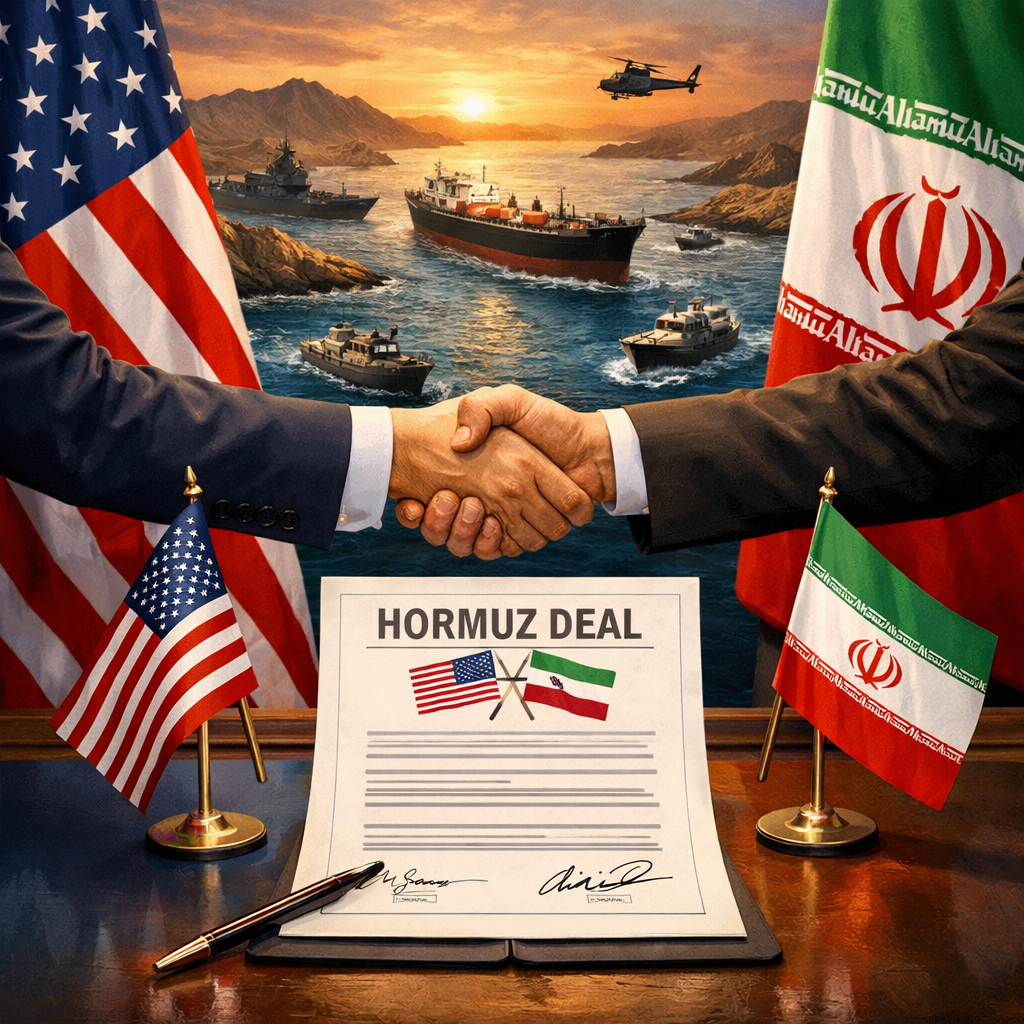
New Delhi: In a major development that could reshape global energy markets and bring relief to oil-importing nations, US President Donald Trump announced on social media that a comprehensive agreement involving the United States, Iran, and key regional powers has been “largely negotiated,” with details expected to be finalized and announced shortly. Central to the deal is the reopening of the Strait of Hormuz, a critical chokepoint for global oil trade that has faced disruptions amid recent tensions.
Trump’s announcement on Truth Social comes after intense diplomatic engagements with leaders from Saudi Arabia, the UAE, Qatar, Pakistan, Turkey, Egypt, Jordan, Bahrain, and Israel. The pact aims to de-escalate hostilities that escalated earlier this year, stabilizing one of the world’s most vital maritime routes through which approximately 20-25% of global seaborne oil passes daily.
For India, the world’s third-largest oil importer, this development represents a significant economic lifeline. India sources nearly 80-85% of its crude oil requirements through imports, with a substantial portion transiting via the Strait of Hormuz from West Asian suppliers like Saudi Arabia, Iraq, and the UAE. Disruptions in the strait over recent months had driven up global crude prices, inflating India’s import bill, contributing to higher fuel costs, and exerting pressure on inflation and the current account deficit.
Economists estimate that a stable and reopened Strait of Hormuz could potentially lower global benchmark crude prices by 10-15% in the short term, translating into substantial savings for India. “This is excellent news for the Indian economy,” said Dr. Rajesh Kumar, Senior Fellow at the Observer Research Foundation. “Every $1 drop in oil prices can save India around $1.5-2 billion annually on its import bill. Lower energy costs will ease inflationary pressures, support the rupee, and provide headroom for the government to focus on growth-oriented policies.”
The Indian government has welcomed the announcement. Sources in the Ministry of External Affairs indicated that New Delhi, which has maintained balanced ties with both Washington and Tehran, played a quiet supportive role through backchannel diplomacy alongside partners like Pakistan. India’s heavy dependence on the Gulf region for energy and remittances — with over 9 million Indian expatriates in the GCC — makes stability in the region a strategic priority.
Analysts predict multiple positive ripple effects:
Lower Fuel Prices: Petrol and diesel prices at pumps could see moderation, benefiting households and the transport sector.
Reduced Inflation: Core inflation, already under watch, could ease, allowing the Reserve Bank of India more flexibility on interest rates.
Boost to Trade and Industry: Sectors like fertilizers, petrochemicals, and logistics stand to gain from lower input costs, enhancing competitiveness of Indian exports.
Stock Market Sentiment: Domestic equity markets, particularly energy and banking stocks, are likely to react positively on Monday.
However, caution remains. Iranian officials have pushed back against some elements of Trump’s narrative, emphasizing their continued control over the strait and signaling that significant sticking points — including sanctions relief and regional security arrangements — still need resolution. Shipping companies have also reacted cautiously, awaiting concrete implementation before resuming full operations.
Trump described the agreement as a step toward broader peace, stating that details covering multiple elements beyond the strait would be revealed soon. The move follows a period of military posturing and partial blockades that had rattled energy markets since February 2026.
For Prime Minister Narendra Modi’s government, already navigating global headwinds ahead of key economic targets, this breakthrough arrives at an opportune moment. Experts believe sustained lower oil prices could help India maintain its growth trajectory above 6.5-7% while supporting fiscal consolidation.
As the world awaits the final announcement, markets and policymakers in New Delhi will be closely monitoring developments. For an energy-hungry emerging giant like India, the reopening of the Strait of Hormuz could mark the beginning of a more stable and prosperous phase in its economic journey.