


By Suresh Unnithan
As professed by a section of political pundits, the once-ironclad bromance between American President Donald Trump and US billionaire Elon Musk has run into terrific turbulence and imploded into a public feud of unprecedented ferocity. The two titans of the planet’s most powerful nation, the United States of America (USA), are on vigorous hostility. The relation that strengthened as a partnership rooted in mutual sycophancy —Trump’s populist bravado paired with Musk’s disruptive genius—has unravelled into a bitter standoff, with Musk going to the extent of demanding impeachment of the President, accusing the later of his “close” relations with the shadowy Jeffrey Epstein files. Jeffrey Epstein was infamous for his muddy deals; had faced multiple criminal and civil cases related to sexual abuse and trafficking of minors. In 2005, Palm Beach police began investigating Epstein after a parent reported he molested their 14-year-old daughter. The investigation uncovered dozens of underage girls alleging sexual abuse at Epstein’s Palm Beach mansion. In 2008, Epstein pleaded guilty to two state felony counts: soliciting a minor for prostitution and procuring a person under 18 for prostitution. He served 13 months in a work-release program. In July 2019, Epstein was arrested in New York on federal charges of sex trafficking and conspiracy to commit sex trafficking, involving minors as young as 14 between 2002 and 2005. The indictment alleged he paid girls for sexual acts at his Manhattan and Palm Beach properties. The charges carried a potential 45-year sentence. Epstein died by suicide in his jail cell in August 2019 while awaiting trial, halting the criminal case.
Trump and Epstein were socially connected in the 1990s, with documented interactions at Mar-a-Lago, on Epstein’s jet, and at events. Trump and Epstein were photographed together at multiple events, including at Mar-a-Lago in 1992, 1997, and 2000, often with Ghislaine Maxwell, Epstein’s associate. Epstein’s private jet flight logs, released in court documents related to Ghislaine Maxwell’s trial, show Trump flew on the jet at least seven times between 1993 and 1997, often between Palm Beach and New York. In a 2002 New York Magazine interview, Trump had described Epstein as a “terrific guy” and noted their shared interest in “beautiful women… on the younger side.” However, after Epstein’s legal troubles became public, Trump distanced himself, stating in 2019 that he was “not a fan” and hadn’t spoken to Epstein in about 15 years.

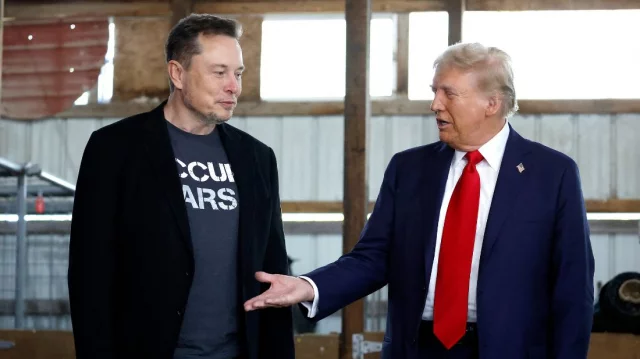
As per media reports from the US “A bitter feud between President Donald Trump and billionaire Elon Musk has erupted, turning a policy dispute over Trump’s ‘One Big Beautiful Bill’ into a vicious public clash.” Musk publicly criticized the Bill as a “disgusting abomination” for increasing the federal deficit and undermining fiscal discipline. The Bill included provisions to eliminate federal electric vehicle (EV) tax credits, worth up to $7,500 for new EV buyers, which directly impacted Tesla’s bottom line. Musk has even asked for impeachment of Trump for the allegations relating to Epstein files.
According to sources, tensions between the two buddies escalated when Donald Trump withdrew the nomination of Jared Isaacman, a Musk ally, to lead NASA (National Aeronautics and Space Administration). This move was seen by the Tech Billionaire as a personal insult, with some sources suggesting it was influenced by Trump’s team, particularly Sergio Gor, as a deliberate jab at Musk. This added to the growing rift, with Musk feeling sidelined despite his significant financial support for Trump’s 2024 campaign.
In fact, Musk’s role as head of the Department of Government Efficiency (DOGE) caused irritation within the Trump administration’s high profile bureaucrats and certain influential Republicans. His abrupt cost-cutting measures, including dismantling agencies like USAID, irked Cabinet officials like Marco Rubio, who clashed with Musk over his approach.
The bitterness became open on June 5, 2025, when Musk and Trump traded insults on their respective social media platforms, X and Truth Social. Musk claimed credit for Trump’s 2024 election victory, stating, “Without me, Trump would have lost the election,” and made a provocative accusation that Trump was withholding Jeffrey Epstein files due to personal implications. Trump retaliated by calling Musk “crazy,” threatening to cut government contracts with Musk’s companies (like SpaceX), and mocking his appearance, including a black eye Musk sported during an Oval Office event. These personal attacks marked a dramatic escalation, with Musk even suggesting the formation of a new political party.
According to political onlookers the relationship was fundamentally volatile due to the exaggerated egos of both men, described as “two egos of equal mass”. Musk’s massive financial contributions of about $277 million to Trump’s poll campaign—and his role as a key advisor gave him unprecedented influence, which some in Trump’s close circle opposed openly. As Musk’s influence waned and his business interests (Tesla, SpaceX, xAI) faced challenges due to Trump’s policies, the partnership tattered. Accepting the advisors’ views that Musk was unpredictable and a liability, Trump decided to distance himself from the tech giant.
As per the US media and international observers “the fallout was not entirely unexpected.” Tensions between the two titans were visible as early as December 2024, on their differing views on business relations with China and tariffs. “Musk’s reliance on Chinese markets and supply chains clashed with Trump’s protectionist policies. Additionally, Musk’s public criticism of Trump’s policies and his declining approval ratings (faster than Trump’s) strained their alliance. While some sources suggest they might reconcile due to Trump’s pragmatic history with former adversaries, the public and personal nature of their June 2025 feud suggests a significant rupture with potential impacts on Tesla’s stock (which dropped 15% on June 5, 2025) and Musk’s political influence.”
In short the intensifying Trump-Musk tussle is driven by policy clashes over EV tax credits and tariffs, personal grievances like the NASA nomination; Musk’s diminishing political capital, and a public escalation of egos and insults.
The public feud between Donald Trump and Elon Musk, which erupted in June 2025, has significant implications for both political and economic landscapes.
According to political observers the public spat between the two could fracture the Republican Party’s cohesion. Musk’s criticism of Trump’s “big, beautiful bill” and calls for the President’s impeachment could potentially alienate some of Trump’s supporters, creating internal divisions. Republican lawmakers, such as Rep. Troy Nehls, have already expressed dismay at Musk’s actions, signalling potential rifts within the party.
Musk’s threat to fund insurgent challengers in the 2026 midterms could further destabilize Republican control of Congress, as his financial resources and social media platform could amplify anti-Trump candidates.
Democrats are already capitalizing on the feud, particularly Musk’s unsubstantiated claim that Trump appears in unreleased Jeffrey Epstein files. Figures like Rep. Dan Goldman have called for the release of these files, aiming to exploit the narrative to damage Trump’s reputation. This could lead to increased pressure for investigations or congressional hearings, potentially distracting from Trump’s legislative agenda.
The damage will not be restricted to Trump and co. Musk’s Tesla stock plunged 14.3% on June 5, 2025, wiping out approximately $150 billion in market value, largely due to Trump’s threat to cut billions in federal subsidies and contracts for Musk’s companies, including Tesla, SpaceX, and Starlink. Continued escalation could further depress Tesla’s stock and affect investor confidence in Musk’s other ventures
Thanks to Trump’s tariffs, Tesla, which relies on parts imported from China, could face increased costs, further straining its profitability, especially after a reported 71% decline in first-quarter profits in 2025. The feud has reignited scrutiny over Musk’s potential conflicts of interest, given his companies’ $38 billion in federal contracts and subsidies over the past two decades.
The feud, described as a “Real Housewives of Pennsylvania Ave” drama, has caught public attention, with memes and social media reactions amplifying the spectacle. This could further polarize public opinion.
Some sources suggest a possible de-escalation due to mutual self-interest. Trump relies on Musk’s companies for strategic goals (like SpaceX’s role in space exploration), and Musk benefits from access to federal contracts. Reports indicate that external pressures, such as Republican leaders like House Speaker Mike Johnson hoping for reconciliation, could lead to a partial resolution in the near term.
Of course, the public feud between Donald Trump and Elon Musk has an impact on the political and technological landscapes not just in the US, but across the globe. Their competing visions for influence, power, and innovation have exposed deep tensions within the spheres they dominate, captivating observers and sparking debates about leadership and accountability. This high-profile confrontation underscores the growing drive for overall supremacy. The World watches closely, waiting for the unfolding of the next chapter in this unparalleled conflict.