


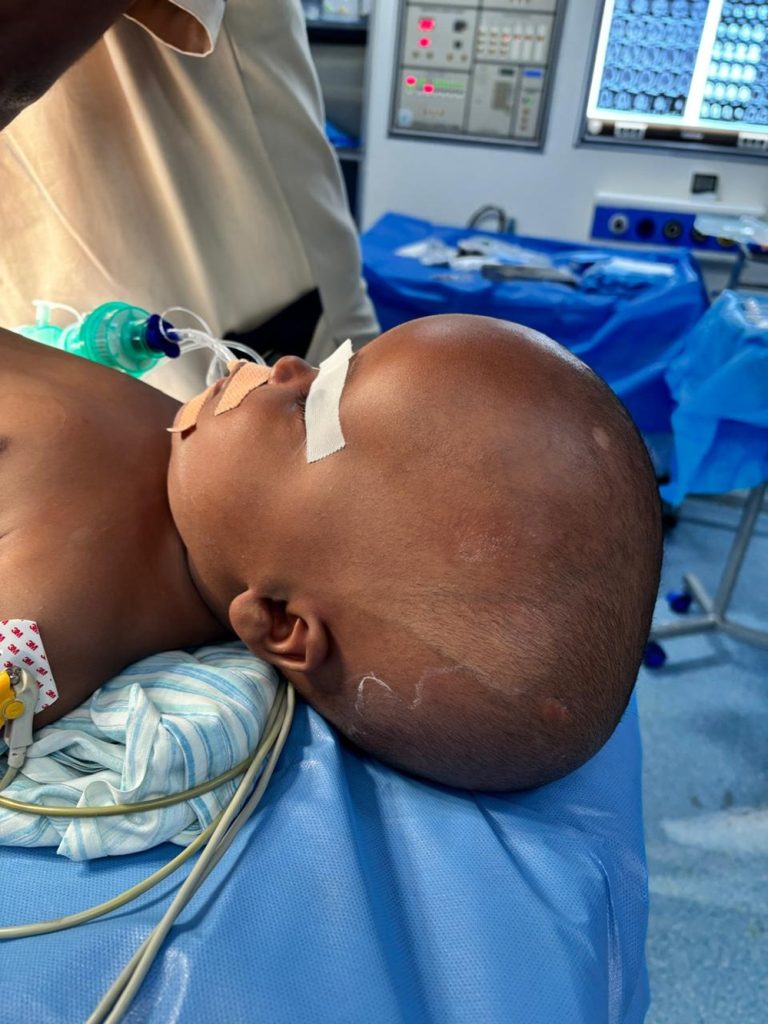
Hyderabad : Doctors at CARE Hospitals, HITEC City, successfully treated a nine-month-old international patient from Somalia suffering from life-threatening hydrocephalus caused by a very rare glioneural Tumour arising from the choroid plexus, a part of the brain responsible for producing cerebrospinal fluid (CSF). The condition caused excessive accumulation of cerebrospinal fluid inside the brain, dangerously increasing pressure and resulting in abnormal enlargement of the baby’s head. A multidisciplinary team successfully performed two complex brain procedures during a single surgery, relieving the pressure on the brain and completely removing the Tumour.
The baby, Master Shafie Mohamed Hussain, was brought to CARE Hospitals after his family noticed that he had become unusually dull, less active and was not responding normally. Following a detailed neurological evaluation and advanced brain imaging, doctors diagnosed him with severe, life-threatening hydrocephalus and a very rare brain Tumour that required urgent surgical intervention.
Detailed investigations revealed severe hydrocephalus, a condition in which excessive cerebrospinal fluid accumulates inside the brain, causing dangerously high pressure on the developing brain. The pressure had also resulted in an abnormal increase in the baby’s head size.
Further evaluation identified a very rare glioneural Tumour arising from the choroid plexus, the tissue inside the brain responsible for producing cerebrospinal fluid. Such Tumours are exceptionally uncommon in infants. Because the Tumour originated from the choroid plexus, it contributed to excessive cerebrospinal fluid production, rapidly worsening the hydrocephalus and making the condition life-threatening.
Doctors explained that both the dangerously raised pressure inside the brain and the Tumour required urgent treatment. If left untreated, the baby was at risk of permanent neurological damage, developmental delay, seizures, vision impairment and other life-threatening complications.
Considering the baby’s young age and the complexity of the condition, the neurosurgical team decided to address both problems during a single operation. This approach enabled doctors to immediately relieve the pressure on the brain while completely removing the Tumour in the same surgical sitting, avoiding the need for separate procedures.
Doctors first inserted a ventriculoperitoneal (VP) shunt, a small tube that diverts excess cerebrospinal fluid from the brain to the abdominal cavity, relieving the dangerously high pressure inside the brain. During the same operation, they performed a craniotomy and completely removed the Tumour.
The removed Tumour was sent for histopathological examination. The biopsy, reported by Dr. Vijaya, Consultant Pathologist, confirmed the diagnosis as a very rare paediatric glioneural Tumour arising from the choroid plexus, validating the surgical findings and guiding further clinical follow-up.
Performing even one major brain surgery in a nine-month-old infant is technically demanding. Successfully carrying out two complex neurosurgical procedures during the same operation required meticulous planning, microsurgical precision and seamless coordination among the Neurosurgery, Anaesthesia, Radiology, Paediatrics and Pathology teams.
Following surgery, the baby recovered well. He was closely monitored in the intensive care unit before being shifted to the ward after his condition stabilised. He was discharged just three days after undergoing the complex surgery and is recovering well.
Dr. Laxminadh Sivaraju, Senior Consultant Neurosurgeon, CARE Hospitals, HITEC City, said, “This baby had life-threatening hydrocephalus caused by a very rare glioneural Tumour arising from the choroid plexus. The Tumour was continuously contributing to excessive cerebrospinal fluid accumulation, resulting in dangerously increased pressure inside the brain and progressive enlargement of the head. We first relieved the pressure by inserting a VP shunt and then completely removed the Tumour during the same surgery. Performing two complex neurosurgical procedures in a nine-month-old infant in a single sitting required meticulous planning, microsurgical precision and close teamwork. We are extremely pleased with the baby’s excellent recovery.”
Dr. Sivaraju added, “This successful outcome was possible because of the seamless teamwork between our Neurosurgery, Anaesthesia, Radiology, Paediatrics and Pathology teams. I also thank Dr. Vijaya for confirming the diagnosis through histopathological examination. Close collaboration across departments was key to the baby’s successful treatment.”
Dr. Pramod Gupta, Chief Operating Officer, CARE Hospitals, HITEC City, said, “Successfully treating a nine-month-old international patient from Somalia with a very rare paediatric glioneural Tumour associated with life-threatening hydrocephalus reflects the advanced neurosurgical expertise and multidisciplinary capabilities available at CARE Hospitals. Performing two major brain procedures during a single operation demonstrates our team’s ability to manage exceptionally rare and complex neurological conditions while delivering world-class care to patients from India and around the world.”
Doctors advised parents not to ignore symptoms such as unusual dullness, poor feeding, repeated vomiting, excessive sleepiness, seizures, abnormal increase in head size or behavioural changes in infants. Early medical evaluation and timely treatment can help diagnose serious brain conditions before they cause permanent damage to the developing brain.