

By Suresh Unnithan

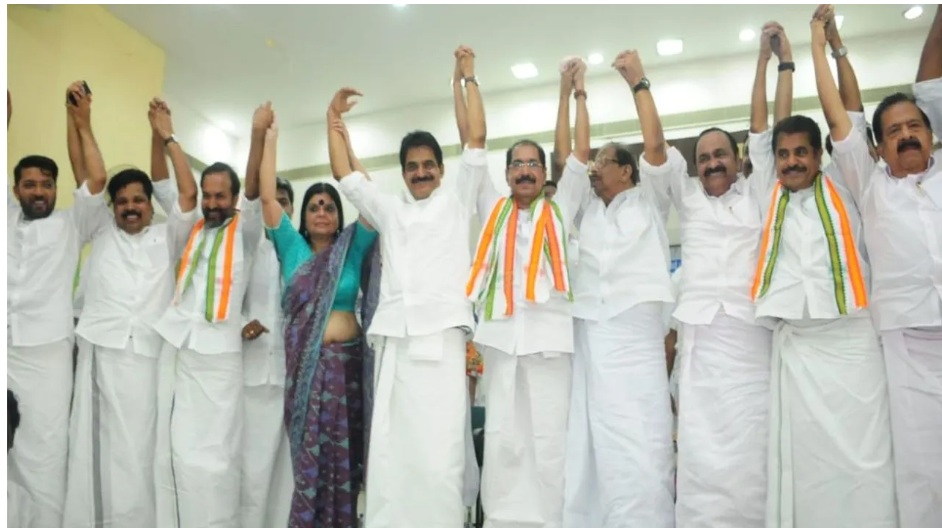
The electorates are seeking a change of guard, but the Congress-led UDF does not heed the voter’s plea. Congress leaders are embroiled in internal rebellion, undermining their own cause.
As Kerala gears up for its impending local body elections in late 2025 and the assembly polls in 2026, the Indian National Congress (INC) finds itself at a perilous position. Once a central political force in the state, the grand old party now appears to be digging its own grave through intensive internal factionalism and self-sabotage. While external rivals like the Left Democratic Front (LDF) and the Bharatiya Janata Party (BJP) pose challenges, the real enemies lurk within the Congress’s own ranks. Groupism has fractured the party into multiple camps, sidelining prolific workers and amplifying egos over collective goals. Unless a detailed and systematic internal cleansing is undertaken, the Congress’s prospects in Kerala—and by extension, nationally—look increasingly bleak. Rahul Gandhi’s tireless efforts to revitalize the party could all come to naught if these festering issues aren’t addressed head-on.
The Cancer of Groupism: A House Divided
At the heart of the Congress’s woes in Kerala is an entrenched culture of groupism that predates the state’s formation in 1956. What was once subtle jockeying for influence has evolved into overt factional warfare, with over half a dozen prominent groups vying for control. Leaders like Ramesh Chennithala, Kodikkunnil Suresh, V.D. Satheesan, and K. Sudhakaran each command their own loyalists, creating silos that prioritize personal ambitions over party unity. This infighting isn’t just a distraction—it’s a destructive force weakening the party’s electoral machinery at a time when cohesion is paramount.
Take V.D. Satheesan, the current Leader of the Opposition in the Kerala Assembly. Critics within the party accuse him of fostering a “group concept” that misleads the Congress and alienates younger members. Similarly, former KPCC president K. Sudhakaran has openly lamented the party’s lack of preparedness due to groupism and infighting, a sentiment that echoes from as far back as 2023 but remains unresolved. Sudhakaran’s recent dissatisfaction with his replacement as KPCC chief highlights how leadership transitions are marred by resentment rather than smooth handovers. Ramesh Chennithala and K.C. Venugopal are often fingered as key architects of this discord, with calls for their sidelining to prevent further damage.
This factionalism extends to allied organizations like the Youth Congress, where recent rifts over leadership appointments—such as the exclusion of Abin Varkey from the state president post—have sparked fresh tensions. Party insiders question the selection process, fearing it perpetuates favoritism and erodes grassroots morale. In a state where the Congress must capitalize on the LDF’s anti-incumbency, such internal squabbles are handing ammunition to opponents on a silver platter.
A Missed Opportunity: Failing to Capitalize on LDF’s Vulnerabilities


The irony of the Congress’s self-destruction is stark when viewed against the backdrop of widespread disillusionment with the ruling LDF government under Chief Minister Pinarayi Vijayan. Neutral voters, who backed the LDF in both the 2016 and 2021 assembly elections, are increasingly disillusioned with the regime’s lackluster performance. Corruption charges have piled up, fueling public outrage and eroding support among traditional CPIM supporters. Major scandals include the long-standing SNC-Lavalin hydroelectric case, where Vijayan faced charges before being acquitted amid controversy; alleged corruption in canceling electricity contracts; irregularities at Digital University Kerala; and a CBI probe into Vijayan’s top advisor K.M. Abraham. Adding fuel to the fire are the extravagance of ministers, exemplified by the lavish Nava Kerala Sadas events and the Keraleeyam cultural festival, widely criticized for wasteful spending amid the state’s financial woes.
The arrogance of CPIM cadres has further alienated the populace, with party reviews admitting that “arrogant behavior from top to bottom” contributed to electoral setbacks, including in the recent Lok Sabha polls. This hubris, combined with off-budget borrowings through entities like KIIFB, has deepened perceptions of fiscal irresponsibility.
Personal allegations against Vijayan’s family have deepened the rot. His daughter, Veena Vijayan, faces serious fraud charges from the SFIO and ED in the CMRL payoff case, where her firm Exalogic allegedly received payments without providing services, leading to money-laundering probes. Similarly, his son, Vivek Kiran Vijayan, was summoned by the ED in 2023 over suspected money laundering linked to the Life Mission housing project, amid bribery allegations involving UAE visa issues. These revelations have created dissatisfaction even among CPIM supporters, prompting whispers of a voter shift away from the LDF.
Many of these disgruntled voters—neutral swing voters who twice entrusted the LDF with power—were mentally preparing to vote against the current government in the upcoming polls. Yet, the Congress has squandered this golden opportunity. Paralyzed by its own infighting, the party has failed to mount a unified campaign that harnesses this anti-incumbency sentiment. Instead of presenting a coherent alternative, the Congress’s factional leaders are too busy undermining each other, allowing the LDF to weather the storm despite its glaring flaws.
Sidelined Talents and Self-Inflicted Wounds
Compounding the groupism is the marginalization of effective ground-level workers, who are often overlooked in favor of factional loyalists. Figures like Anil Akkara, a former MLA known for his anti-corruption stance, and Jyotikumar Chamakkala, a committed organizer, have been pushed to the periphery despite their proven track records. This not only demotivates the cadre but also deprives the party of the energy needed to mount a robust campaign. As one observer notes, the seniors are “destroying the party with groupism,” urging Rahul Gandhi to heed the voices of the youth.
Anil Akkara, in particular, exemplifies this tragic sidelining. He has been instrumental in exposing major corruption scandals plaguing the LDF, including the Life Mission housing scam, the Karuvannur Cooperative Bank fraud, and the Highrich fraud cases. In the Life Mission case, Akkara has relentlessly pursued allegations of bribery and FCRA violations in the UAE-funded apartment project in Wadakkanchery, even writing to the ED to demand action against the CM’s son. The Karuvannur scam, a multi-crore fraud at the Thrissur-based cooperative bank, saw Akkara accusing former Minister A.C. Moideen of embezzling Rs 29 crore through benamis, with ED chargesheets later naming several CPIM leaders, including Moideen, MP K. Radhakrishnan, and the party itself as accused. Similarly, in the Highrich fraud—a massive money chain scheme involving over Rs 1,600 crore—Akkara has highlighted government complicity, labeling it a “government-sponsored scam.” Unfortunately, Akkara did not receive sufficient backing from the Congress state leadership to amplify these exposures, which could have served as powerful weapons against the ruling LDF. For reasons known within party circles—likely tied to internal rivalries and reluctance to escalate—the leadership failed to support him, allowing these scandals to simmer rather than explode into full-blown political ammunition.
Then there’s the issue of self-goals from high-profile leaders. Shashi Tharoor, the charismatic MP from Thiruvananthapuram, has repeatedly found himself in hot water, making statements or decisions that embarrass the party. Recent snubs by the Party’s Kerala unit and internal frictions have only amplified this, with Tharoor attempting to downplay tensions while subtly criticizing the leadership. Speculation about projecting him as a chief ministerial face persists, but it risks further alienating factions rather than uniting them. Meanwhile, K.C. Venugopal, the AICC general secretary, is increasingly seen as a liability. His irresponsible statements and alleged role in fueling groupism are playing directly into the hands of political rivals, undermining the party’s credibility.
The AICC has attempted interventions, cracking down on internal leaks and infighting to safeguard “Mission 2025” for the local body polls. Yet, these measures feel like band-aids on a gaping wound. A new leadership team installed earlier this year has failed to quell the dissent, with the same old troubles resurfacing as elections loom.
Sleeper Cells and National Ramifications
Whispers of “sleeper cells” within the Congress—elements allegedly working for political opponents—add a sinister layer to the crisis. While hard evidence is scarce, the persistent leaks and strategic missteps suggest internal sabotage, possibly from disgruntled factions or infiltrators. This isn’t unique to Kerala; it’s symptomatic of the national party’s ailments. For instance, in March 2025, Rahul Gandhi issued a stark warning during a visit to Gujarat, accusing several leaders within the state Congress unit of acting as “sleeper cells” for the BJP and claiming that half of the Gujarat Congress was effectively working for the rival party. He vowed to identify and purge these elements to restore party integrity. Such revelations underscore the pervasive nature of this issue across state units, mirroring the challenges faced in Kerala.
Rahul Gandhi’s campaigns, including his focus on Wayanad, have injected hope, but without purging these toxic elements, his efforts risk being in vain.
Nationally, the Congress grapples with similar issues: outdated leadership, factional pulls, and a failure to adapt. In states like Bihar, allies have shunned the party for state polls due to its disarray. Kerala, with its educated electorate and history of alternating governments, could be a bellwether. If the party falters here, it signals deeper rot that could hobble its 2029 Lok Sabha ambitions.
The Path Forward: Jettison and Cleanse
The Congress’s predicament demands bold action: jettisoning liabilities like Venugopal and Tharoor if they continue to hinder unity, empowering sidelined workers, and enforcing zero tolerance for groupism. An internal audit, perhaps overseen by the high command, is essential to root out sleeper cells and rebuild trust. As Mallikarjun Kharge and the Gandhis chart the course, the 2026 Kerala assembly election looms as a litmus test. Failure to act could consign this age-old party to irrelevance, proving that sometimes, the greatest threats come from within. The time for half-measures is over—clean house, or face oblivion.